Tag: Quote-to-Cash

Beyond Billing: How Finance Leaders Are Revolutionizing NetSuite Revenue Operations

Continuous and NetSuite

For finance and RevOps teams using NetSuite, this article explains how embedding revenue operations into sales processes helps automate pricing, billing, and revenue without adding standalone billing tools.

TL;DR
- NetSuite customers are often pushed to add standalone billing tools to handle complex pricing and revenue workflows.
- Embedding revenue operations earlier in the sales cycle aligns quoting, billing, and revenue recognition inside NetSuite.
- Automated pricing, rating, billing, and credit tracking reduce manual work and compliance risk.
- A unified revenue operations approach gives finance real-time visibility without duplications or integrations.

You invested heavily in NetSuite, so why are you constantly pressured to add yet another specialized billing or revenue tool? Imagine if NetSuite could effortlessly handle any pricing, rating, billing, and revenue scenario without complicated integrations, duplicated workflows, or restrictions on your sales team’s flexibility.

Achieving this requires finance teams to proactively embed revenue operations directly into your sales processes from the outset, while also enhancing NetSuite’s capabilities to handle advanced rating and calculations not supported natively. Here’s exactly what you can do to strategically transform your NetSuite revenue operations:

Quote-to-Cash Alignment and Control

1. Proactively Embed Revenue Operations at the Start of the Sales Cycle

Integrate finance directly into your sales channels—including Salesforce and partner channels—to unify financial controls and streamline your end-to-end revenue operations.

Impact: Reduce manual tasks, simplify integration handoffs, minimize errors, and ensure consistency from quoting to billing.

2. Align Revenue Recognition Directly with Sales Contracts

Integrate revenue recognition rules from Salesforce or other CRM systems directly into NetSuite, automating and simplifying compliance with ASC 606 and IFRS 15.

Impact: Reduce compliance risks, simplify audits, and streamline financial reporting processes.

Automated Pricing, Rating, and Billing Efficiency

3. Replace Specialized Usage-Based Billing Vendors and Manual Rating with Embedded Automation

Implement scalable, automated usage-rating capabilities directly within NetSuite to translate complex pricing models seamlessly into accurate billing processes.

Impact: Simplify rating processes, reduce manual errors, and focus finance resources on strategic growth initiatives.

4. Fully Automate Revenue Processes to Accelerate Cash Flow

Eliminate manual invoicing, prorations, and billing adjustments by embedding automated processes directly within NetSuite.

Impact: Accelerate billing cycles, improve cash flow, and increase productivity and accuracy within your finance operations.

Real-Time Financial Visibility and Insights

5. Establish Real-Time Tracking of Prepaid Credits

Transition away from manual spreadsheet tracking by embedding real-time credit balance management within NetSuite, providing precise and reliable financial insights. Bonus: Ensure sales and customer success teams have real-time access to credit balances, enabling proactive management and customer engagement.

Impact: Ensure accurate credit management, eliminate revenue leakage, and enhance financial transparency.

6. Integrate Real-Time Revenue Analytics into Your Dashboards

Embed comprehensive analytics within NetSuite dashboards to deliver actionable insights into customer behaviors, usage trends, and overall revenue performance.Impact: Make informed, rapid decisions that proactively drive revenue growth and strengthen customer retention.

Future-Proof Your Revenue Stack with Continuous

Traditionally, achieving these revenue operations improvements required substantial investments in customizations, complex integrations, and ongoing maintenance. Continuous, however, uniquely addresses this challenge as the world’s first embedded revenue infrastructure offering. Our embedded technology within Salesforce and NetSuite delivers precisely what standalone SaaS recurring billing vendors have promised but struggled to deliver: seamless integration, simplified revenue management, and genuine flexibility.

Ready to simplify your NetSuite revenue processes immediately? Schedule a personalized demo today and see exactly how Continuous transforms your capabilities, enhances data consistency, and delivers immediate value.

Continuous empowers your finance team to automate complex processes, achieve seamless integration, and gain actionable, real-time insights—all without standalone billing systems.

Take control, simplify operations, and strategically position your finance team to lead growth with embedded revenue infrastructure.

Embedded Revenue Infrastructure: The End of Standalone Billing

Continuous Billing Workflows for Salesforce and NetSuite

For RevOps, sales, and finance teams, this article explains why embedded revenue infrastructure is replacing standalone billing, and how embedding monetization into CRM and ERP simplifies scale.

TL;DR
- Standalone billing platforms create duplication, reconciliation, and slow pricing changes.
- Embedded Revenue Infrastructure places pricing and billing logic directly inside Salesforce and NetSuite workflows.
- This approach supports subscriptions, usage, prepaid credits, and hybrid pricing models.
- Embedding monetization simplifies operations, improves visibility, and keeps teams aligned.


Editor’s note: This post builds on Part 1 of our Embedded Revenue Infrastructure series, where we explored how SaaS billing evolved from subscription simplicity to usage-based complexity—and why traditional billing platforms can’t keep up.

In Part 2, we define the new approach: Embedded Revenue Infrastructure—and explain why it’s replacing standalone billing for modern B2B teams.

It’s time for a new approach.

For years, the promise of recurring billing platforms was simplicity. Standardize pricing. Automate invoices. Get paid faster.

But somewhere along the way, things got more complicated. Today, many B2B companies find themselves stuck between their CRM and ERP, trying to make a third system—the billing platform—play nice with everything else.

That third system often becomes a bottleneck. Teams waste time reconciling data, rebuilding product catalogs, and explaining invoices to confused customers. Pricing innovation slows to a crawl. The tools that were meant to streamline revenue operations now stand in the way.

Embedded Revenue Infrastructure means monetization isn’t handled in a separate system. It’s woven into your core processes—from quoting to invoicing to revenue recognition.

This isn’t just a technical shift—it’s a philosophical one:

Billing should extend your existing workflows, not require an entirely new one.


The Three Principles of Embedded Revenue Infrastructure

1. Revenue Logic Embedded in Sales and Finance Workflows

Standalone billing platforms treat monetization as a separate domain. That leads to duplicated product catalogs, contract terms, and customer hierarchies.

Embedded Revenue Infrastructure eliminates that duplication by placing pricing and billing logic directly inside your CRM and ERP.
Salesforce handles quoting. NetSuite handles invoicing. APIs connect to your usage data. Everyone works in the tools they already know.

Fewer integrations. Faster changes. Teams that stay in sync.


2. Flexible for Any Pricing Model

Modern businesses don’t just sell subscriptions. They sell prepaid credits, usage tiers, annual commitments, and complex hybrid models.

Most billing systems force you to contort your pricing strategy to fit their data model. Embedded Revenue Infrastructure flips that:

You define the pricing model. The system adapts.

That flexibility means faster time to market, better enterprise deal support, and less time rebuilding your stack with every pricing change.


3. Real-Time, Accurate, and Efficient

Traditional billing platforms rely on syncing data across systems. That leads to delays, mismatches, and costly reconciliation.

Embedded Revenue Infrastructure avoids all of that. Because revenue logic lives inside your workflows, your data stays accurate and real-time—without middleware or batch jobs.

Finance gets clean invoices. Sales sees real-time balances. Customers stop disputing bills. Everyone saves time.

Embedded vs. Standalone Billing: A Quick Comparison

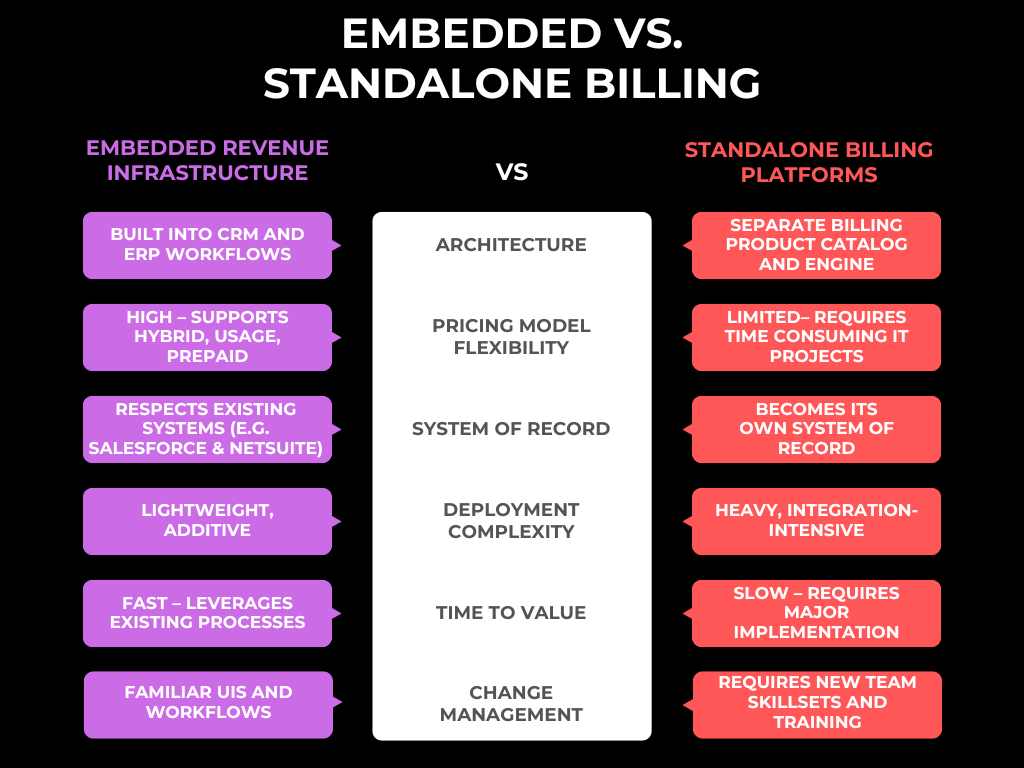
Table comparing Embedded Revenue Infrastructure vs. Standalone Billing Platforms across architecture, pricing flexibility, system of record, deployment complexity, time to value, and change management.

Stop Comparing the Wrong Things

One of the biggest traps companies fall into is comparing billing platforms like commodity software. Who has the best quoting UI? Who supports more revenue recognition scenarios? Who automates more?

It’s not that those questions are wrong—they’re just based on the wrong assumption:
That billing needs to be a separate system at all.

Standalone vendors benefit from this thinking. It lets them justify rebuilding parts of your CRM and ERP. It turns them into the system of record for your most critical financial logic. And it locks you into a platform that wasn’t built to work with your stack—but to replace it.

A Different Starting Point

At Continuous, we started from a different place.
We asked:

What do our customers already have in place?
What’s already working?

Instead of building a “sticky” platform that replaces your core systems, we built a flexible layer that embeds into them—whether that’s Salesforce, NetSuite, or internal usage systems. This approach became Embedded Revenue Infrastructure. And it requires a different way of evaluating solutions.

The New Evaluation Criteria

Instead of asking who checks the most feature boxes, ask:

  • Will this solution extend or replace our CRM and ERP?
  • Can it embed into our existing quote-to-cash process—without starting over?
  • Is it flexible enough to meet us where we are and grow with us?

We Don’t Have a One-Size-Fits-All Answer

The truth is, we don’t know exactly how Continuous should be embedded in your stack until we understand your current architecture. That’s the point.

We believe architecture should follow your business—not the other way around.

Some customers use Salesforce CPQ and NetSuite Advanced Financials. Others use Revenue Cloud Advanced, Stripe, or homegrown metering. What they have in common is that Continuous fits into their existing stack—not the other way around.

That’s the real difference. And it’s why we believe Embedded Revenue Infrastructure is the future.

Ready to Simplify Sales and Finance?

Stop juggling disconnected systems and painful integrations.
Continuous helps unify your sales and finance processes by embedding directly into the platforms you already trust.

Request your free Revenue Operations Assessment
Get a tailored review of your current architecture and personalized insights on where Continuous can drive the most value.

👉 Fill out this quick form and one of our experts will follow up with your survey—no pressure, no commitment.

Continuous and AscribeIT Partner to Streamline Revenue Operations for Salesforce and NetSuite

Continuous and AscribeIT Partner

For Salesforce and NetSuite teams, this announcement explains how Continuous and AscribeIT partner to streamline revenue operations and support advanced pricing without standalone billing systems.

TL;DR
- Continuous and AscribeIT partnered to help enterprises modernize revenue operations.
- The collaboration supports usage-based, prepaid, and hybrid pricing models.
- Customers benefit from embedded monetization inside Salesforce and NetSuite.
- The partnership combines implementation expertise with scalable revenue infrastructure.

Continuous, the first embedded pricing and revenue solution purpose-built for Salesforce and NetSuite, is excited to announce a strategic partnership with AscribeIT, specialists in CPQ, billing automation, early adopters of outcome-based pricing, and revenue operations excellence. This collaboration empowers enterprises to efficiently deploy and optimize advanced pricing and monetization models directly within their CRM and ERP environments, eliminating the typical headaches of standalone billing systems.

Better Together

Companies today face increasing pressure to deploy sophisticated monetization strategies—including hybrid subscription plans, usage-based pricing, and innovative credit management models. However, traditional billing solutions often complicate rather than streamline these processes, creating unnecessary friction between Sales, Finance, and IT teams.

Continuous seamlessly integrates powerful pricing, rating, and credit management capabilities directly into Salesforce and NetSuite, allowing businesses to leverage their existing systems without costly integrations or silos. AscribeIT uses Continuous as a complement to core applications by providing expert implementation and strategic guidance around Salesforce solutions like Revenue Cloud Advanced, ensuring smooth adoption and rapid operational improvements.

Together, Continuous and AscribeIT enable customers to:

  • Rapidly deploy and scale innovative pricing strategies directly within Salesforce and ERP solutions including NetSuite, Intacct, and others
  • Align sales, finance, and IT processes into a single, cohesive ecosystem.
  • Automate and simplify revenue operations, significantly reducing manual effort and error rates.

A Collaborative Approach to Revenue Operations

AscribeIT brings deep expertise in configuring and optimizing CPQ and billing solutions, helping customers align technology with business processes effectively. Continuous enhances these implementations by embedding sophisticated rating and monetization capabilities directly into Salesforce and NetSuite, eliminating the limitations of traditional standalone billing systems. This approach enables specific use cases including prepaid credit management, advanced usage-based billing scenarios, consumption-based pricing models, and hybrid monetization strategies.

Perspectives from Our Leadership

“We’re excited to partner with AscribeIT,” said Sean Joyce, Co-founder and Head of Alliances at Continuous. “Their proven expertise in CPQ and billing automation perfectly complements our embedded monetization approach. Together, we’re making complex revenue operations simpler and more efficient, allowing enterprises to quickly implement innovative pricing strategies.”

“Continuous solves a critical challenge for our customers by providing robust, real-time pricing and rating capabilities directly inside their existing systems,” said Avinash Boyana, Partner Alliance Director at AscribeIT. “Our combined solutions simplify and accelerate complex monetization scenarios, enabling our customers to streamline operations and rapidly scale their revenue strategies.”

Looking Ahead

This strategic partnership between Continuous and AscribeIT positions both companies to deliver immediate and sustainable value to customers aiming to modernize their revenue operations. By combining best-in-class embedded revenue technology with expert implementation services, customers can confidently transition to sophisticated monetization models while maintaining seamless operational alignment.

To explore how Continuous and AscribeIT can streamline your revenue operations, please contact us or visit our partnership page for more information.


About Continuous

Continuous provides the first embedded pricing and revenue platform specifically designed to enhance Salesforce and NetSuite, enabling enterprises to quickly launch and scale complex usage, credit, and hybrid monetization models without standalone billing systems. By leveraging existing CRM and ERP investments, Continuous delivers unmatched flexibility, scalability, and speed to market. Learn more.

About AscribeIT

AscribeIT has a combined experience of more than 30 years delivering RevOps solutions across all market segments, being the ultimate choice to transform revenue operations. Learn more.


Is Your Business RCA-Ready? Five Questions to Ask Before Making the Leap

Salesforce RCA Consumption-Based Pricing and Rating

A practical guide for RevOps, Sales Ops, and Finance leaders evaluating Salesforce Revenue Cloud Advanced. Learn when to move to RCA, when to extend CPQ, and how to close readiness gaps without disrupting revenue.

TL;DR
- Revenue Cloud Advanced (RCA) isn’t the right next step for every team—readiness matters.
- Many organizations benefit from extending CPQ and Billing before re-architecting.
- Common gaps include SKU sprawl, poor usage data, and disconnected lifecycle events.
- Continuous helps teams close those gaps and move to RCA only when it truly makes sense.

Part 3 of our RCA Series

In Part 1, we introduced Salesforce Revenue Cloud Advanced (RCA) and its vision for end-to-end monetization. In Part 2, we explored how RCA supports usage-based pricing—and how Continuous enhances it for scale. 

Now, in Part 3, we’re focusing on readiness. For some companies, RCA is the clear next step. For others, continuing to optimize legacy CPQ and/or Billing may be the right call for now. We’re sharing what we’ve learned from working with our customers: the most common readiness gaps that hold teams back from realizing RCA’s full potential—and how to close them before making the move.

You’ve implemented Salesforce CPQ—or even CPQ + Billing. You’ve standardized quoting, brought pricing and approvals into Salesforce, and made major strides toward scalable revenue operations. But as your business grows and your pricing models evolve, you may be asking: What about RCA?

For many organizations, the next step is Salesforce Revenue Cloud Advanced (RCA)—and the opportunity to modernize monetization even further.

Salesforce Revenue Cloud Advanced (RCA) introduces a fully native Salesforce architecture purpose-built for modern revenue operations. It supports more flexible pricing models—including usage-based—and brings quoting, contracting, and billing closer together within a composable, API-first framework. 

But the move to RCA isn’t right for everyone and some may benefit from continuing to optimize their current CPQ or CPQ + Billing investment. At Continuous, we help customers navigate these decisions every day, providing scalable solutions that bridge the gap between CPQ and RCA.

Not Everyone Needs to Move to RCA (Yet)

Moving to RCA now isn’t the right fit for every organization. If your organization recently invested in Salesforce CPQ (with or without Salesforce Billing), the last thing you want is to disrupt that deployment. Instead, your goal is likely to get even more value out of your current investment.

That’s exactly where Continuous comes in. Continuous enhances Salesforce CPQ by seamlessly adding support for complex usage, consumption, and credit-based pricing scenarios—all without introducing new billing silos. Even better, Continuous enables you to fully leverage NetSuite as your financial system of record, allowing for streamlined payments, collections, invoicing, and revenue reporting directly within your existing ERP environment.

With Continuous you can:

  • Support advanced usage, consumption, and hybrid pricing models directly within Salesforce CPQ.
  • Fully leverage NetSuite for financial reporting, invoicing, collections, and revenue recognition.
  • Extend—not replace—the significant investment you’ve already made in Salesforce CPQ.

If your team is feeling pressure to move to Revenue Cloud Advanced but wants a more strategic path forward, start by requesting a free RCA Readiness Assessment. We’ll show you how to enhance what you already have, so you can move to RCA (or any advanced solution) only when—and if—it truly makes sense for your business.

What We’re Seeing In The Market: Success Meets Operational Reality

At Continuous, while we work with companies who are deep into CPQ or CPQ Billing, five patterns consistently emerge:

Your Customer Experience Shouldn’t Depend on Support Tickets
→ Most customers can’t see their usage, credit balances, or contract details—so they open support tickets for basic questions. This reactive model frustrates users, burdens internal teams, and erodes trust—especially in usage-based models where real-time visibility is expected.

When SKUs Don’t Map to Value, Trust Breaks Down
→ Workarounds that helped get CPQ live or bring a new product to market—like placeholder SKUs or loosely defined product hierarchies—create quoting confusion and billing disconnects, leaving customers unsure of what they purchased or why they were charged.

Governance Gaps and Swivel Chair Handoffs Create a Loop of Rework and Risk
→What began as flexible CPQ configuration has evolved into a patchwork of overrides, manual workarounds, and uncontrolled customizations. Even after deals are signed, corrections are still required before revenue can be recognized. The result: delayed deals, inconsistent data, and ongoing rework across Sales, RevOps, and Finance

Unstructured or Manual Consumption Data
→ As businesses shift and are eager to monetize consumption— the supporting data simply isn’t there. Usage data is often captured inconsistently, defined differently across products, or manually maintained in spreadsheets—if it’s tracked at all. Sales teams miss clear signals for upsells or expansion, Finance can’t reconcile revenue, and customers are left in the dark about what they’ve used or why they’re being charged—limiting revenue growth and customer trust.

Fragmented, Disconnected Lifecycle Events Derail Growth
→ Renewals, amendments, and cancellations are often managed through manual workarounds or outside systems—like spreadsheets, net-new quotes, or support tickets. This leads to duplicate records, conflicting contract data, customer confusion, and unreliable revenue and renewal reporting.

Recognize these challenges? Let’s talk about how Continuous can help your team tackle them today, before they stall your growth.

Is Your Business RCA-Ready?

RCA assumes a strong foundation—but that’s where many teams struggle. Before diving in, ask yourself:

  • Is our product catalog standardized and enforceable?
  • Do our SKUs map to value—for us and our customers?
  • Is our usage data reliable and available in real-time?
  • Are renewals, amendments, and cancellations governed and aligned?
  • Can Sales, Finance, and Customers all see the same thing?

Without that foundation, even the best RCA implementation can fall short of expectations.

How Continuous Extends RCA

Continuous doesn’t replace RCA—we make it stronger. We embed directly into your Salesforce environment, working alongside RCA to:

  • Extend RCA to NetSuite or any ERP—no middleware required
  • Standardize SKUs and Rate Plans across sales and billing
  • Mediate and rate usage data at scale, in real time
  • Enable enterprise credit pools, prepayments, and true-ups
  • Align lifecycle events (renewals, expansions, cancellations) across Salesforce and ERP

And because Continuous is Salesforce-native, your teams stay in the systems they already know. No duplicate catalogs. No disconnected workflows.

RCA opens the door to modern revenue operations—but the difference between deploying it and unlocking its full value comes down to readiness.

Request a free RCA Readiness Assessment

Request your free RCA Readiness Assessment from Continuous and get expert insights tailored specifically to your business—no cost, no commitment. Simply fill out this quick form, and one of our RCA experts will reach out with your assessment survey.


Continuous and Milo Massimo Announce Strategic Partnership to Transform Monetization for Salesforce and NetSuite Customers

Milo Masimo logo

For RevOps, Finance, and Product leaders running Salesforce and NetSuite, Continuous and Milo Massimo announce a strategic partnership to simplify usage and credit-based monetization without adding billing silos or disrupting existing systems.

TL;DR
- Continuous and Milo Massimo have formed a strategic partnership to help Salesforce and NetSuite customers operationalize advanced monetization.
- Together, they enable usage and credit-based pricing directly inside CRM and ERP—without adding billing silos.
- Milo Massimo brings deep Revenue Cloud Advanced implementation expertise.
- Continuous provides embedded usage rating, credit management, and scalable pricing infrastructure that accelerates time to revenue.

Continuous, the first embedded pricing and revenue solution purpose-built for Salesforce and NetSuite, is excited to announce a strategic partnership with Milo Massimo, experts in Salesforce Revenue Cloud Advanced (RCA) implementation and strategic advisory. This collaboration simplifies and accelerates how enterprises operationalize advanced consumption and credit-based pricing models directly within their existing CRM and ERP environments—without introducing additional billing silos.

Why This Partnership Matters

Today, businesses are rapidly adopting sophisticated pricing strategies like consumption-based and prepaid credit models. Yet many find themselves hindered by the complexity of legacy billing tools and challenging integrations between sales (CRM) and finance (ERP) systems.

Continuous uniquely solves this challenge by seamlessly integrating advanced usage rating, credit management, and flexible pricing directly into Salesforce and NetSuite. Milo Massimo complements this capability by providing deep, process-driven expertise in deploying and optimizing Salesforce Revenue Cloud environments, ensuring seamless alignment between sales and finance processes.

Together, Continuous and Milo Massimo offer a complete solution, enabling enterprise customers to:

  • Quickly launch and scale complex credit and usage-based pricing models.
  • Maintain a single integrated ecosystem across Salesforce CRM and NetSuite ERP.
  • Eliminate manual processes, reduce errors, and accelerate revenue cycles.

Shared Vision, Complementary Strengths

Milo Massimo’s extensive experience with Salesforce Revenue Cloud and their process-first implementation methodology ensures clients achieve streamlined, user-friendly experiences. Continuous enhances these implementations by providing powerful, flexible billing capabilities specifically tailored for sophisticated monetization scenarios, eliminating the need for costly customizations or standalone billing silos.

Insights from Our Teams

“We’re thrilled to partner with Milo Massimo,” said Sean Joyce, Co-founder and Head of Alliances at Continuous. “Milo Massimo’s unmatched expertise in Salesforce Revenue Cloud Advanced implementations aligns perfectly with our mission of simplifying consumption-based monetization. Together, we’re empowering companies to rapidly adopt innovative pricing strategies without disrupting their existing sales and finance systems.”


“Continuous fills a critical gap for our clients,” said Maria Warheit, CEO of Milo Massimo. “With their real-time usage rating and robust credit management capabilities, Continuous allows us to implement sophisticated monetization strategies directly within Salesforce Revenue Cloud and NetSuite. This partnership ensures our clients can innovate quickly and scale.”

What’s Next?

This strategic partnership positions Continuous and Milo Massimo to deliver rapid value to enterprise customers looking for a seamless way to manage consumption and credit-based monetization. Our joint solutions offer businesses a clear pathway to modernize their quote-to-cash processes, driving efficiency and unlocking new revenue opportunities.

To learn more about how Continuous and Milo Massimo can transform your monetization approach, please contact us or visit our partnership page for additional details.


About Continuous

Continuous provides the first embedded pricing and revenue platform specifically designed to enhance Salesforce and NetSuite, enabling enterprises to quickly launch and scale complex usage, credit, and hybrid monetization models without standalone billing systems. By leveraging existing CRM and ERP investments, Continuous delivers unmatched flexibility, scalability, and speed to market. Learn more.

About Milo Massimo

Milo Massimo is a consultancy built around making Salesforce Revenue Cloud work at scale across industries. Combining strategic advisory and hands-on implementation, Milo Massimo helps enterprises streamline revenue operations, eliminate friction, and realize faster outcomes across Sales and Finance. Learn more.


How Salesforce Revenue Cloud Advanced Powers Modern Usage-Based Pricing—And Where Continuous Makes It Even Stronger

For RevOps, Finance, and Product leaders evaluating usage-based pricing, this guide explains how Salesforce Revenue Cloud Advanced supports consumption models—and where Continuous strengthens scalability, credit management, and financial accuracy.

TL;DR
- Salesforce Revenue Cloud Advanced provides a native, API-first foundation for usage-based pricing.
- Usage models introduce complexity around rating, scale, credits, and financial accuracy.
- Continuous extends RCA with real-time usage mediation, high-volume rating, and enterprise credit management.
- Together, RCA and Continuous enable scalable, compliant, and finance-ready usage-driven revenue models.

What is Salesforce RCA?

Salesforce Revenue Cloud Advanced (RCA) is redefining modern revenue lifecycle management by unifying quoting, contracts, billing, and order management into a seamless, native Salesforce experience. Businesses adopting RCA benefit from enhanced automation, flexible pricing models, and streamlined collaboration across sales, finance, and legal teams.

But, as businesses evolve beyond traditional subscriptions toward usage-based pricing, they’re discovering powerful new opportunities—and equally complex challenges. Usage-based pricing, now the gold standard in SaaS, cloud, telecom, and technology industries, directly ties revenue to the actual value customers receive, creating stronger customer relationships and more dynamic revenue streams.

Building upon our previous primer on Salesforce Revenue Cloud Advanced, this deeper dive explores how RCA supports usage-based pricing and rating, highlighting areas where Continuous significantly enhances RCA capabilities including:

  • Advanced rating and high usage volumes
  • Real-time usage mediation and aggregation, ensuring timely and accurate handoff to finance systems for comprehensive visibility across sales, customer service, finance teams, and customers.
  • Credit balance, prepayment, and enterprise savings plans

We’ll outline RCA’s strengths, identify critical considerations, and illustrate how Continuous enhances RCA capabilities—particularly around scalability, compliance, financial accuracy, and seamless ERP integration.

Whether you’re currently using Salesforce CPQ & Billing, considering RCA, or exploring consumption-based pricing, this guide provides essential insights for mastering usage-driven revenue models.

How does Salesforce RCA simplify usage-based billing?

Salesforce RCA differentiates itself through several core features:

Unified Salesforce-Native Architecture: RCA is fully built on Salesforce’s core platform, eliminating the previous reliance on managed packages inherent to Salesforce CPQ & Billing. This architecture leverages Salesforce’s robust scalability, security, and integration capabilities as well as enabling easy upgrades using Salesforce’s seasonal release schedule.

API-First Composable Architecture: RCA offers an API-first, composable approach, empowering customers to selectively deploy the elements of RCA they specifically require—including complex configuration, dynamic revenue orchestration, contract lifecycle management, and usage-based selling and billing. This modular flexibility enables rapid adaptation to evolving business models without the need for wholesale system replacements.

Real-Time Visibility via Digital Wallet: RCA’s digital wallet provides immediate, transparent tracking of credit balances and usage commitments, forming a robust foundation for credit and commitment-based pricing models. This visibility empowers sales, finance, customer service teams, and customers themselves to proactively manage usage, ensure contractual compliance, and adapt quickly to changing consumption patterns.

How Continuous Complements Salesforce RCA

Continuous builds on the already robust foundation provided by Salesforce RCA, empowering companies to confidently evolve their pricing models without needing to replace their existing sales or billing systems. By enhancing RCA’s capabilities, Continuous addresses complex scenarios and enterprise-scale challenges:

Enhanced Scalability for High-Volume Data

During peak periods, usage data can significantly exceed typical volumes. Continuous provides an off-platform rating engine optimized for large data volumes, preserving Salesforce’s responsiveness and efficiency.

Support for Real-Time Usage Mediation and Rating

Customers benefit from immediate insight into their usage. Continuous complements RCA’s periodic data aggregation with real-time mediation and rating capabilities, ensuring accurate, up-to-the-minute visibility.

Advanced Credit Balance and Enterprise Management

Visibility into commitment progress is crucial for sales, customer service, finance teams, and customers themselves. Continuous ensures synchronized visibility across Salesforce, ERP, and other platforms:

  • Enterprise-Wide Credit Pools: Centralized credit management across multiple departments or subsidiaries.
  • Automated Credit Rollovers and Replenishments: Seamless, automated credit management aligned with contractual agreements.
  • Complex True-Up Calculations: Real-time monitoring and adjustments, ensuring billing accuracy and compliance across all systems.

Streamlined Financial Integration and Compliance

Continuous seamlessly integrates RCA’s sales-driven rating processes with ERP and accounting systems, including a productized integration specifically for NetSuite, while remaining flexible enough to support any downstream financial application. By embedding the Continuous Revenue Fabric within RCA, Continuous ensures an optimal handoff tailored to the specific needs of revenue operations and finance teams. This approach provides finance teams with a complete and reliable financial system of record, delivering comprehensive visibility and significantly reducing manual reconciliation efforts.

Advanced Pricing Insights and Analytics

Continuous provides advanced analytics and pricing capabilities, enabling customers and sales teams to more accurately estimate and price usage-based offerings. This facilitates precise determination of prepaid credit amounts and commitments required upfront. Additionally, Continuous can leverage actual customer usage data to deliver powerful insights through integration with leading analytics tools like Tableau or Snowflake, driving informed decision-making and enhanced revenue growth.

Real-World Scenario: Cloud Infrastructure Company

Consider a cloud infrastructure company offering platform subscriptions paired with usage-based, pay-as-you-go charges. They manage highly complex rating scenarios involving millions of usage records that need to be assessed across multiple attributes to accurately reflect how the platform is used.

Initially, customers utilize a pure pay-as-you-go model but the company aims to transition them toward prepaid commitments using virtual currency credits. RCA provides foundational support through robust rate cards and digital wallet visibility, enabling the sales and customer success teams to track usage effectively.

Continuous further enhances RCA by managing extremely high usage volumes off-platform, providing real-time mediation and aggregation of billions of records without impacting Salesforce performance. This capability allows precise, multi-attribute rating essential for accurate billing.

Moreover, Continuous ensures seamless integration with their ERP, NetSuite, ensuring that detailed usage data and credit consumption are fully visible for critical financial processes including Accounts Receivable, Revenue Recognition, and Financial Reporting. Additionally, by utilizing actual customer usage data, Continuous facilitates accurate cost estimates that help customers confidently transition to prepaid commitments.

Finally, the enriched usage data integrated into analytics tools like Tableau or Snowflake empowers broader business insights, influencing strategic decisions beyond billing—such as product development, customer retention strategies, and marketing initiatives.

Ready to Optimize Your Usage-Based Pricing and Billing? Talk to Our Experts Today

Together, Salesforce RCA and Continuous provide a comprehensive solution optimized for complex, consumption-driven scenarios. This combined approach ensures scalability, real-time accuracy, advanced credit management, financial compliance, and actionable analytics, empowering businesses to confidently scale their usage-based revenue models.

Whether you are a current Salesforce Revenue Cloud user, considering an upgrade to Revenue Cloud Advanced, or simply navigating challenges operationalizing usage and credit-based pricing, Continuous is here to help. Reach out to us today to discuss —Connect with our consumption-based pricing experts

Frequently Asked Questions (FAQ)

What types of businesses benefit most from Salesforce RCA and Continuous?
Any business using complex pricing models, particularly in SaaS, cloud services, telecom, or technology, will greatly benefit from RCA combined with Continuous.

Can Continuous work with other Salesforce applications such as CPQ & Billing?
Yes, Continuous extends any Salesforce application including Salesforce Sales Cloud and Salesforce CPQ & Billing.

Can Continuous integrate with ERP systems other than NetSuite?
Yes, Continuous has a productized integration for NetSuite but can also integrate seamlessly with virtually any ERP or downstream financial system.

Do I need to replace my current Salesforce deployment to use Continuous?
No, Continuous complements and enhances your existing Salesforce setup, allowing you to extend capabilities without replacing your core deployment.

How does Continuous support large-scale data requirements?
Continuous uses an off-platform rating engine optimized for extremely high data volumes, managing billions of records monthly without affecting Salesforce performance.

Can you explain the difference between Salesforce CPQ & Billing and Revenue Cloud Advanced?
Salesforce CPQ & Billing originated from Salesforce’s acquisition of Steelbrick and InvoiceIT, and thus still relies on managed packages. Revenue Cloud Advanced, on the other hand, is fully built on Salesforce’s core platform. It leverages an API-driven, composable architecture, bringing forward all the strengths of the original CPQ & Billing solution while offering significantly enhanced flexibility, scalability, and integration capabilities.

How is Continuous different from other usage-based billing systems?
Traditional usage-based billing applications require businesses to set up products within their own separate billing catalogs and then integrate these catalogs with sales tools like Salesforce—an approach that often creates complexity, cost, and maintenance challenges. Continuous eliminates this complexity by embedding directly within Salesforce’s existing product catalog through native AppExchange extensions. This unique embedded “revenue fabric” approach ensures businesses can manage all pricing and packaging directly within Salesforce, completely removing the need for complex billing system integrations. Additionally, Continuous ensures your existing financial system—such as NetSuite—remains the financial system of record, avoiding duplication of functionality and the cost and complexity associated with maintaining integrations. This embedded approach ensures coordinated visibility and control across revenue operations and finance teams, allowing businesses to leverage the full capabilities of both Salesforce and their ERP solutions.