
Nine predictions for finance, RevOps, and systems leaders on how quote-to-cash becomes core infrastructure as hybrid revenue models redefine operations in 2026.
TL;DR
- In 2026, quote-to-cash becomes core business infrastructure, not a system you rebuild every year.
- Hybrid revenue models expose the cracks between Salesforce and NetSuite faster than teams can patch them.
- Embedded revenue logic replaces stacked tools, fragile integrations, and constant reimplementation.
- Companies that connect revenue end-to-end will price faster, bill cleaner, and scale with confidence.
The next year will redefine how companies manage quote-to-cash across Sales, Finance, Product, and Pricing. With hybrid and consumption-based models now the standard, it’s clear that most organizations weren’t built to support them. 2026 is about closing that gap.
The focus will shift to making these models operational, whether by modernizing legacy systems or building new architectures designed for what’s next. And success will depend on keeping everything connected through a single source of truth. That means keeping Sales in Salesforce, Finance in NetSuite, and revenue data perfectly aligned between them.
When that alignment doesn’t exist, the cracks show up fast. Usage, credits, commitments, and multi-year deals expose the gaps between CRM and ERP, forcing teams into custom code, spreadsheets, or one-off billing pilots just to keep deals moving and invoices accurate.
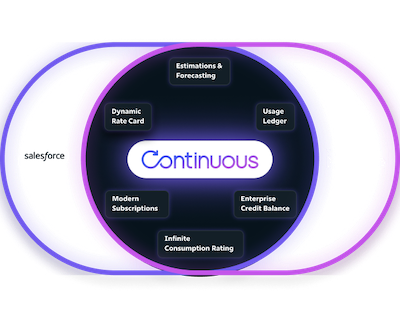
Continuous exists to solve that problem. We run directly inside Salesforce and NetSuite, providing a shared revenue layer that keeps pricing, lifecycle changes, usage, and financial impact connected end to end, whether a company is extending what it has today or preparing for what comes next. Here’s what we see coming in 2026.
1. Quote-to-Cash Becomes Essential Business Infrastructure
In 2026, companies will stop treating quote-to-cash as a project and start treating it as mission-critical infrastructure. The 12 to 18 month rebuild cycle can’t keep up with how fast pricing and go to market strategies evolve, and teams are tired of redoing the same work every year.
This is the year revenue logic moves inside the systems that already run the business, Salesforce and NetSuite, instead of relying on disconnected tools and fragile integrations. When pricing, product, and revenue logic live inside the core systems, companies can evolve how they sell and bill without breaking downstream finance every time monetization changes.
The most resilient companies will take this approach, eliminating the middleware tax that has slowed transformation for years.
2. Companies Stop Adding Revenue Systems and Embed Revenue Logic Instead
In 2026, companies will stop trying to solve quote-to-cash complexity by adding more systems. Years of layering CPQ, billing, usage tools, and reporting platforms have created duplication everywhere. Change one thing in pricing or packaging, and suddenly CRM, billing, revenue recognition, and reporting all need to be updated separately.
That approach won’t hold. Leading teams will focus on aligning how Salesforce and NetSuite handle pricing, usage, entitlements, and lifecycle events instead of expanding the stack. This alignment becomes critical as businesses introduce more hybrid, consumption, and commitment-based models.
This shift gives rise to embedded revenue infrastructure. Rather than introducing another standalone billing or monetization platform, companies will embed revenue logic directly into the systems they already run. The result is a shared revenue foundation that supports complex quote-to-cash without duplication, constant rework, or fragile integrations.
3. Hybrid Revenue Models Become Table Stakes
In 2026, hybrid revenue models will no longer be a competitive advantage. They will be the baseline. Subscriptions, usage, credits, commitments, and overages will coexist inside the same customer relationship, and companies will be expected to support all of them at once.
The difference will be execution. Leading companies will design their quote-to-cash architecture to handle multiple revenue motions simultaneously instead of optimizing for a single model. Teams that can operationalize this complexity will forecast more accurately, bill with fewer exceptions, and give customers clear visibility into what they’ve bought and consumed.
Companies that can’t will feel the impact quickly, not in pricing strategy debates, but in broken billing, unreliable forecasts, and frustrated customers.
4. Entitlements Become the Glue Between Sales, Product, and Finance
In 2026, entitlements become the new source of truth. Companies will be forced to reconcile what customers actually bought with what they actually have. Entitlements evolve into the connective tissue linking quoting, provisioning, billing, and renewals.
If your entitlement data is wrong, every downstream motion is wrong. The most effective teams will treat entitlements as infrastructure, not afterthoughts, keeping sales, product, and finance in sync and every renewal accurate. Clean entitlements mean clean revenue.
5. Finance Moves Upstream and Sets the Guardrails for Quote-to-Cash Design and Architecture
As revenue models become more complex, informal rules and downstream cleanup no longer scale. Pricing logic, usage handling, entitlements, and lifecycle changes carry immediate billing and revenue recognition implications. When those rules live in spreadsheets, custom code, or disconnected systems, finance is left reacting after problems appear.
In 2026, companies respond by formalizing quote-to-cash rules inside the systems that run the business. Pricing, usage, entitlements, and lifecycle constraints are embedded and enforceable, applied consistently from deal design through financial reporting. This shift makes governance possible upstream instead of downstream.
As a result, finance is no longer brought in after deals are designed. It is involved upfront, setting the constraints that quote-to-cash solutions must meet. Sales and RevOps still design deals, but they do so within guardrails that ensure billing, revenue recognition, and audit requirements are met by default.
6. Cleanup Beats Quote-to-Cash Reimplementation
Salesforce CPQ’s end-of-sale will tempt teams to blow everything up. In 2026, the smartest companies will resist that urge. Instead of launching massive quote-to-cash reimplementation projects, they will improve what they already have.
These teams will modernize in steps: clean the catalog, return to out-of-the-box where possible, embed the right logic, and move to Revenue Cloud Advanced when they are ready. Companies that attempt giant, multi-year reimplementations will spend 2026 managing risk and overruns instead of delivering business value.
Cleanup beats reimplementation every time.
7. The 60-Second Rule: Data Transparency Defines the Next Market Leaders
In 2026, data trust becomes the ultimate differentiator. Boards, investors, and executives will expect revenue answers on demand, not after days of reconciliation. The companies that can trace every deal from quote to contract to invoice to revenue in under 60 seconds will earn the confidence of their boards, investors, and markets alike.
Clean revenue lineage evolves from operational hygiene to strategic foresight. Teams will stop treating traceability as a reporting exercise and start designing for it upfront. With connected data architectures uniting bookings, billings, and revenue, finance shifts from proving what happened to driving what comes next, anchored in truth rather than assumptions.
8. The Rise of the Revenue Architect
A new role is emerging inside scaling organizations: the Revenue Architect. Equal parts business analyst, systems thinker, and finance translator, these leaders will bridge the gap between CRM and ERP, guiding architecture decisions that last. In 2026, companies that empower this role will build cleaner systems and scale faster than those that do not.
9. Companies That Rapidly Innovate Pricing Will Dominate and Grow
In 2026, pricing agility becomes the new growth lever. The fastest teams will stop treating pricing changes like mini transformations and start shipping new models continuously: commits, credits, outcomes, and more, all without breaking quoting or billing.
Companies that can do this will outpace competitors and compound growth. If you can’t change pricing fast, you won’t compete with companies that can.
What This Means for 2026
In 2026, companies that treat quote-to-cash as connective infrastructure will move faster, price more creatively, and operate with confidence across sales and finance. Those that continue to rely on fragmented systems, manual workarounds, and downstream cleanup will struggle to keep up.
Continuous helps leading organizations operationalize complex revenue models by embedding the revenue infrastructure that connects Salesforce and NetSuite, so change is possible without breaking billing, revenue, or trust.
____________________________________________________________________________
About Continuous
Continuous helps B2B companies modernize and future-proof quote-to-cash directly inside Salesforce and NetSuite. By embedding pricing, usage, and credit models into the core systems of record, Continuous creates a single, shared source of truth across sales and finance.
With Continuous, companies can support complex revenue models without adding new systems, breaking downstream finance, or re-implementing quote-to-cash every time the business changes. The result is faster monetization, cleaner revenue, and confidence that what sales sells can actually be billed, recognized, and reported accurately.