You Can’t Scale What You Can’t Explain
A Q&A with Jen Larco, Product Manager at Continuous
A conversation for finance, RevOps, and systems leaders on quote-to-cash transformation, cross-functional operations, and what it actually takes to connect the front office to the back office.
- Jen Larco joins Continuous as Product Manager with deep experience across Sales Operations, Finance, and IT
- Her background spans Salesforce CPQ, Salesforce Billing, BigMachines, , Oracle ERP, RevPro, and complex end-to-end quote-to-cash architecture
- Her core belief: if you can explain your revenue model clearly, you can operationalize it. If you can’t explain it, you never will
- She’s spent her career translating between business teams and technical teams. Now she’s translating customer pain into product
- On complex revenue models: complexity is fine. Exotic is not. Know the difference
Jen Larco joins Continuous as Product Manager bringing over two decades of experience sitting at the intersection of Sales Operations, Finance, and IT, including years at UKG focused on Salesforce CPQ, Salesforce Billing, ERP integrations, and large-scale quote-to-cash initiatives. She has a mug that says “requirements” with a smiley face and “solutions” with a frown on it. It tracks
You’ve worked across Sales Operations, Finance, and IT throughout your career. How has that shaped the way you think about quote-to-cash?
Honestly, I probably wouldn’t even understand what quote-to-cash was if I hadn’t worked in all three. Sales Ops gave me direct exposure to the go-to-market motion. Finance taught me how businesses manage their financials and stay compliant. And IT, historically, IT’s job has been to connect those two worlds. That’s where the quote-to-cash perspective comes from.
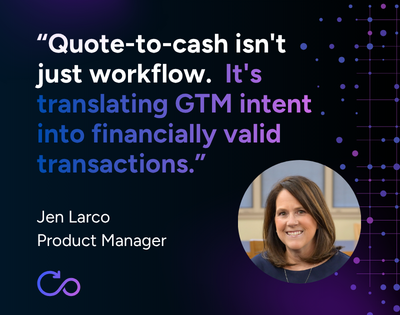
If I’d only worked in one area, I’d have a sales perspective or a finance perspective. Working across all three taught me that what you’re really doing is translating GTM intent into financially valid transactions. That’s quote-to-cash. The parts make up the whole.
A lot of your recent experience at UKG focused on CPQ, Salesforce Billing, and complex downstream integrations. What were you solving most often?
The number one challenge, no matter what we were doing, was implementing integrated end-to-end solutions. Whether it was a new product introduction, where you need to price it, quote it, order it, bill it, and recognize it, or automating a ramp deal with multiple usage tiers, the hard part was always making sure it worked end-to-end across every function. Not just one piece.
A lot of organizations can solve one part of the process. But if Sales can quote something that Finance can’t properly bill or recognize, the whole thing breaks down. It’s a great first step if you can quote. If you can’t translate what you quoted into bookings, billable amounts or revenue, you can’t manage your business.
You’ve worked with Oracle ERP, RevPro, Microsoft Dynamics, Salesforce, and more. Where do quote-to-cash processes tend to break down as companies grow?
I have a mug on my desk that says “Requirements” with a smiley face and “Solutions” with a frown that some dear friends (and savvy stakeholders) gave to me. That’s the answer.
The number one challenge across all of those systems is getting stakeholders to define clear business requirements before trying to automate anything. If you jump straight to automation without a well-defined process and a clear outcome, you’ll spin in circles.
And it’s not just about one part of the process. Cross-functional alignment is just as critical. You can solve the quoting problem perfectly and still fail if Finance isn’t part of the conversation from the start. The spinning just moves to a different room.
What attracted you to Continuous?
A couple of things.
The first is the people. I was a customer of John Banks years ago as an early adopter in the Salesforce CPQ and Billing space while he was head of product at Salesforce. The way that John and his team worked back then was something I always aspired to. I’d get on a call with them and they could speak to my business problem, translate it into their technology, and then translate it back to me in terms that actually made sense. The team at Continuous not only possesses that translation ability but also an immense amount of the Quote to Cash industry expertise. I wanted to be on the team that has seen it all and is passionate about working in this challenging space (these people get me!).The second is what Continuous actually does. The company understands that quote-to-cash isn’t an integration mapping problem. There’s a much bigger translation happening between GTM strategy and financial execution. And after being here only a short time, I’ve already had moments where I thought, I wish we had brought Continuous in to solve some of the challenges we were dealing with at my last company. That’s exciting. It means we’re solving problems I’ve personally lived through. Finally, after providing references to dozens of Salesforce prospects and customers over the last several years, it was table stakes for me to move to a company that maintains a Salesforce partnership.
Tell me about your role as Product Manager at Continuous.
I’ve always thought of myself as a translator. Previously that meant translating between business teams and technical teams. Now it means translating what customers are experiencing, what their problems are, where the gaps are in the current technology, into products and capabilities that actually solve them.
I want to understand the full end-to-end Continuous stack, not just one piece of it. My brain doesn’t work well if I don’t know where things start, where they end, and everything in between. Success looks like working with customers, understanding how their problems evolve over time, and making sure what we build simplifies complexity instead of adding more of it.
Why is fixing quote-to-cash becoming more urgent for modern businesses?
A few reasons.
AI is the obvious one. Everybody is looking for agents to come in and automate everything. But if you’re talking about quote-to-cash, GTM and finance business processes, you can deploy all the agents you want. If there isn’t a solid, connected foundation underneath them, you’re just automating chaos faster. AI on top of bad process is an even worse process .
Beyond AI, it’s about growth. Companies are adding products, acquiring other companies, introducing new go-to-market motions. The more you do that without a connected front office and back office, the longer everything takes. At some point it doesn’t just slow you down. It stops you from moving ahead at all.
What advice would you give companies trying to modernize their revenue models without overcomplicating them?
Early in my career I was in a CPQ webinar where someone introduced the concept of exotic pricing models. The message was simple: do not introduce them.
That stuck with me. And over the years I’ve taken it further. It’s not just about pricing. It’s about quoting, billing, recognition, modifications in term after the initial sale or at renewal, and how you explain the model to everyone involved. The problem isn’t complexity. Since my early days, I’ve certainly seen the introduction of more complex models that make excellent business sense and the introduction of technology to manage them. Exotic models are non-standard and fragile, because they break outside of the conditions they were designed for.
Here’s the test I use. If you can explain your revenue model(s) clearly, in plain language, to any person in any role at your company, you can operationalize it. You can automate it. You can scale it. If you can’t explain it, you’ll never get there. The system isn’t what’s stopping you. The clarity is.
I have had Sales Executives tell me the same thing. Give me a box. Help me understand levers that I can pull and levers that I can’t. Standardization helps Sales close deals faster instead of restructuring a new deal for every prospect. It helps Finance execute. And it helps IT build something that actually holds up as the business grows.
Complex and standardized is something you can build on. Complex and impossible to explain is something you’ll be rebuilding forever.
Outside of work, what do you enjoy?
I’m a very proud mom of a teenage son who just finished his freshman year of college.. My favorite pastime is watching him play baseball. Now that he’s In college I have a bit more time to find things to do on my own. The answer lately has been tennis, I recently joined my first USTA league. I also love to travel with my family and friends whenever I can.
Jen’s cross-functional perspective and deep operational experience bring a rare combination to Continuous, someone who has lived on every side of the quote-to-cash problem and spent her career figuring out how to connect them. As she puts it: if you can explain it clearly, you can scale it. If you can’t explain it, you never will.