Tag: Salesforce ERP Integration

Scaling Smarter: A Q&A with Owen Karlsson on Joining Continuous

Continuous Insights_Quote-to-Cash Conversation with Owen Karlsson, SVP NetSuite Solution Management

A Q&A for finance, RevOps, and systems leaders on Owen Karlsson joining Continuous, scaling NetSuite revenue operations, and fixing quote-to-cash across Salesforce and NetSuite.

TL;DR
Owen Karlsson joins Continuous as SVP of NetSuite Solution Management.
- He brings deep NetSuite and ARM expertise, including leading ASC 606 conversions.
- His focus is scaling revenue operations and connecting Salesforce and NetSuite.
- Continuous aims to close the gap between sales creativity and finance execution.

____________________________________________________________________________

Owen Karlsson, Senior Vice President of NetSuite Solution Management, joins Continuous with more than a decade in the NetSuite ecosystem, spanning operations, professional services leadership, and hands-on revenue management. He was the first person globally certified on NetSuite Advanced Revenue Management (ARM) and has led dozens of revenue conversion and optimization projects for software companies.

At Continuous, he will help advance the company’s mission to fix quote-to-cash in Salesforce and NetSuite, bridging two of the most critical systems in modern revenue operations.

What does your new role at Continuous entail, and where will you focus first?

The title is Senior Vice President, NetSuite Solution Management. In the short term, I’m bringing a group of NetSuite customers I’ve supported for years into the Continuous family and making their transition smooth: same responsiveness, same results.

From there, I’ll focus on three things. First, building strong NetSuite relationships, navigating Oracle’s partner ecosystem and keeping efforts aligned. Second, supporting sales and credibility by joining customer conversations where deep finance knowledge helps move things forward. And third, shaping product direction, especially around revenue management. 

We’re solving business-critical problems today and expanding the number we can solve tomorrow, and that’s how you scale impact.

Give us the quick version of your path into NetSuite.

I first got to know NetSuite at Rapid7 in 2012, where it ran both CRM and ERP in a complex, heavily customized setup. I started as a user, moved into an admin role, and was there when the company went public. Later I joined Zone & Co as one of the first hires. We grew from a small services firm into a product-led company after customers asked us to tackle usage and variable billing. I led professional services, operations, and later built out the knowledge and training side of the business. That experience taught me that the best users are the ones who can self-educate, and if you don’t build for that, you’ll never have power users.

Most recently I founded OK Consulting, and through ongoing work with Avalara, I met John Banks and the Continuous team.

Fun fact: I was the first person globally certified on NetSuite Advanced Revenue Management (ARM) and led around 50 ASC 606 revenue conversion projects, mostly for software companies.

How does your experience scaling operations and leading professional services inform how you’ll approach this new role?

At Zone, I helped grow the services organization and then built a team to implement a new billing product while keeping traditional NetSuite projects healthy. Later, as Chief Knowledge Officer, I focused on customer enablement, building a public knowledge base and training program so people could solve problems faster.

That mix of delivery discipline, enablement, and scalable processes is how I’ll operate here. The goal is always the same: build solutions that scale as fast as the business does.

What attracted you to Continuous and this next chapter in your career?

Honestly, it was John Banks and the team. I wasn’t looking to make a move, but the way John talked about the company, the culture, and the opportunity really stood out.

Continuous brings together deep Salesforce and NetSuite expertise. It felt like a natural fit, a team that thinks big, moves fast, and loves building. Salesforce and NetSuite are the two giants of the cloud, and Continuous sits right between them. Fixing quote-to-cash across those systems isn’t just the goal, it’s the mission.

Continuous’ mission is to fix quote-to-cash in Salesforce and NetSuite. Why is this challenge so important right now, and what makes Continuous uniquely positioned to solve it?

Sales creativity always outpaces systems. Every few years, there’s a new sales motion like subscriptions, usage, credits, or consumption, and sales can start selling it long before finance can operationalize it. That gap is where the friction lives. The companies that win are the ones whose systems evolve just as fast as their go-to-market.

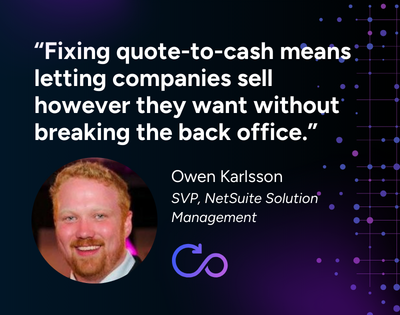
Continuous was built to close that gap, to fix quote-to-cash in Salesforce and NetSuite so companies can sell however they want without breaking the back office. We already handle prepaid and credit models really well, and we’re expanding into more complex revenue motions without adding unnecessary complexity. The more flexible we make quote-to-cash, the more confidently our customers can grow.

You’ve worked across every phase of the NetSuite lifecycle. What are the biggest opportunities for improvement you see in how companies manage finance and revenue today?

Most companies still have too many disconnected processes between sales and finance. Every manual step, rekeying data, duplicating orders, or reconciling invoices, adds friction and limits scale. The big opportunity is to build connected, auditable systems that keep up with how the business actually sells. When that happens, revenue operations stop reacting and start driving growth.

AI is reshaping every step of quote-to-cash, from forecasting and pricing to billing and revenue recognition. Where do you see the biggest potential for automation and intelligence to create real business value?

The biggest shift will come from AI-driven consumption models, where credits or usage for AI features become billable SKUs. That changes how companies price, forecast, and even pay commissions.  I’m optimistic about AI as a productivity multiplier, but cautious about unchecked automation in finance. The key is systems that support new pricing models safely, accelerating innovation without sacrificing accuracy.

Finally, when you’re not thinking about finance and optimization, how do you like to spend your time?

Sports, golf, family, and my dog. I’m a lifelong New York sports fan, Yankees, Giants, Knicks, Rangers, and a proud uncle to five nieces and nephews. That’s my favorite title, honestly.


Owen’s deep NetSuite experience, operational discipline, and product vision strengthen Continuous’ mission to fix quote-to-cash in Salesforce and NetSuite, helping companies scale revenue operations with confidence.

As he puts it, sales creativity always outpaces systems, and Continuous exists to close that gap.
Quote-to-Cash in NetSuite, a Q&A with Adnan Patel

Continuous Insights_Quote-to-Cash Conversation with Adnan Patel, General Manager

A Q&A for finance, RevOps, and systems leaders on simplifying quote-to-cash in NetSuite, embedding revenue infrastructure, and making finance a true growth partner.

TL;DR
- Quote-to-cash breaks when sales and finance operate on disconnected systems.
- NetSuite customers need a single, connected view of revenue, not more tools.
- Embedded revenue infrastructure handles complex subscriptions, usage, and consumption without replicating data.
- When revenue stays connected, finance moves from cleanup to strategic growth.


Continuous is entering its next phase of growth in the NetSuite ecosystem, and leading that charge is Adnan Patel, General Manager of the NetSuite business. With years of experience helping companies modernize financial operations and connect NetSuite to the broader revenue lifecycle, Adnan brings both deep technical expertise and a practical vision for what’s next. As pricing models evolve and intelligent systems reshape how sales and finance work together, he is focused on helping NetSuite customers simplify quote-to-cash, fix what’s broken, and make finance a true growth partner. 

We sat down with him to talk about what drew him to Continuous, how the company is simplifying revenue infrastructure and outcomes for clients, and what’s ahead for Continuous’ NetSuite business.

Can you share a bit about your experience in the NetSuite ecosystem and what drew you to this space originally?

My background has always been rooted in helping companies use technology to solve complex business problems. Early in my career, I worked with enterprise CRM systems like Siebel, helping global organizations drive success with their implementations. Over time, I realized that many companies, especially outside the Fortune 500, needed the same caliber of expertise but with solutions that better fit their size and speed (faster). That’s what led me to NetSuite. I was drawn to its promise of “one system, no limits,” a platform that unifies CRM, ERP, and financials in a single application. That vision of end-to-end connection is what first brought me in, and it’s what has kept me engaged in this ecosystem ever since. Most recently, I led the global NetSuite practice at Crowe, where I was responsible for building and scaling a 100-person team delivering NetSuite implementations and revenue operations services for multinational companies.

What made joining Continuous the right next step for you, and how do you define your role as General Manager?

For me, Continuous represents the next evolution of what companies like ours have been trying to solve for years: the friction between CRM and ERP, between how companies sell and how they account for that revenue. Having implemented countless quote-to-cash processes using Salesforce and NetSuite, I’ve seen firsthand how complex billing and revenue models slow down transformation. Continuous’ approach, which simplifies that complexity while keeping data connected and consistent, made immediate sense to me as both a technologist and consultant. As General Manager, my role is to expand our NetSuite business, build strategic partnerships, and ensure that every customer and partner in the ecosystem understands the value Continuous brings. It’s about driving awareness, scale, and consistency in how companies adopt this new model of connected revenue operations.

How do you describe Continuous to someone new to the brand?

I describe Continuous as the engine that powers sales growth and modern revenue operations. It’s built to handle the hardest part of quote-to-cash – the complex math behind subscriptions, usage, and consumption billing – so companies don’t have to. Rather than trying to replace CRM or ERP systems, Continuous strengthens them. It reads the contract data and usage activity, performs the complex and high-volume calculations, and passes the rated charges to NetSuite or Salesforce for billing and revenue recognition. It’s simple in concept but powerful in impact because it lets companies sell however they want without breaking their systems or creating new silos.

From your perspective, what makes Continuous different from other players in the Salesforce and NetSuite space?

Continuous takes an approach we call Embedded Revenue Infrastructure, and what we mean by that is an engine that operates within your existing systems to do the complex work of processing billing data and revenue calculation. Unlike stand alone billing tools that replicate data or sit outside your core architecture, Continuous embeds directly into your CRM and ERP environment. It’s headless, API-first, and designed to scale. That means it can calculate at volume, support any mix of pricing or monetization models, and pass clean, auditable data back to NetSuite for invoicing and revenue recognition. It’s a new kind of infrastructure, lightweight but deeply embedded, that gives companies both flexibility and control.

The NetSuite market is evolving quickly. What changes are you seeing in how customers approach revenue operations?

Customers are getting much more strategic about monetization. For years, the challenge was shifting to subscription or usage-based models. Now the focus is on operationalizing those models effectively and efficiently, whether that’s within the systems they already rely on or through a hybrid of new and existing tools. Success today comes from creating a single, connected view of revenue that aligns sales and finance without forcing teams to change how they work. That’s where Continuous really shines.

Continuous talks a lot about “fixing quote-to-cash” and making finance strategic. What does that mean to you in the context of the NetSuite business?

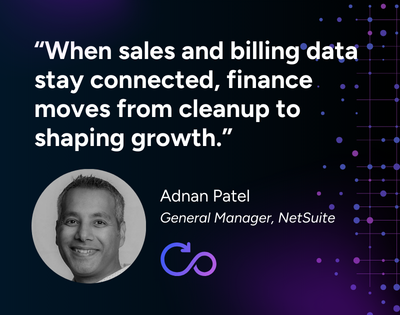
Fixing quote-to-cash means eliminating the gaps that create friction between how a company sells and how it books and recognizes revenue. For finance teams, that’s about more than automation—it’s about visibility. When the sales and billing data stay connected, finance no longer has to manually reconcile spreadsheets or patch over disconnected systems. They can see, in real time, which pricing models are performing, what’s driving margin, and where to optimize. That’s what makes finance truly strategic. It moves from reporting results to shaping them.

What types of customers or challenges are you most eager to take on?

We’re focused on helping growth-minded companies, those that are either expanding globally, introducing new billing models, or looking to bring order to complex revenue streams. That includes high-tech, SaaS, and services companies, but also industries like wholesale distribution and manufacturing that are embracing recurring or consumption-based pricing. Anywhere there’s complexity in how revenue is earned, billed, or recognized, Continuous adds clarity.

You’re coming in at a time of significant momentum. What are your top priorities in your first few months leading the NetSuite business?

My first priority is awareness. The NetSuite ecosystem is full of strong partners and customers who need exactly what Continuous offers, they just may not know who to turn to yet. Once that awareness builds, everything else follows: market penetration, partnerships, and customer growth. I’m also focused on building a world-class partner network that shares our approach to thoughtful, customer-first delivery. Whether a company works with our professional services team or one of our partners, they should have the same consistent experience: a smooth implementation, faster time to value, and long-term scalability.

For companies looking to modernize their revenue stack, where should they start? What advice would you give to finance or RevOps leaders who are feeling the pain of disconnected systems?

Start with strategy, not software. Too often, companies jump straight to buying tools without clearly defining their monetization strategy – how they want to charge, what models their customers expect, and what data needs to flow across the process. Quote-to-cash is one continuous motion, not a set of disconnected steps. Once you understand your pricing and revenue strategy, then you can determine the right systems and structure to support it. That’s where Continuous helps bridge the gap.

Looking ahead, what excites you most about the next 12 months for Continuous and the customers you’ll serve?

I’m excited about where the market is heading. AI-driven services and hybrid pricing models are pushing companies to think differently about how they sell and monetize their offerings. That creates enormous opportunity but also complexity. Continuous is uniquely positioned to help companies manage that complexity in a scalable, intelligent way. And beyond technology, what excites me most is the chance to work with a team that helped define this space—people who saw the problems firsthand and built something better.

Finally, tell us something personal. What do you do for fun outside of work?

I love to cook and travel, and I’m a big basketball fan. My kids all played growing up, so that became a big part of our lives. I also like to build things, whether that’s software tools, Legos, or even advising other startups focused on solving some really interesting problems. There’s something satisfying about taking something complex, working through it piece by piece, and seeing it come to life, which honestly isn’t that different from what we do at Continuous.

____________________________________________________________________________

As Continuous moves into its next chapter of growth, Adnan is helping shape what that story looks like for NetSuite customers. His focus is clear: simplify complexity, empower finance, and bring sales and finance together around a single, connected view of revenue. It’s a vision that mirrors Continuous itself, practical, forward-looking, and built to help companies fix quote-to-cash and grow smarter with every evolution of their business.

Reclaim Your Roadmap: Why In-House Usage Rating & Billing Logic Might Be Stalling Product Innovation

Usage and Prepayments

For product, engineering, and RevOps teams, this article explains why in-house usage rating and billing logic becomes a drag on innovation, and how offloading operational complexity helps teams scale faster.

TL;DR
- Building custom usage rating and billing logic offers early control but creates growing maintenance and complexity as pricing evolves.
- Engineers get pulled into finance rules, edge cases, and compliance work that slows feature delivery.
- Embedding revenue logic inside product code introduces performance risk, fragile integrations, and technical debt.
- Offloading usage rating and billing into revenue infrastructure frees engineers to focus on core product innovation.

Intro

Customers choose your product for the value your features deliver—not for the billing engine under the hood. While building usage rating and billing logic can initially offer control and flexibility, as complexity grows and new pricing models are introduced, engineering teams often find themselves burdened by ongoing maintenance of credit logic and billing rules.

After all, who knows your usage better than you? It seems logical to leverage that insight internally, especially when usage data also supports analytics, operations, and customer insights.

But what often starts as a well-intentioned and logical choice to maintain control can, as your business scales and product offerings evolve, introduce hidden complexity. Prepaid credits, tiered pricing, and sophisticated overage rules can turn initial flexibility into a significant drain on engineering time, focus, and resources, pulling them away from the innovations that truly set your product apart.

Tuning Your Custom Usage Rating and Billing Engine

For companies who’ve already invested in in-house rating and billing, the goal isn’t always a full rip-and-replace. It’s about optimizing your investment and strategically shifting additional complexity from your core product so you can scale more easily, move faster, and free engineers to build the capabilities that differentiate you.

Even well-built, custom usage rating and billing logic often encounters increasing friction as businesses scale and innovate:

  • Expertise Shortfall: Accurate usage-rating, billing, and revenue recognition rely on nuanced finance rules, tax regulations, and compliance standards. As new tiers or credit models emerge, keeping up with edge cases (proration, true-ups, audit trails) can become a specialist’s job, not a feature team’s.
  • On-Going Maintenance: Every pricing tweak—new discount tier, updated overage rate, expired credit pool—translates into code changes and QA cycles. That steady upkeep can quietly consume cycles meant for customer-facing innovation.
  • Fragile Integrations: Custom connections to Salesforce, NetSuite, or your own analytics stack can break when data models or schemas shift—leading to mismatches that require urgent fixes.
  • Performance Degradation: Running core revenue logic inside your application can introduce additional CPU, I/O, or network calls—potentially adding latency to user transactions and affecting overall system responsiveness, impacting the very experience your product aims to deliver.
  • Growing Technical Debt: Quick-win patches for one-off pricing or usage rules often become permanent fixtures. Over time, those patches form a web of interdependencies that slows every release, making your codebase harder to manage and evolve.
  • Roadmap Slowdown: When usage and billing logic is deeply embedded in your product, every update carries the risk of unintended side effects on rating or billing. This can significantly drag down feature velocity and delay crucial product roadmap items.
  • Audit & Compliance Overhead: Ensuring every transaction and revenue event is auditable and compliant with financial regulations (like SOX) requires complex logging and reconciliation, pulling engineers into non-feature work.

The good news? For many, the path forward isn’t necessarily a full rip-and-replace of existing systems. Instead, it’s about strategically offloading the operational complexities that slow you down, allowing you to optimize your current investment while reclaiming valuable engineering cycles.

Unlock Agility with Embedded Revenue Infrastructure

Instead of grappling with operational complexity in your product, shift it into a specialized layer that seamlessly plugs into the tools your teams already use. Embedded Revenue Infrastructure empowers you to:

  • Centralize metering and rating in a purpose-built service, keeping complex usage rating and billing logic out of your product code 
  • Configure pricing models via UI, empowering non-technical teams to add or tweak usage tiers, prepaid credits, and rate plans without a single line of code.
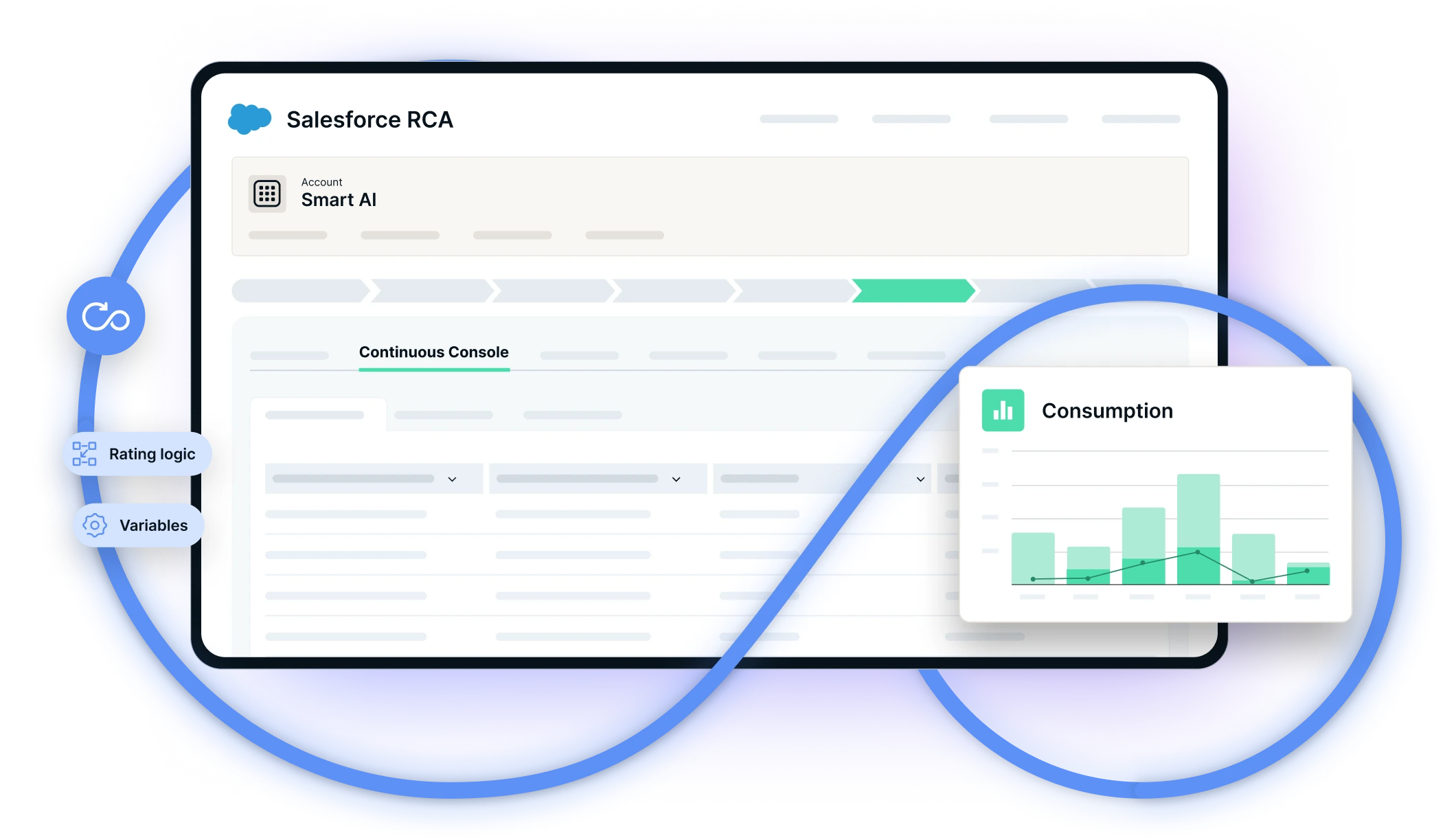
  • Surface real-time usage insights directly in Salesforce, eliminating manual exports, custom integrations, and the delays of spreadsheet gymnastics.
  • Automate credit burn and revenue events through APIs, moving beyond manual scripts and batch jobs to ensure accuracy and efficiency.
  • Free engineers to focus on shipping features that truly propel your product forward and delight customers.

By strategically moving this logic out of your product codebase, you accelerate feature delivery, scale reliably, and eliminate the hidden costs of managing homegrown billing and rating.

Modern usage rating, billing, and overage management should always accelerate product velocity, not stall it. When facing complex pricing models—like prepaid credits, hybrid plans, or multi-phase commitments—the critical question for Product and Engineering leadership becomes: What logic is truly strategic to our core product, and what is operational infrastructure that pulls engineers away from building differentiating features? Your engineers need to focus on delivering that core innovation, not patching metering pipelines or maintaining invoicing scripts.

Ready to reclaim engineering time and scale without revenue headaches? 

Schedule a personalized demo today and see exactly how Continuous transforms your capabilities, enhances data consistency, and delivers immediate value.

Strengthening Our NetSuite Strategy: Welcoming Adnan Patel as Strategic Advisor

Adnan Patel, Strategic Advisor

For NetSuite customers and partners, this announcement explains why Adnan Patel joined Continuous as a strategic advisor and how his experience strengthens our NetSuite and ERP strategy.

TL;DR
- Continuous welcomed Adnan Patel as a strategic advisor focused on NetSuite and ERP.
- Adnan brings more than 18 years of NetSuite experience and leadership across 1,200 plus implementations.
- His guidance strengthens how Continuous supports embedded revenue infrastructure inside NetSuite.
- Customers and partners benefit from deeper NetSuite expertise and practitioner-led strategy..

At Continuous, we’re known for our innovations in recurring revenue. We’ve helped leading companies shift from subscriptions to usage, from custom billing to embedded revenue infrastructure, always with a focus on making Salesforce work better for Sales, RevOps, and Finance teams.

Today, we’re excited to share that Adnan Patel is joining Continuous as a Strategic Advisor, focused on NetSuite and ERP.

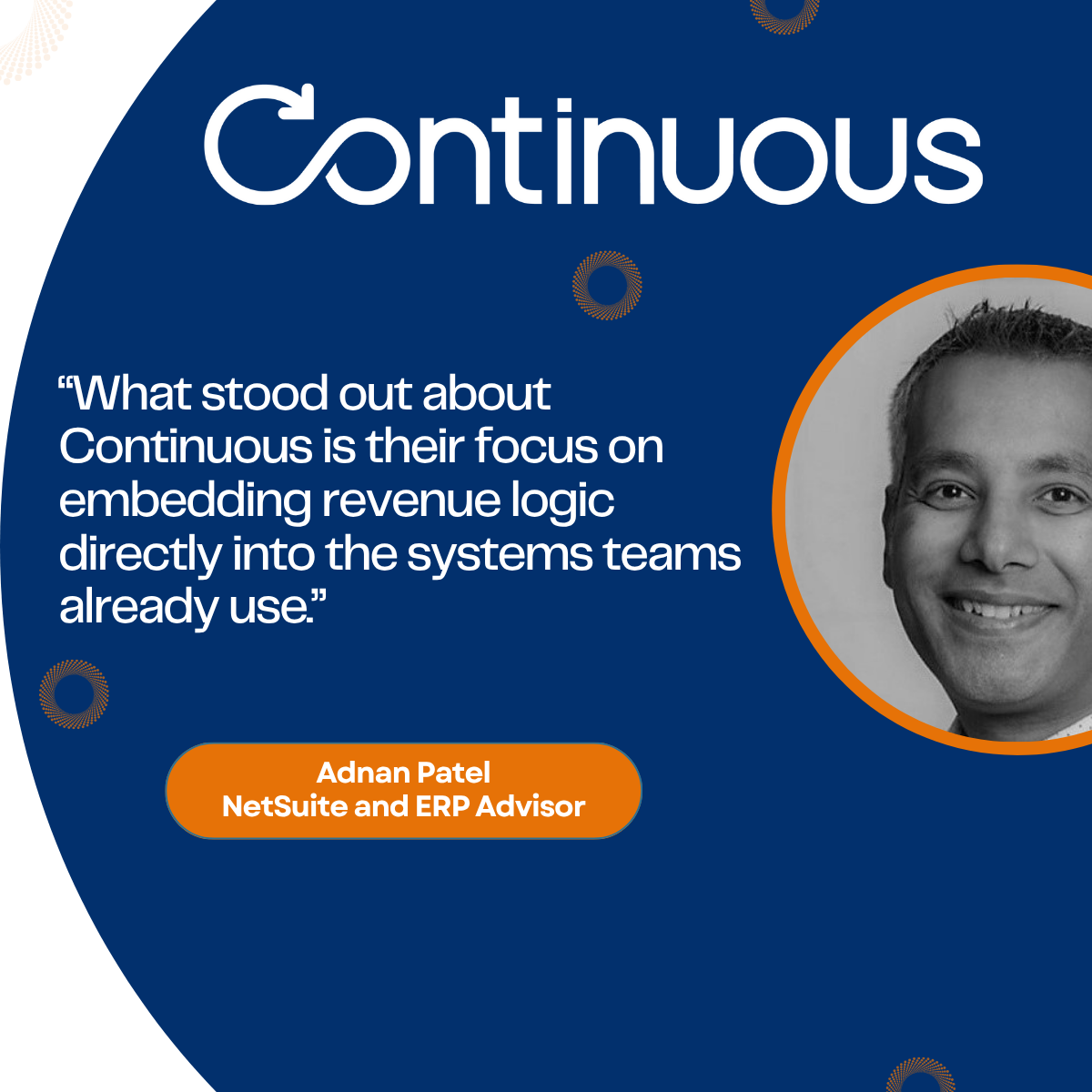
“I’ve spent my career helping companies get more out of NetSuite,” said Adnan Patel. “What stood out about Continuous is their focus on embedding revenue logic directly into the systems teams already use. It’s a smarter way to simplify complexity without adding another tool.”

A Recognized Leader in the NetSuite Ecosystem

Adnan has had a massive impact on the NetSuite ecosystem. He’s the founder of Sixred, an eight-time NetSuite 5-Star Award winner and one of NetSuite’s most respected Solution Providers. Over the course of 18+ years, his team has led more than 1,200 NetSuite implementations across industries, helping organizations scale smarter with cloud ERP.

When Sixred was acquired by Crowe LLP, Adnan took on the role of Principal, where he led Crowe’s global NetSuite practice, built industry accelerators, mentored NetSuite consultants, and helped clients modernize finance and operations with confidence. He’s a familiar face at SuiteWorld and other Oracle NetSuite events, where he’s shared insights on scaling ERP practices and driving successful cloud transformations.

“Adnan understands what works best with scaling ERP systems for growing companies,” said John Banks, Founder and CEO of Continuous. “His applied experience with thousands of NetSuite projects offers a practical, tested perspective as we expand our footprint and continue supporting Salesforce and NetSuite users.”

Building the Bridge Between CRM and ERP

Continuous has always taken a different approach to billing and revenue infrastructure. Our mission is to prove that the most scalable model isn’t a third-party system, but one that extends the CRM and ERP platforms customers already use.

With Salesforce, that means embedding deeply into the Revenue Cloud Advanced experience. Now, with Adnan’s guidance, we’re doing the same within the NetSuite ecosystem.

Whether customers use NetSuite Advanced Financials or SuiteBilling, the goal is the same:
Make usage-based pricing, credit drawdowns, revenue accounting and reporting easier by embedding logic where it belongs.

We see a future where NetSuite customers can manage usage, rating, and billing scenarios without introducing yet another standalone billing system. With Adnan’s experience, we’re building that future on a strong foundation.

What This Means for Our Customers and Partners

Adnan’s involvement will accelerate product development on NetSuite and strengthen how we support system integrators, NetSuite sellers, and implementation partners. It also ensures we’re learning from the best—bringing a practitioner’s lens to every step we take.

If you’re a NetSuite customer exploring usage-based pricing, or a partner helping clients operationalize complex billing models, we’d love to connect. With Adnan on board, we’re more ready than ever to support your success.

Want to learn more about how Continuous supports Salesforce and NetSuite customers?

Get a tailored review of your current architecture and personalized insights on where Continuous can drive the most value.

👉 Fill out this quick form and one of our experts will follow up with your survey—no pressure, no commitment.

Continuous and AscribeIT Partner to Streamline Revenue Operations for Salesforce and NetSuite

Continuous and AscribeIT Partner

For Salesforce and NetSuite teams, this announcement explains how Continuous and AscribeIT partner to streamline revenue operations and support advanced pricing without standalone billing systems.

TL;DR
- Continuous and AscribeIT partnered to help enterprises modernize revenue operations.
- The collaboration supports usage-based, prepaid, and hybrid pricing models.
- Customers benefit from embedded monetization inside Salesforce and NetSuite.
- The partnership combines implementation expertise with scalable revenue infrastructure.

Continuous, the first embedded pricing and revenue solution purpose-built for Salesforce and NetSuite, is excited to announce a strategic partnership with AscribeIT, specialists in CPQ, billing automation, early adopters of outcome-based pricing, and revenue operations excellence. This collaboration empowers enterprises to efficiently deploy and optimize advanced pricing and monetization models directly within their CRM and ERP environments, eliminating the typical headaches of standalone billing systems.

Better Together

Companies today face increasing pressure to deploy sophisticated monetization strategies—including hybrid subscription plans, usage-based pricing, and innovative credit management models. However, traditional billing solutions often complicate rather than streamline these processes, creating unnecessary friction between Sales, Finance, and IT teams.

Continuous seamlessly integrates powerful pricing, rating, and credit management capabilities directly into Salesforce and NetSuite, allowing businesses to leverage their existing systems without costly integrations or silos. AscribeIT uses Continuous as a complement to core applications by providing expert implementation and strategic guidance around Salesforce solutions like Revenue Cloud Advanced, ensuring smooth adoption and rapid operational improvements.

Together, Continuous and AscribeIT enable customers to:

  • Rapidly deploy and scale innovative pricing strategies directly within Salesforce and ERP solutions including NetSuite, Intacct, and others
  • Align sales, finance, and IT processes into a single, cohesive ecosystem.
  • Automate and simplify revenue operations, significantly reducing manual effort and error rates.

A Collaborative Approach to Revenue Operations

AscribeIT brings deep expertise in configuring and optimizing CPQ and billing solutions, helping customers align technology with business processes effectively. Continuous enhances these implementations by embedding sophisticated rating and monetization capabilities directly into Salesforce and NetSuite, eliminating the limitations of traditional standalone billing systems. This approach enables specific use cases including prepaid credit management, advanced usage-based billing scenarios, consumption-based pricing models, and hybrid monetization strategies.

Perspectives from Our Leadership

“We’re excited to partner with AscribeIT,” said Sean Joyce, Co-founder and Head of Alliances at Continuous. “Their proven expertise in CPQ and billing automation perfectly complements our embedded monetization approach. Together, we’re making complex revenue operations simpler and more efficient, allowing enterprises to quickly implement innovative pricing strategies.”

“Continuous solves a critical challenge for our customers by providing robust, real-time pricing and rating capabilities directly inside their existing systems,” said Avinash Boyana, Partner Alliance Director at AscribeIT. “Our combined solutions simplify and accelerate complex monetization scenarios, enabling our customers to streamline operations and rapidly scale their revenue strategies.”

Looking Ahead

This strategic partnership between Continuous and AscribeIT positions both companies to deliver immediate and sustainable value to customers aiming to modernize their revenue operations. By combining best-in-class embedded revenue technology with expert implementation services, customers can confidently transition to sophisticated monetization models while maintaining seamless operational alignment.

To explore how Continuous and AscribeIT can streamline your revenue operations, please contact us or visit our partnership page for more information.


About Continuous

Continuous provides the first embedded pricing and revenue platform specifically designed to enhance Salesforce and NetSuite, enabling enterprises to quickly launch and scale complex usage, credit, and hybrid monetization models without standalone billing systems. By leveraging existing CRM and ERP investments, Continuous delivers unmatched flexibility, scalability, and speed to market. Learn more.

About AscribeIT

AscribeIT has a combined experience of more than 30 years delivering RevOps solutions across all market segments, being the ultimate choice to transform revenue operations. Learn more.


Is Your Business RCA-Ready? Five Questions to Ask Before Making the Leap

Salesforce RCA Consumption-Based Pricing and Rating

A practical guide for RevOps, Sales Ops, and Finance leaders evaluating Salesforce Revenue Cloud Advanced. Learn when to move to RCA, when to extend CPQ, and how to close readiness gaps without disrupting revenue.

TL;DR
- Revenue Cloud Advanced (RCA) isn’t the right next step for every team—readiness matters.
- Many organizations benefit from extending CPQ and Billing before re-architecting.
- Common gaps include SKU sprawl, poor usage data, and disconnected lifecycle events.
- Continuous helps teams close those gaps and move to RCA only when it truly makes sense.

Part 3 of our RCA Series

In Part 1, we introduced Salesforce Revenue Cloud Advanced (RCA) and its vision for end-to-end monetization. In Part 2, we explored how RCA supports usage-based pricing—and how Continuous enhances it for scale. 

Now, in Part 3, we’re focusing on readiness. For some companies, RCA is the clear next step. For others, continuing to optimize legacy CPQ and/or Billing may be the right call for now. We’re sharing what we’ve learned from working with our customers: the most common readiness gaps that hold teams back from realizing RCA’s full potential—and how to close them before making the move.

You’ve implemented Salesforce CPQ—or even CPQ + Billing. You’ve standardized quoting, brought pricing and approvals into Salesforce, and made major strides toward scalable revenue operations. But as your business grows and your pricing models evolve, you may be asking: What about RCA?

For many organizations, the next step is Salesforce Revenue Cloud Advanced (RCA)—and the opportunity to modernize monetization even further.

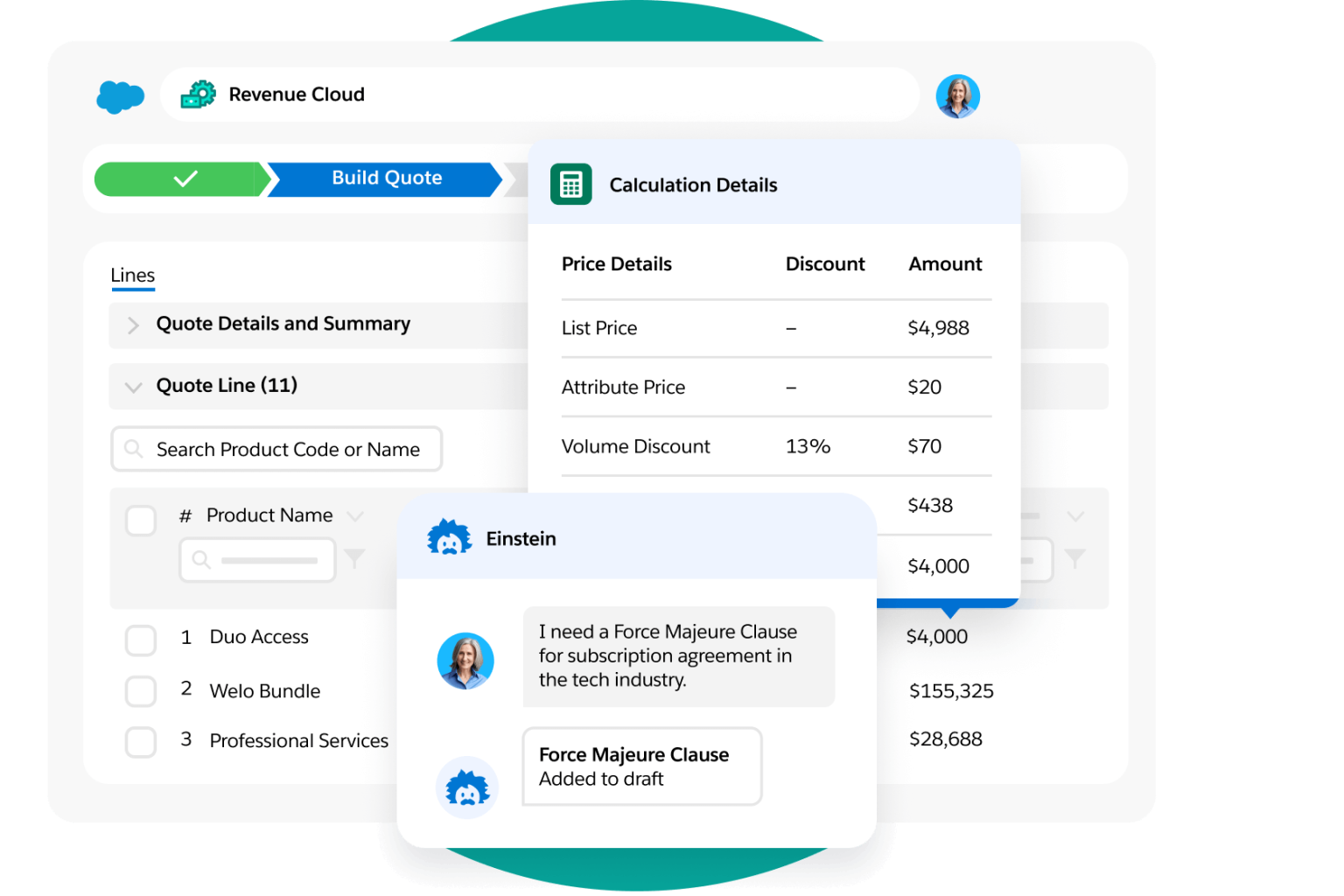
Salesforce Revenue Cloud Advanced (RCA) introduces a fully native Salesforce architecture purpose-built for modern revenue operations. It supports more flexible pricing models—including usage-based—and brings quoting, contracting, and billing closer together within a composable, API-first framework. 

But the move to RCA isn’t right for everyone and some may benefit from continuing to optimize their current CPQ or CPQ + Billing investment. At Continuous, we help customers navigate these decisions every day, providing scalable solutions that bridge the gap between CPQ and RCA.

Not Everyone Needs to Move to RCA (Yet)

Moving to RCA now isn’t the right fit for every organization. If your organization recently invested in Salesforce CPQ (with or without Salesforce Billing), the last thing you want is to disrupt that deployment. Instead, your goal is likely to get even more value out of your current investment.

That’s exactly where Continuous comes in. Continuous enhances Salesforce CPQ by seamlessly adding support for complex usage, consumption, and credit-based pricing scenarios—all without introducing new billing silos. Even better, Continuous enables you to fully leverage NetSuite as your financial system of record, allowing for streamlined payments, collections, invoicing, and revenue reporting directly within your existing ERP environment.

With Continuous you can:

  • Support advanced usage, consumption, and hybrid pricing models directly within Salesforce CPQ.
  • Fully leverage NetSuite for financial reporting, invoicing, collections, and revenue recognition.
  • Extend—not replace—the significant investment you’ve already made in Salesforce CPQ.

If your team is feeling pressure to move to Revenue Cloud Advanced but wants a more strategic path forward, start by requesting a free RCA Readiness Assessment. We’ll show you how to enhance what you already have, so you can move to RCA (or any advanced solution) only when—and if—it truly makes sense for your business.

What We’re Seeing In The Market: Success Meets Operational Reality

At Continuous, while we work with companies who are deep into CPQ or CPQ Billing, five patterns consistently emerge:

Your Customer Experience Shouldn’t Depend on Support Tickets
→ Most customers can’t see their usage, credit balances, or contract details—so they open support tickets for basic questions. This reactive model frustrates users, burdens internal teams, and erodes trust—especially in usage-based models where real-time visibility is expected.

When SKUs Don’t Map to Value, Trust Breaks Down
→ Workarounds that helped get CPQ live or bring a new product to market—like placeholder SKUs or loosely defined product hierarchies—create quoting confusion and billing disconnects, leaving customers unsure of what they purchased or why they were charged.

Governance Gaps and Swivel Chair Handoffs Create a Loop of Rework and Risk
→What began as flexible CPQ configuration has evolved into a patchwork of overrides, manual workarounds, and uncontrolled customizations. Even after deals are signed, corrections are still required before revenue can be recognized. The result: delayed deals, inconsistent data, and ongoing rework across Sales, RevOps, and Finance

Unstructured or Manual Consumption Data
→ As businesses shift and are eager to monetize consumption— the supporting data simply isn’t there. Usage data is often captured inconsistently, defined differently across products, or manually maintained in spreadsheets—if it’s tracked at all. Sales teams miss clear signals for upsells or expansion, Finance can’t reconcile revenue, and customers are left in the dark about what they’ve used or why they’re being charged—limiting revenue growth and customer trust.

Fragmented, Disconnected Lifecycle Events Derail Growth
→ Renewals, amendments, and cancellations are often managed through manual workarounds or outside systems—like spreadsheets, net-new quotes, or support tickets. This leads to duplicate records, conflicting contract data, customer confusion, and unreliable revenue and renewal reporting.

Recognize these challenges? Let’s talk about how Continuous can help your team tackle them today, before they stall your growth.

Is Your Business RCA-Ready?

RCA assumes a strong foundation—but that’s where many teams struggle. Before diving in, ask yourself:

  • Is our product catalog standardized and enforceable?
  • Do our SKUs map to value—for us and our customers?
  • Is our usage data reliable and available in real-time?
  • Are renewals, amendments, and cancellations governed and aligned?
  • Can Sales, Finance, and Customers all see the same thing?

Without that foundation, even the best RCA implementation can fall short of expectations.

How Continuous Extends RCA

Continuous doesn’t replace RCA—we make it stronger. We embed directly into your Salesforce environment, working alongside RCA to:

  • Extend RCA to NetSuite or any ERP—no middleware required
  • Standardize SKUs and Rate Plans across sales and billing
  • Mediate and rate usage data at scale, in real time
  • Enable enterprise credit pools, prepayments, and true-ups
  • Align lifecycle events (renewals, expansions, cancellations) across Salesforce and ERP

And because Continuous is Salesforce-native, your teams stay in the systems they already know. No duplicate catalogs. No disconnected workflows.

RCA opens the door to modern revenue operations—but the difference between deploying it and unlocking its full value comes down to readiness.

Request a free RCA Readiness Assessment

Request your free RCA Readiness Assessment from Continuous and get expert insights tailored specifically to your business—no cost, no commitment. Simply fill out this quick form, and one of our RCA experts will reach out with your assessment survey.