Tag: Revenue Architecture

How to Survive (and Win) Your Revenue Cloud Advanced Implementation

What Salesforce and NetSuite teams need to know before starting a Revenue Cloud Advanced (ARM) reimplementation—and how to avoid rebuilding quote-to-cash twice.

TL;DR
– Revenue Cloud Advanced (ARM) is a full architectural reset, not a CPQ upgrade.
– Treating ARM as lift-and-shift just recreates old quote-to-cash problems in a more complex system.
– Winning teams clean up CPQ, design for future pricing models, and build cross-functional ARM expertise.
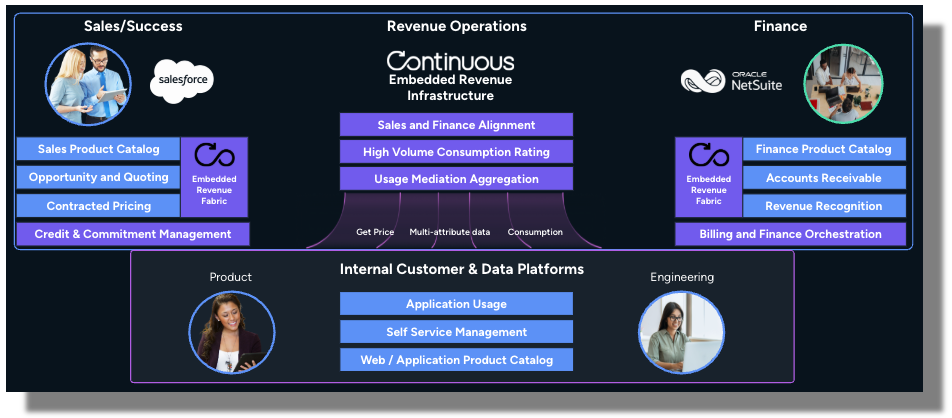
– Embedded revenue infrastructure connects Salesforce and NetSuite so ARM delivers scale instead of chaos.


Let’s Be Honest: RCA/ARM Isn’t an Upgrade — It’s a Reimplementation

Revenue Cloud Advanced (RCA), now Agentforce Revenue Management (ARM), isn’t just the next version of Salesforce CPQ & Billing.  It represents an entirely different product approach, and is a total paradigm shift. 

RCA/ARM introduces a new, event-driven foundation built for hybrid, usage-based, and consumption pricing. It’s powerful, but it’s not plug-and-play, it needs the right skills and developers to achieve its full potential. If you treat it like a “lift-and-shift,” you’ll just move your old quote-to-cash problems into a more complex architecture.

Do it right, and you’ll come out revenue ready, with a scalable, modern foundation that actually works. Do it wrong, and you’ll be managing chaos in a system that’s supposed to make things easier.

RCA/ARM ≠ CPQ

Let’s be clear: RCA/ARM isn’t CPQ 2.0. 

  • It’s event-driven. Every revenue event triggers automation, rating, and reconciliation — in real time.
  • It’s headless. RCA/ARM is designed for machine-to-machine transactions, not seat-based licensing.
  • It’s developer-heavy by design. The flexibility is incredible, but it requires architects who can design across CRM and ERP.

Think of it this way: Salesforce just handed you the best toolset in the world. But it’s still on you to design the house.  This is where you need your master carpenters, people who know how to build end-to-end on Salesforce and NetSuite.

Four Crucial Steps before Starting RCA

The companies getting this right are using their RCA/ARM reimplementation to fix quote-to-cash issues now, not replicate them.

  1. Clean up CPQ first: Don’t drag legacy workarounds into a modern architecture. RCA/ARM is different, don’t put the CD player in a 2025 car. Start by removing unnecessary custom complexity, returning to sustainable configurations, and stabilizing your current CPQ environment.  This affords you time and control, not just a temporary fix.
  2. Plan for what’s next, not what’s now.: RCA/ARM is built for consumption, flexibility, and automation. Architect beyond your current product catalog and pricing logic.

    Do you have any upcoming initiatives or roadmap items that should be taken into consideration at this time?
    • New product launches or pricing packages
    • Usage-based or hybrid monetization
    • Digital wallets and prepaid credits
    • Ramp and milestone-based deals
    • Self-service or PLG motion
    • Channel or partner expansion
    • AI and predictive revenue intelligence

  3. Build the right team: To get RCA/ARM right, you need people who understand both Salesforce’s event-driven, API-first architecture and the business logic that actually runs quote-to-cash.  Here’s the truth: RCA/ARM skills are not CPQ skills. CPQ is rules and workflows. RCA/ARM is events, automation, and real-time data flows.

    Most teams can’t afford the years it takes to build both skill sets while the business keeps shipping new pricing models. That’s where Continuous changes the game.

    We bring RCA/ARM expertise, deep CPQ mastery, and industry-specific insight to design pricing, packaging, usage, and revenue flows that actually work. While others are still learning Salesforce’s new model, we’re already executing it at scale.

    Pair Continuous with the right internal stakeholders and you don’t just implement RCA/ARM, you build a modern revenue architecture grounded in real experience, not guesswork.

    Your winning team blends:
    • Architects who design across Salesforce, NetSuite, and connected data flows
    • RevOps + Finance leaders who align pricing, process, compliance, and controls
    • Developers/engineers who implement event-driven logic, integrations, and usage instrumentation
    • Data owners who define, model, and reconcile usage and event flows
    • Process + change leaders who drive adoption and measurable outcomes

      RCA/ARM success depends on collaboration, not configuration. The teams who win treat it as a cross-functional design effort that unites Sales, Finance, and Operations around a shared revenue architecture.

  4. Choose the right foundation: The winners are embedding revenue infrastructure inside their systems of record.

    The connection between your CRM, ERP, customer systems, and product should all work together without duplicate data sources. When done right, usage and consumption data should be usable in real-time, across all systems and processes. 

    Sound too good to be true?  See how ACI learning put this into action

How Continuous Helps You Get Revenue Ready

Revenue models have been evolving for decades and so have the associated tools. This next generation of Salesforce architecture is designed to unlock so much more. At the risk of sounding like a broken record, I will state again, this is not lift and shift…you need a bridge to the future. 

Continuous enables Salesforce customers to modernize their revenue stack, Revenue Cloud or ARM, while maintaining day-to-day operations and modernizing.  We extend Salesforce with flexible pricing, rating, and ERP-ready billing logic that works across both current and next-generation architectures.

With Continuous, teams can:

  • Assess your options
  • Clean up CPQ and reduce risk for the next path you choose
  • Add modern pricing, usage, and credit models directly within Salesforce. No new platform required.
  • Connect Salesforce quoting and billing to NetSuite or other ERPs with real-time data flow and reconciliation.
  • Evaluate ARM readiness and move on their own timeline — adopting RCA/ARM when they’re ready, without business disruption.

Continuous builds the foundation you’ll need for RCA/ARM, while delivering value now. When you go live, your architecture, processes, and people are already ready.

Final Word

RCA/ARM is rewriting Salesforce’s revenue architecture. This isn’t just another release, it’s your chance to get back to out-of-the-box, simplify and modernize for good.

Maximize the systems your teams operate within and create a future-proof infrastructure to power your business. Embedded revenue infrastructure is the revenue fabric that will directly stitch together  Salesforce and NetSuite. We’ve fixed quote-to-cash, and we make sure your business stays revenue ready for whatever comes next.

→ Learn how Continuous fixed quote-to-cash in Salesforce and NetSuite. Request a demo today or reach out for a RCA/ARM readiness audit. 
Why We Partnered with NetSuite: Making Finance Strategic from the Start

Continuous and NetSuite

For finance and RevOps teams using NetSuite, this article explains why revenue logic must be embedded earlier in the sales process, and how revenue infrastructure supports usage-based pricing without pulling finance out of its system of record.

TL;DR
-Finance teams are often brought in too late, forcing manual reconciliation and audit risk inside NetSuite.
- Revenue logic frequently lives outside Salesforce and NetSuite, creating misalignment between sales and finance.
- Standalone billing systems add complexity by pulling finance out of its system of record.
- Revenue infrastructure embeds pricing, billing, and revenue logic upstream so NetSuite receives clean, trusted data from day one.


Introduction

Before joining Continuous, I worked as a public accountant and auditor. Quarter-end always brought the same scramble: reconcile revenue schedules, trace usage back to pricing, and figure out why what was sold didn’t match what showed up in NetSuite.

The common thread was simple: finance was brought in too late. By the time we saw the deal, fixing it meant more manual work, more risk, and more delays.

At Continuous, we’re solving that problem head-on. We deliver revenue infrastructure for NetSuite customers who need to manage complex pricing without pulling finance out of their system of record. That’s exactly why we partnered with NetSuite.

The Disconnect We’ve All Seen

Most B2B companies run on Salesforce and NetSuite. Sales lives in CRM. Finance lives in ERP.

But what connects those systems — the pricing terms, calculations, billing logic, and revenue triggers — often lives outside of both.

Instead, it gets scattered across spreadsheets, hardcoded in point solutions, or duplicated in a standalone billing system. Finance teams are often left performing calculations manually, or even worse, asked to pull finance processes out of NetSuite entirely and into a new billing engine that introduces more complexity instead of solving it.

This disconnect creates chaos across the entire process. Finance teams get stuck cleaning up revenue logic they didn’t control. Sales teams are slowed down by rules that don’t align with how they sell. The numbers are unclear, and trust erodes on both sides.

Why NetSuite?

This is a fundamental architectural shift from how billing has been handled for years.

Most standalone billing vendors ask you to move your teams and processes off of your core systems and onto theirs. That model was introduced when subscriptions took off, and it didn’t work well even then. It’s an even worse fit now, as companies adopt more dynamic models like usage billing, digital wallets, and prepaid credits.

Those vendors want to become the new system of record. We don’t.

We partnered with NetSuite because it’s where finance teams already live. It is the system of record, and it should stay that way.

But for NetSuite to work, it needs clean, structured data from upstream. Not after the contract is signed. Not when the first invoice is due. At the quote.

That’s where Continuous comes in. We embed revenue logic into the sales process, whether it happens in Salesforce, self-service commerce, or through a partner deal, so NetSuite receives everything it needs to generate accurate invoices and recognize revenue the right way.

We don’t replace NetSuite or Salesforce. We make them work better together.

What We Built

The Continuous NetSuite SuiteApp is designed to support finance from day one:

  • Align Salesforce and NetSuite without duplicating catalogs
  • Support usage-based pricing, pooled credits, and prepaid drawdowns
  • Ensure billing and revenue logic is captured correctly at the quote stage
  • Avoid the need for a separate billing system or downstream custom work

This is not just another integration. It is revenue infrastructure for NetSuite, designed to support complex pricing and billing at scale. It’s an embedded layer that ensures what happens in Salesforce flows cleanly into NetSuite, without surprises.

A Better Way Forward

With Continuous, finance stays in NetSuite. Sales keeps the flexibility they need, whether they are quoting in Salesforce, enabling partner channels, or powering a self-service flow. And both sides stay aligned, even as pricing models get more complex.

Whether you’re dealing with usage billing, hybrid subscriptions, pooled credits, digital wallets, or just trying to avoid a reconciliation nightmare, Continuous helps you stay ahead of it.

If you’ve ever been stuck in auditor mode at quarter-end, I get it. That’s the problem we’re solving.

What’s Next

Our SuiteApp is now live, and we’re excited to help teams bring sales and finance closer together inside NetSuite.

If you’re heading to SuiteWorld, we’d love to show you what we’ve built.

And if your team is still cleaning up billing logic after the fact, maybe it’s time to bring finance in earlier and make it strategic from the start.

Want to see how it works? Book a quick demo or schedule time with our team at SuiteWorld.

Strengthening Our NetSuite Strategy: Welcoming Adnan Patel as Strategic Advisor

Adnan Patel, Strategic Advisor

For NetSuite customers and partners, this announcement explains why Adnan Patel joined Continuous as a strategic advisor and how his experience strengthens our NetSuite and ERP strategy.

TL;DR
- Continuous welcomed Adnan Patel as a strategic advisor focused on NetSuite and ERP.
- Adnan brings more than 18 years of NetSuite experience and leadership across 1,200 plus implementations.
- His guidance strengthens how Continuous supports embedded revenue infrastructure inside NetSuite.
- Customers and partners benefit from deeper NetSuite expertise and practitioner-led strategy..

At Continuous, we’re known for our innovations in recurring revenue. We’ve helped leading companies shift from subscriptions to usage, from custom billing to embedded revenue infrastructure, always with a focus on making Salesforce work better for Sales, RevOps, and Finance teams.

Today, we’re excited to share that Adnan Patel is joining Continuous as a Strategic Advisor, focused on NetSuite and ERP.

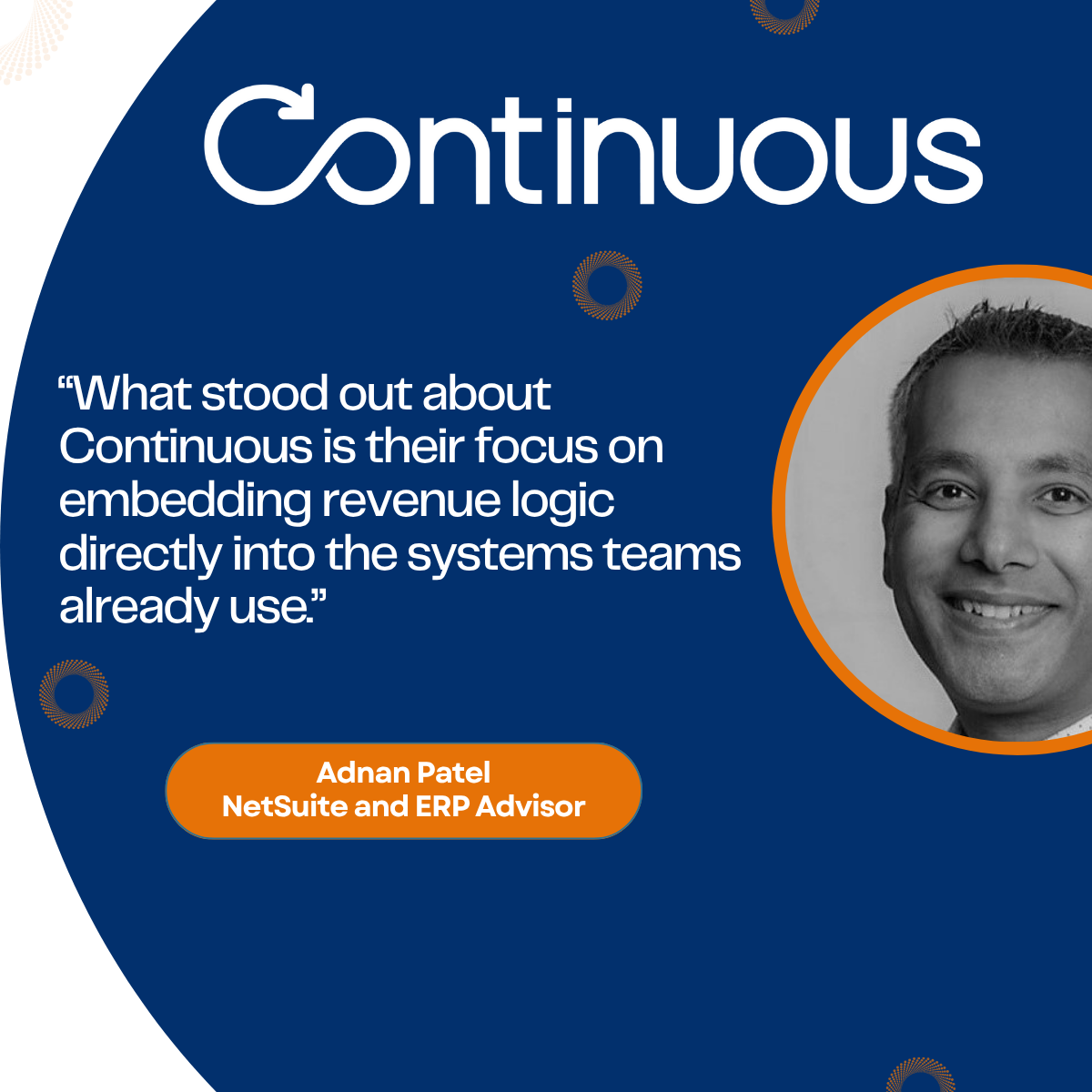
“I’ve spent my career helping companies get more out of NetSuite,” said Adnan Patel. “What stood out about Continuous is their focus on embedding revenue logic directly into the systems teams already use. It’s a smarter way to simplify complexity without adding another tool.”

A Recognized Leader in the NetSuite Ecosystem

Adnan has had a massive impact on the NetSuite ecosystem. He’s the founder of Sixred, an eight-time NetSuite 5-Star Award winner and one of NetSuite’s most respected Solution Providers. Over the course of 18+ years, his team has led more than 1,200 NetSuite implementations across industries, helping organizations scale smarter with cloud ERP.

When Sixred was acquired by Crowe LLP, Adnan took on the role of Principal, where he led Crowe’s global NetSuite practice, built industry accelerators, mentored NetSuite consultants, and helped clients modernize finance and operations with confidence. He’s a familiar face at SuiteWorld and other Oracle NetSuite events, where he’s shared insights on scaling ERP practices and driving successful cloud transformations.

“Adnan understands what works best with scaling ERP systems for growing companies,” said John Banks, Founder and CEO of Continuous. “His applied experience with thousands of NetSuite projects offers a practical, tested perspective as we expand our footprint and continue supporting Salesforce and NetSuite users.”

Building the Bridge Between CRM and ERP

Continuous has always taken a different approach to billing and revenue infrastructure. Our mission is to prove that the most scalable model isn’t a third-party system, but one that extends the CRM and ERP platforms customers already use.

With Salesforce, that means embedding deeply into the Revenue Cloud Advanced experience. Now, with Adnan’s guidance, we’re doing the same within the NetSuite ecosystem.

Whether customers use NetSuite Advanced Financials or SuiteBilling, the goal is the same:
Make usage-based pricing, credit drawdowns, revenue accounting and reporting easier by embedding logic where it belongs.

We see a future where NetSuite customers can manage usage, rating, and billing scenarios without introducing yet another standalone billing system. With Adnan’s experience, we’re building that future on a strong foundation.

What This Means for Our Customers and Partners

Adnan’s involvement will accelerate product development on NetSuite and strengthen how we support system integrators, NetSuite sellers, and implementation partners. It also ensures we’re learning from the best—bringing a practitioner’s lens to every step we take.

If you’re a NetSuite customer exploring usage-based pricing, or a partner helping clients operationalize complex billing models, we’d love to connect. With Adnan on board, we’re more ready than ever to support your success.

Want to learn more about how Continuous supports Salesforce and NetSuite customers?

Get a tailored review of your current architecture and personalized insights on where Continuous can drive the most value.

👉 Fill out this quick form and one of our experts will follow up with your survey—no pressure, no commitment.

You Don’t Need Another Billing System—You Need a Better Approach

Quadrant Graph with Question Mark

For RevOps, sales, and finance teams, this article explains why standalone billing systems fail at scale, and how Embedded Revenue Infrastructure offers a better approach.

TL;DR
- Standalone billing systems emerged to fill gaps when CRM and ERP lacked recurring revenue support.
- Modern pricing complexity exposes the limits of third-system billing architectures.
- Disconnected product catalogs and integrations create errors, delays, and revenue leakage.
- Continuous Embedded Revenue Infrastructure unifies CRM, ERP, and front-office systems into a single approach.

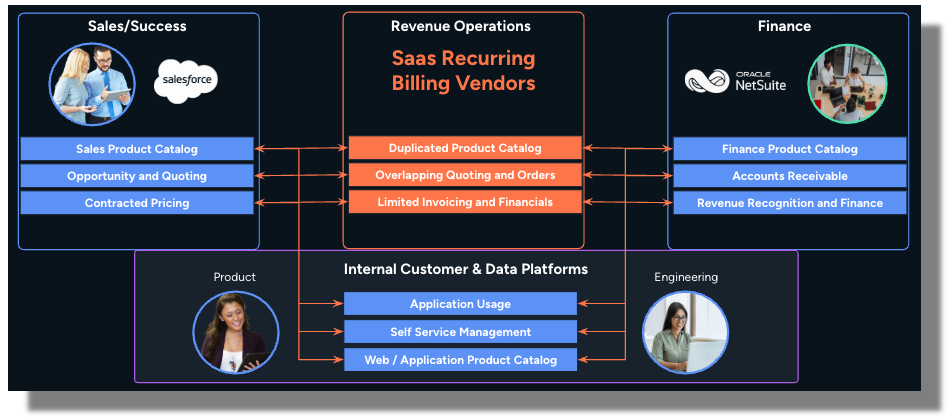
Recurring billing vendors promised simplicity. As businesses shifted toward what became known as the “Subscription Economy,” CRM, ERP, and customer-facing (front-office) systems lacked native support for recurring revenue models, creating operational gaps that gave rise to specialized vendors—”SaaS Recurring Billing“—to bridge the divide.

Today, customer expectations have evolved dramatically. Businesses now face greater complexity as customers demand flexible, personalized options for consuming and paying for products and services. This complexity significantly impacts front-office sales processes and drives downstream billing and reporting challenges.

While CRM and ERP platforms like Salesforce and NetSuite have responded to these evolving demands by continually innovating and enhancing their capabilities, the standalone billing vendors—both legacy providers and new entrants—have largely failed to keep pace. Instead of true innovation, these vendors have continued promoting a “third cloud” model that positions standalone platforms between CRM, ERP, and front-office systems. This outdated approach results in operational fragmentation and duplicated efforts, rather than genuine improvement.

Before exploring why standalone billing platforms inherently struggle, we must first clearly understand the essential pillars of every modern B2B organization’s revenue infrastructure:

CRM, ERP, and Front-Office Systems: Essential Pillars of Revenue Infrastructure
Effective revenue operations depend on three interconnected core platforms:

Infographic Showing CRM, ERP, and Front-Office Systems

CRM Systems: Excel in managing customer relationships, deal structuring, quoting, and flexible pricing management. Salesforce provides robust examples of integrated quoting and subscription management directly within CRM workflows.

ERP Systems: Focused on financial accuracy, compliance, revenue recognition, and accounts receivable. Platforms like NetSuite integrate comprehensive financial management aligned closely with accounting processes.

Customer/Front-Office Systems: Include platforms such as e-commerce, self-service portals, and internal product systems that manage customer engagement, subscriptions, credits, and prepayments, capturing the precise usage data critical for billing and monetization.

Additionally, specialized capabilities such as tax calculation engines, payment gateways, and specialized usage management systems can provide significant value if effectively connected to the core revenue stack. For companies already invested in specialized usage management solutions, leveraging these systems within a unified revenue infrastructure is crucial to ensure seamless interoperability and to avoid redundant or fragmented processes.

Together, these core systems should form a cohesive and unified revenue infrastructure. Effective monetization solutions must complement and enhance these systems—not duplicate or disrupt them.

Why Standalone Billing Platforms Fail to Deliver

Standalone billing platforms typically fall into three categories, each with inherent limitations and a critical shared flaw:

Quote-to-Revenue Platforms: While these newer entrants accurately recognize the importance of cohesive front-to-back-office collaboration, their strategy of replicating pricing, configuration, quoting, billing, revenue recognition, and collections capabilities within a single solution proves impractical at scale. Inevitably, they cannot match the depth and flexibility of dedicated CRM and ERP systems.

Legacy Subscription Management Solutions: Initially built for simple subscription models, these systems struggle significantly with complex usage-based or hybrid monetization strategies. Attempting to address complexity, many legacy vendors developed their own CPQ tools around their proprietary billing catalogs, which are inherently limited compared to modern CPQ systems.

Usage-Based Billing Platforms: These specialized platforms excel at usage rating but struggle to clearly define how their capabilities seamlessly integrate into broader CRM, ERP, and front-office ecosystems, often resulting in redundant configurations and operational friction.

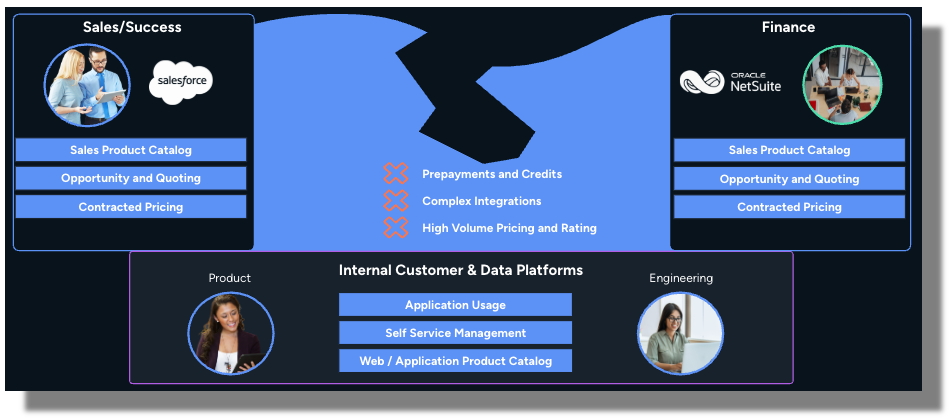
The fundamental flaw shared by these SaaS Recurring Billers is their reliance on multiple disconnected product catalogs. Defining sales rules in CRM and separately redefining them in billing systems inevitably introduces complexity, data discrepancies, and costly integration challenges.

Infographic Showing SaaS Recurring Billing Vendor Challenges

Symptoms Your Revenue Infrastructure Is Breaking Down

How do you know if your revenue infrastructure is failing to support your business effectively? Look for these recognizable symptoms:

  • Forced Manual Handoffs: Sales and finance teams repeatedly re-enter or manually adjust data because your sales and billing systems don’t talk to each other efficiently.
  • Slow Pricing and Packaging Changes: Launching new pricing strategies or monetization models requires extensive IT projects and lengthy configurations.
  • Billing Inaccuracies and Revenue Leakage: Persistent discrepancies between quoted prices and billed amounts cause customer frustration and lost revenue.
  • Internal Team Frustration: Sales, finance, and revenue operations teams are misaligned, each blaming the other for process inefficiencies and delays.
  • Engineering and IT Overload: Significant resources are spent maintaining fragile custom integrations and resolving data conflicts rather than focusing on strategic initiatives.

These symptoms aren’t just operational headaches—they’re clear indicators that your revenue infrastructure needs immediate attention.businesses to build complex integrations, making it harder to achieve a seamless sales-to-finance workflow.

The Future: Introducing Embedded Revenue Infrastructure

Infographic Showing Continuous Revenue Infrastructure and a Seamless Workflow

The true issue is not any single billing solution but the outdated concept of a standalone “third cloud.” Originally necessary when CRM, ERP, and front-office systems were immature, this approach now struggles under modern monetization demands.

The future of revenue management demands Embedded Revenue Infrastructure—an innovative model that integrates advanced pricing, usage tracking, billing, and revenue logic directly into existing CRM, ERP, and front-office systems. This approach eliminates redundant catalogs and complex integrations, creating a unified, agile, and scalable foundation for revenue operations.

In our next blog, we’ll dive deeper into Embedded Revenue Infrastructure, explore its transformative potential, and show precisely how it addresses these critical operational challenges.

Ready to simplify your sales and finance processes?

Stop juggling fragmented systems and costly integrations. At Continuous, we unify your sales and finance workflows by building on the trusted CRM and ERP platforms you already use.

Request your free Revenue Operations Assessment from Continuous and get expert insights tailored specifically to your business—no cost, no commitment. Simply fill out this quick form, and one of our experts will reach out with your assessment survey.

Rethinking the Recurring Billing Status Quo: Why Analyst Reports Highlight a Broken Market

Quadrant Graph with Question Mark

Analyst reports from Gartner and Forrester expose a deeper issue in recurring billing. This article is for RevOps, Finance, and IT leaders evaluating billing platforms who want to understand why standalone billing systems create complexity, and what a better model looks like.

TL;DR
- Analyst reports reveal a recurring billing market built around standalone billing systems.
- These platforms attempt to own sales, billing, and finance workflows that already belong in CRM and ERP.
- The result is fragmented data, costly integrations, and rigid architectures that slow change.
- Recurring billing works best when embedded directly into systems like Salesforce and NetSuite.
- Continuous challenges the standalone billing model by extending CRM and ERP instead of replacing them.

On August 6, 2024, Gartner released their latest Magic Quadrant for Recurring Billing Applications followed by Forrester’s The Recurring Billing Solutions Landscape, Q3 2024 on September 3, 2024. These reports assess a competitive landscape that has been evolving for over a decade, evaluating vendors based on their ability to manage the entire sales-to-finance process for recurring billing.

While these reports are valuable, they also reveal a deeper problem in the industry—a problem rooted in how standalone billing systems approach the recurring billing challenge. At Continuous, we believe the way the market has evolved has fundamentally misunderstood the nature of the recurring billing problem, making it difficult for analysts to cover accurately and even more painful for customers to select the right solutions.

Both the Gartner and Forrester reports rank vendors based on their ability to handle the entire recurring billing lifecycle, which includes tasks such as:

Sales Process and Quoting:
Creating flexible pricing models and accurate quotes within the sales cycle, ensuring they align seamlessly with both CRM and billing systems.

Contracting:
Managing the transition from quoting to contracts, including drafting, signing, and handling amendments or renewals, while integrating pricing and terms from the sales process.

Service Provisioning:
Setting up and activating services according to contract terms, tracking usage in real-time to ensure accurate billing.

Usage Data Collection and Rating:
Capturing, mediating, and rating usage data in real-time, applying pricing rules to ensure accurate and scalable billing for consumption-based models.

Billing and Invoice Generation:
Consolidating one time, periodic and usage charges into detailed invoices, ensuring timely delivery to customers via their preferred channels.

Payment Processing:
Facilitating payment collection, managing recurring payments, and ensuring accurate reconciliation with financial systems.

Revenue Recognition and Financial Reporting:
Ensuring compliance with accounting standards by accurately recognizing revenue and providing detailed financial reports that integrate with the ERP system.

These tasks encompass a wide range of functions traditionally handled by CRM (Sales) and ERP (Finance) platforms. However, over the past decade, specialized billing vendors have emerged to address gaps in these systems. Their solution? Introduce a “billing system of record” – a third platform that sits between CRM and ERP to manage these critical processes. This shift has created a new category of software, one that analysts like Gartner, Forrester, IDC, and others are now tasked with evaluating.

The Rise of Standalone Billing Systems: A New Category Emerges

Around 2010, a belief took hold that CRM and ERP vendors couldn’t handle the increasing complexity of billing as companies shifted from traditional perpetual license models to subscription billing models. In response, a range of specialized billing systems began emerging, offering solutions to support this new “Subscription Economy”.

By 2017, this new category of standalone billing systems had matured enough to receive formal analyst coverage, leading to the release of reports like the Gartner Magic Quadrant and Forrester Wave. These vendors promised to simplify recurring billing by offering a third-party solution that could manage the billing lifecycle independently. This trend accelerated as consumption and prepaid credit models gained popularity, leading to the crowded market landscape we see today.

But here’s the issue: billing is not, and never should be, a standalone process. It’s intertwined with sales, finance, and customer management. When billing is siloed into a separate platform, businesses are forced to build complex integrations, juggle multiple systems, and deal with costly maintenance—problems that CRM and ERP systems were originally designed to solve.

What These Reports Reveal: Complexity, Not Simplicity

The criteria used by Gartner and Forrester to evaluate vendors include tasks that traditionally belong within the domains of CRM and ERP systems. However, instead of enhancing these core systems, standalone billing vendors have introduced an unnecessary third layer of complexity.

Consider the following:

  • Quote Creation and Negotiation are native functions of CRM systems, where sales teams manage customer interactions and quote data from all channels should be stored.
  • Contract Drafting and Management should flow naturally from CRM to ERP, enabling seamless financial reporting.
  • Invoice Creation and Payment Processing are core functions of billing that should reside within the ERP or CRM system, where financial and sales data is already managed.

By positioning a third-party billing system as essential, standalone vendors have shifted what should be natural extensions of CRM and ERP into fragmented processes. This fragmentation forces businesses to build complex integrations, making it harder to achieve a seamless sales-to-finance workflow.

The Problem with Standalone Billing Systems

At Continuous, we believe the current approach taken by standalone billing vendors is fundamentally flawed. Instead of simplifying processes, these vendors create friction by placing themselves as overlapping solutions with the CRM and ERP systems they are also dependent on. This introduces costly, cumbersome integrations that are difficult to maintain—particularly as pricing and packaging models evolve.

There’s no inherent reason why traditional sales and financial processes should be managed by a separate system when sales and finance teams have already invested in systems like Salesforce and NetSuite. Standalone billing vendors want businesses to believe they must control these processes, but the reality is that doing so makes their systems “stickier” by requiring complex customizations and significant services investments. The end result for customers of these vendors are deployments that are:

  • Expensive to integrate: Building and maintaining integrations between CRM, ERP, and standalone billing systems often requires costly services and custom work.
  • Rigid and limiting: Once integrations are built, they become rigid, making it difficult for businesses to adapt to new pricing models or market changes without extensive rework.
  • Manual and error-prone: Despite these integrations, many billing processes still require manual intervention, leading to inefficiencies and potential errors in financial reporting and customer invoicing.

This is why the current market is so difficult for analysts to cover: the premise of a standalone billing system is inherently flawed. The criteria that Gartner and Forrester use to evaluate these vendors encompass functions that should naturally belong in core CRM and ERP systems. However, standalone vendors pull these critical processes into a third cloud, which struggles to work effectively alongside CRM or ERP solutions.

The Continuous Approach: Back to Common Sense

At Continuous, we challenge this status quo. We believe that the best way to solve the recurring billing problem is to go back to what was previously common sense: there should not be a third cloud in between CRM and ERP.

Instead, we advocate for enhancing the core applications that B2B companies already rely on—CRM for sales and ERP for finance—and supplementing them with a powerful calculation engine that integrates with customers’ internal platforms. By doing this, we enable a truly unified quote-to-consumption process that is:

  • Easier to maintain.
  • More flexible as pricing and packaging needs evolve.
  • Less expensive to deploy, reducing both software license and integration costs.

Conclusion: Challenging the Status Quo

The release of the Gartner Magic Quadrant and Forrester Wave reports highlights how deeply entrenched the idea of standalone billing systems has become. But as businesses increasingly adopt complex pricing models and usage-based billing, the limitations of these systems become more apparent.

At Continuous, we believe there’s a better way—one that embeds billing awareness directly into the tools businesses use every day, rather than introducing another layer of complexity. By rethinking how billing should work, we can simplify the process for businesses and create a more efficient, flexible future for recurring billing.

Ready to simplify your sales and finance processes?

Stop juggling fragmented systems and costly integrations. At Continuous, we unify your sales and finance workflows by building on the trusted CRM and ERP platforms you already use.

If you’re ready to move beyond the limitations of standalone billing systems, let’s talk. Explore how Continuous can streamline your quote-to-cash process and help your business scale with confidence. Find out more today at: Product | Continuous Technologies.