This article is for finance and RevOps teams running usage-based pricing on NetSuite.
For many NetSuite customers—whether you’re using Advanced Financials, SuiteBilling, or Zone Advanced Billing—subscription billing runs smoothly. But add high-volume usage pricing, and the process can buckle under millions of records. What was once simple becomes a scramble of error-prone spreadsheets, delayed invoices, and costly disputes.
We see it everywhere: finance teams hitting transaction and API limits, or relying on brittle workarounds that can’t scale. And it’s not just a NetSuite challenge—Salesforce Revenue Cloud Advanced Billing (RCA-B) customers face the same last-mile problem: getting clean, rated usage data into the system without slowing everything down.
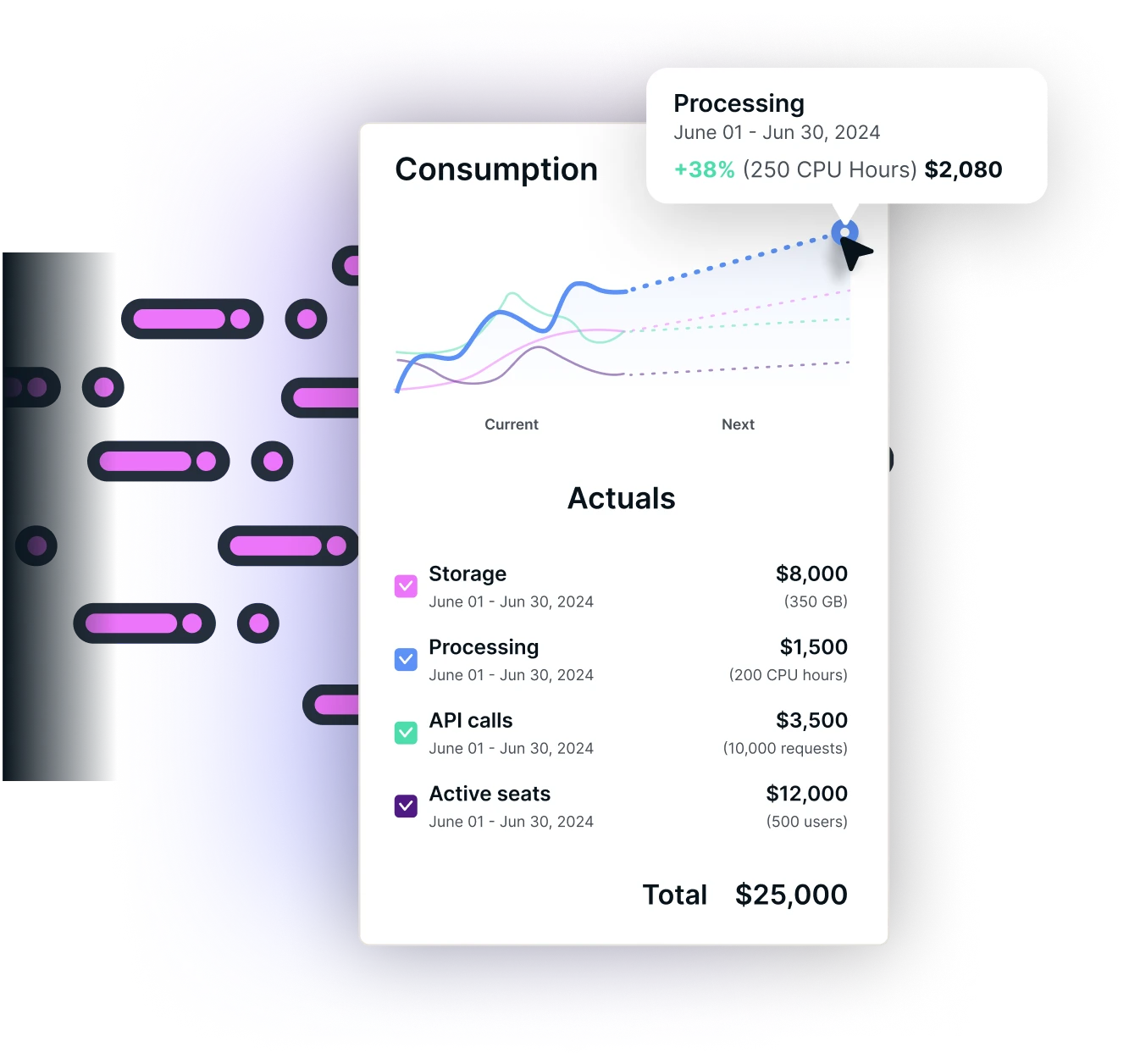
That’s why we built Continuous. Our platform pre-processes and rates usage before it reaches your billing application, condensing millions—or even billions—of events into a single, accurate transaction NetSuite (Advanced Financials, SuiteBilling, or Zone Advanced Billing) can handle with zero errors and no drama.
With Continuous, you can:
Stay within platform limits – Avoid hitting NetSuite’s transaction and API thresholds, even with massive data volumes.
Eliminate manual errors – Replace spreadsheets and manual rating with automated, accurate calculations.
Accelerate cash flow – Get invoices out faster with zero disputes, keeping customers happy and revenue on track.
The result: No limits. No late invoices. No disputes. Just a clean, scalable path to growth.
For finance and RevOps teams using NetSuite, this article explains why revenue logic must be embedded earlier in the sales process, and how revenue infrastructure supports usage-based pricing without pulling finance out of its system of record.
TL;DR
-Finance teams are often brought in too late, forcing manual reconciliation and audit risk inside NetSuite.
- Revenue logic frequently lives outside Salesforce and NetSuite, creating misalignment between sales and finance.
- Standalone billing systems add complexity by pulling finance out of its system of record.
- Revenue infrastructure embeds pricing, billing, and revenue logic upstream so NetSuite receives clean, trusted data from day one.
Introduction
Before joining Continuous, I worked as a public accountant and auditor. Quarter-end always brought the same scramble: reconcile revenue schedules, trace usage back to pricing, and figure out why what was sold didn’t match what showed up in NetSuite.
The common thread was simple: finance was brought in too late. By the time we saw the deal, fixing it meant more manual work, more risk, and more delays.
At Continuous, we’re solving that problem head-on. We deliver revenue infrastructure for NetSuite customers who need to manage complex pricing without pulling finance out of their system of record. That’s exactly why we partnered with NetSuite.
The Disconnect We’ve All Seen
Most B2B companies run on Salesforce and NetSuite. Sales lives in CRM. Finance lives in ERP.
But what connects those systems — the pricing terms, calculations, billing logic, and revenue triggers — often lives outside of both.
Instead, it gets scattered across spreadsheets, hardcoded in point solutions, or duplicated in a standalone billing system. Finance teams are often left performing calculations manually, or even worse, asked to pull finance processes out of NetSuite entirely and into a new billing engine that introduces more complexity instead of solving it.
This disconnect creates chaos across the entire process. Finance teams get stuck cleaning up revenue logic they didn’t control. Sales teams are slowed down by rules that don’t align with how they sell. The numbers are unclear, and trust erodes on both sides.
Why NetSuite?
This is a fundamental architectural shift from how billing has been handled for years.
Most standalone billing vendors ask you to move your teams and processes off of your core systems and onto theirs. That model was introduced when subscriptions took off, and it didn’t work well even then. It’s an even worse fit now, as companies adopt more dynamic models like usage billing, digital wallets, and prepaid credits.
Those vendors want to become the new system of record. We don’t.
We partnered with NetSuite because it’s where finance teams already live. It is the system of record, and it should stay that way.
But for NetSuite to work, it needs clean, structured data from upstream. Not after the contract is signed. Not when the first invoice is due. At the quote.
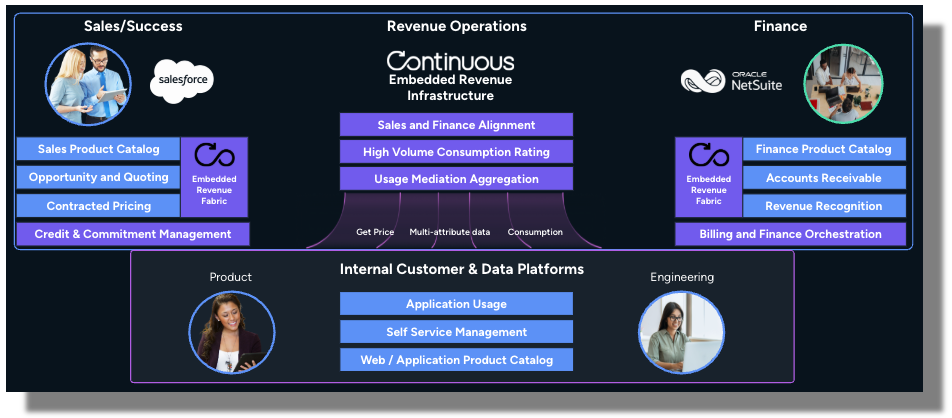
That’s where Continuous comes in. We embed revenue logic into the sales process, whether it happens in Salesforce, self-service commerce, or through a partner deal, so NetSuite receives everything it needs to generate accurate invoices and recognize revenue the right way.
We don’t replace NetSuite or Salesforce. We make them work better together.
Align Salesforce and NetSuite without duplicating catalogs
Support usage-based pricing, pooled credits, and prepaid drawdowns
Ensure billing and revenue logic is captured correctly at the quote stage
Avoid the need for a separate billing system or downstream custom work
This is not just another integration. It is revenue infrastructure for NetSuite, designed to support complex pricing and billing at scale. It’s an embedded layer that ensures what happens in Salesforce flows cleanly into NetSuite, without surprises.
A Better Way Forward
With Continuous, finance stays in NetSuite. Sales keeps the flexibility they need, whether they are quoting in Salesforce, enabling partner channels, or powering a self-service flow. And both sides stay aligned, even as pricing models get more complex.
Whether you’re dealing with usage billing, hybrid subscriptions, pooled credits, digital wallets, or just trying to avoid a reconciliation nightmare, Continuous helps you stay ahead of it.
If you’ve ever been stuck in auditor mode at quarter-end, I get it. That’s the problem we’re solving.
What’s Next
Our SuiteApp is now live, and we’re excited to help teams bring sales and finance closer together inside NetSuite.
If you’re heading to SuiteWorld, we’d love to show you what we’ve built.
And if your team is still cleaning up billing logic after the fact, maybe it’s time to bring finance in earlier and make it strategic from the start.
For finance and RevOps teams using NetSuite, this article explains how embedding revenue operations into sales processes helps automate pricing, billing, and revenue without adding standalone billing tools.
TL;DR
- NetSuite customers are often pushed to add standalone billing tools to handle complex pricing and revenue workflows.
- Embedding revenue operations earlier in the sales cycle aligns quoting, billing, and revenue recognition inside NetSuite.
- Automated pricing, rating, billing, and credit tracking reduce manual work and compliance risk.
- A unified revenue operations approach gives finance real-time visibility without duplications or integrations.
You invested heavily in NetSuite, so why are you constantly pressured to add yet another specialized billing or revenue tool? Imagine if NetSuite could effortlessly handle any pricing, rating, billing, and revenue scenario without complicated integrations, duplicated workflows, or restrictions on your sales team’s flexibility.
Achieving this requires finance teams to proactively embed revenue operations directly into your sales processes from the outset, while also enhancing NetSuite’s capabilities to handle advanced rating and calculations not supported natively. Here’s exactly what you can do to strategically transform your NetSuite revenue operations:
Quote-to-Cash Alignment and Control
1. Proactively Embed Revenue Operations at the Start of the Sales Cycle
Integrate finance directly into your sales channels—including Salesforce and partner channels—to unify financial controls and streamline your end-to-end revenue operations.
Impact: Reduce manual tasks, simplify integration handoffs, minimize errors, and ensure consistency from quoting to billing.
2. Align Revenue Recognition Directly with Sales Contracts
Integrate revenue recognition rules from Salesforce or other CRM systems directly into NetSuite, automating and simplifying compliance with ASC 606 and IFRS 15.
3. Replace Specialized Usage-Based Billing Vendors and Manual Rating with Embedded Automation
Implement scalable, automated usage-rating capabilities directly within NetSuite to translate complex pricing models seamlessly into accurate billing processes.
Impact: Simplify rating processes, reduce manual errors, and focus finance resources on strategic growth initiatives.
4. Fully Automate Revenue Processes to Accelerate Cash Flow
Eliminate manual invoicing, prorations, and billing adjustments by embedding automated processes directly within NetSuite.
Impact: Accelerate billing cycles, improve cash flow, and increase productivity and accuracy within your finance operations.
Real-Time Financial Visibility and Insights
5. Establish Real-Time Tracking of Prepaid Credits
Transition away from manual spreadsheet tracking by embedding real-time credit balance management within NetSuite, providing precise and reliable financial insights. Bonus: Ensure sales and customer success teams have real-time access to credit balances, enabling proactive management and customer engagement.
Impact: Ensure accurate credit management, eliminate revenue leakage, and enhance financial transparency.
6. Integrate Real-Time Revenue Analytics into Your Dashboards
Embed comprehensive analytics within NetSuite dashboards to deliver actionable insights into customer behaviors, usage trends, and overall revenue performance.Impact: Make informed, rapid decisions that proactively drive revenue growth and strengthen customer retention.
Future-Proof Your Revenue Stack with Continuous
Traditionally, achieving these revenue operations improvements required substantial investments in customizations, complex integrations, and ongoing maintenance. Continuous, however, uniquely addresses this challenge as the world’s first embedded revenue infrastructure offering. Our embedded technology within Salesforce and NetSuite delivers precisely what standalone SaaS recurring billing vendors have promised but struggled to deliver: seamless integration, simplified revenue management, and genuine flexibility.
Ready to simplify your NetSuite revenue processes immediately? Schedule a personalized demo today and see exactly how Continuous transforms your capabilities, enhances data consistency, and delivers immediate value.
Continuous empowers your finance team to automate complex processes, achieve seamless integration, and gain actionable, real-time insights—all without standalone billing systems.
Take control, simplify operations, and strategically position your finance team to lead growth with embedded revenue infrastructure.
For NetSuite customers and partners, this announcement explains why Adnan Patel joined Continuous as a strategic advisor and how his experience strengthens our NetSuite and ERP strategy.
TL;DR
- Continuous welcomed Adnan Patel as a strategic advisor focused on NetSuite and ERP.
- Adnan brings more than 18 years of NetSuite experience and leadership across 1,200 plus implementations.
- His guidance strengthens how Continuous supports embedded revenue infrastructure inside NetSuite.
- Customers and partners benefit from deeper NetSuite expertise and practitioner-led strategy..
At Continuous, we’re known for our innovations in recurring revenue. We’ve helped leading companies shift from subscriptions to usage, from custom billing to embedded revenue infrastructure, always with a focus on making Salesforce work better for Sales, RevOps, and Finance teams.
Today, we’re excited to share that Adnan Patel is joining Continuous as a Strategic Advisor, focused on NetSuite and ERP.
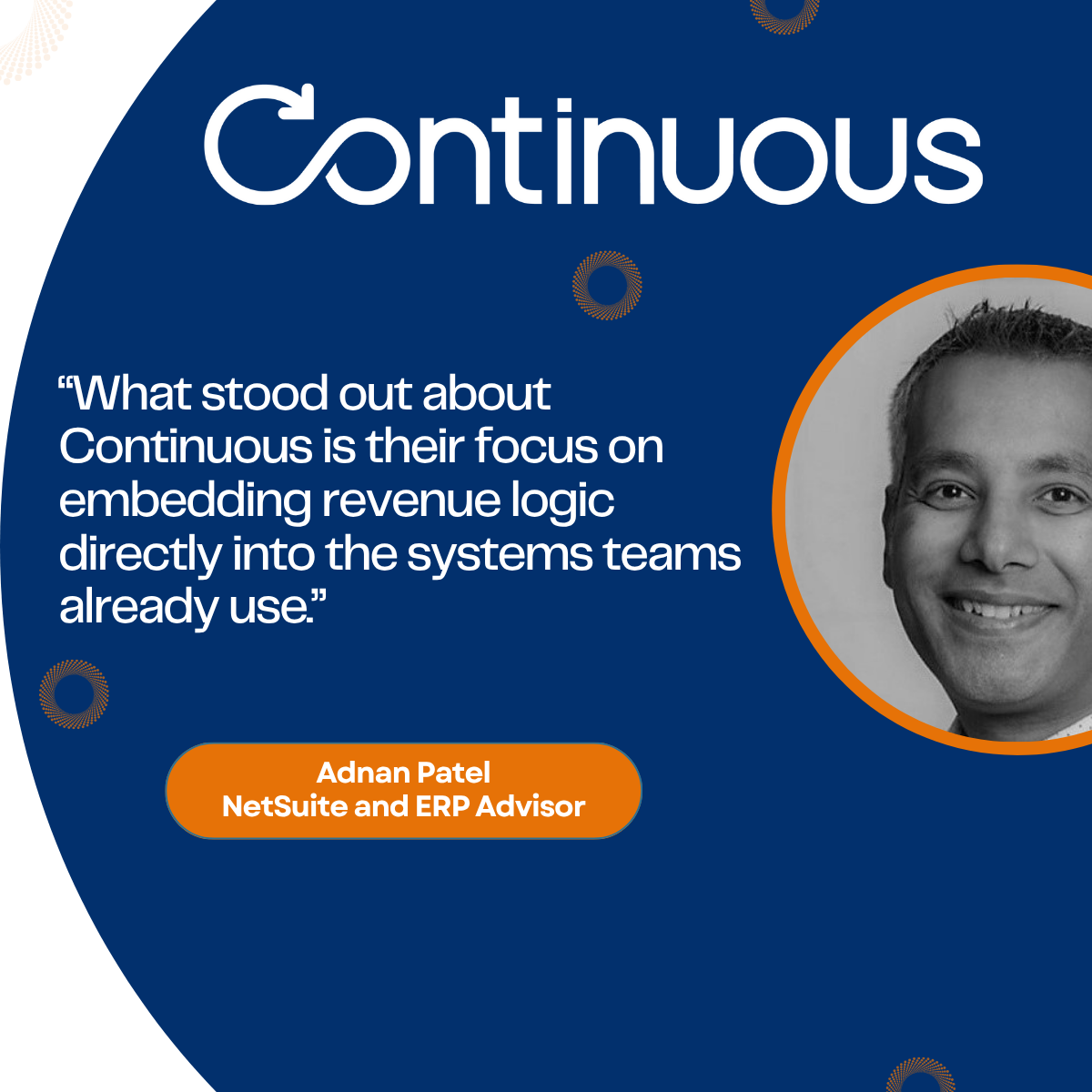
“I’ve spent my career helping companies get more out of NetSuite,” said Adnan Patel. “What stood out about Continuous is their focus on embedding revenue logic directly into the systems teams already use. It’s a smarter way to simplify complexity without adding another tool.”
A Recognized Leader in the NetSuite Ecosystem
Adnan has had a massive impact on the NetSuite ecosystem. He’s the founder of Sixred, an eight-time NetSuite 5-Star Award winner and one of NetSuite’s most respected Solution Providers. Over the course of 18+ years, his team has led more than 1,200 NetSuite implementations across industries, helping organizations scale smarter with cloud ERP.
When Sixred was acquired by Crowe LLP, Adnan took on the role of Principal, where he led Crowe’s global NetSuite practice, built industry accelerators, mentored NetSuite consultants, and helped clients modernize finance and operations with confidence. He’s a familiar face at SuiteWorld and other Oracle NetSuite events, where he’s shared insights on scaling ERP practices and driving successful cloud transformations.
“Adnan understands what works best with scaling ERP systems for growing companies,” said John Banks, Founder and CEO of Continuous. “His applied experience with thousands of NetSuite projects offers a practical, tested perspective as we expand our footprint and continue supporting Salesforce and NetSuite users.”
Building the Bridge Between CRM and ERP
Continuous has always taken a different approach to billing and revenue infrastructure. Our mission is to prove that the most scalable model isn’t a third-party system, but one that extends the CRM and ERP platforms customers already use.
With Salesforce, that means embedding deeply into the Revenue Cloud Advanced experience. Now, with Adnan’s guidance, we’re doing the same within the NetSuite ecosystem.
Whether customers use NetSuite Advanced Financials or SuiteBilling, the goal is the same: Make usage-based pricing, credit drawdowns, revenue accounting and reporting easier by embedding logic where it belongs.
We see a future where NetSuite customers can manage usage, rating, and billing scenarios without introducing yet another standalone billing system. With Adnan’s experience, we’re building that future on a strong foundation.
What This Means for Our Customers and Partners
Adnan’s involvement will accelerate product development on NetSuite and strengthen how we support system integrators, NetSuite sellers, and implementation partners. It also ensures we’re learning from the best—bringing a practitioner’s lens to every step we take.
If you’re a NetSuite customer exploring usage-based pricing, or a partner helping clients operationalize complex billing models, we’d love to connect. With Adnan on board, we’re more ready than ever to support your success.
Want to learn more about how Continuous supports Salesforce and NetSuite customers?
Get a tailored review of your current architecture and personalized insights on where Continuous can drive the most value.
👉 Fill out this quick form and one of our experts will follow up with your survey—no pressure, no commitment.