Tag: Finance Operations

Making NetSuite Work for Modern Finance Teams: A Q&A with Caitlin Swofford

Caitlin Swofford, VP of Solution Delivery

A Q&A for finance and RevOps leaders on delivery, embedded revenue infrastructure, and how to fix quote-to-cash in NetSuite without adding risk or new systems.

TL;DR
- Quote-to-cash breaks when finance teams are forced to manage complexity across disconnected systems.
- Adding another billing or monetization platform increases delivery risk instead of reducing it.
- Embedded revenue infrastructure keeps Salesforce and NetSuite aligned without spreadsheets or manual handoffs.
- Continuous helps finance teams support modern pricing models while maintaining control, auditability, and trust in the numbers.


Continuous is scaling its NetSuite presence and strengthening delivery to match. Caitlin Swofford, VP of Solution Delivery at Continuous, brings deep experience spanning NetSuite administration, Salesforce, enterprise applications, consulting, and engineering leadership.

Her focus is simple. Help finance teams make quote-to-cash work as pricing models grow more complex, without adding more systems, risk, or spreadsheet-driven workarounds.

We sat down with Caitlin to talk about what drew her to Continuous, how she approaches delivery as a strategic lever, and what it really takes to make NetSuite work for modern finance teams.

You’ve had a unique path into NetSuite. What led you here?

I didn’t start in finance or ERP. I started in marketing operations and marketing technologies, working with tools like Marketo, Eloqua, and even Siebel CRM early on. My first exposure to NetSuite came in a high-growth environment, and the more I saw it, the more intrigued I became. It was powerful, configurable, and deeply connected to how the business actually runs.

When an opportunity opened up to step into a NetSuite administrator role, I jumped at it. From there, I expanded into owning broader enterprise applications, including NetSuite and Salesforce, with a strong focus on compliance, change management, SDLC, and segregation of duties. Later, I shifted into consulting and services, partnering directly with customers to implement and optimize NetSuite in real-world environments.

That mix of being both a system owner and a services partner really shapes how I think about delivery today.

What made Continuous the right next step?

Two things stood out to me. The people and the product.

Culture matters a lot to me, especially as a remote worker. I want to feel like I’m part of a team moving in the same direction and building something meaningful. Continuous gave me that feeling from day one.

The product mission was equally compelling. I’ve seen how often quote-to-cash becomes a bottleneck as pricing models evolve. What stood out is that Continuous is not about adding another system. It is about improving how the systems finance teams already rely on work together.

How do you explain Continuous Revenue Fabric to finance leaders dealing with complexity across Salesforce and NetSuite?

I think of Revenue Fabric as something that embeds into your existing tools and helps them work together the way they were meant to.

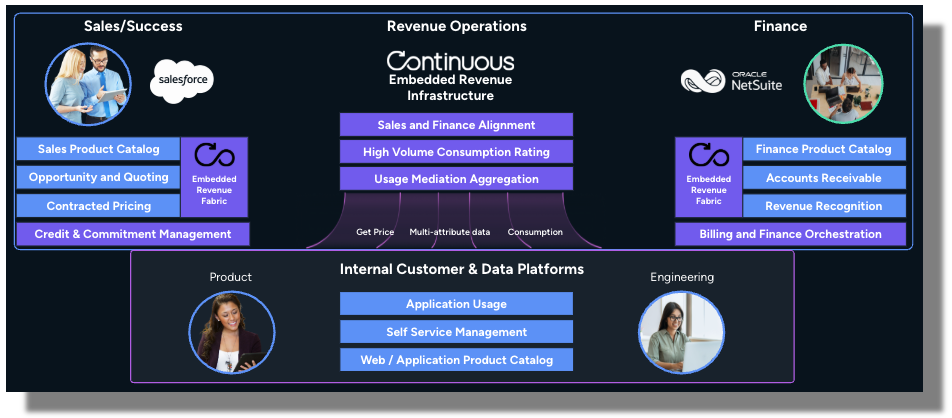
If sales is quoting in Salesforce and finance is managing orders, billing, and revenue in NetSuite, those systems often don’t speak the same language, especially with usage-based or hybrid pricing. Continuous Revenue Fabric enables that flow end to end so sales can stay in Salesforce, finance can stay in NetSuite, and the handoffs actually work without forcing teams into a third standalone system.

Why does embedded revenue infrastructure matter from a delivery perspective?

From a delivery standpoint, the biggest risk I see is introducing more complexity in the name of solving complexity.

Standalone billing platforms often introduce a separate operating layer with their own logic, workflows, and reconciliation processes. Even when data syncs back to Salesforce or NetSuite, teams still end up managing pricing rules, billing behavior, and exceptions outside the systems they rely on day to day. That fragmentation is where delivery risk shows up.

Embedded infrastructure keeps the flow where it belongs, between the systems finance and sales already trust. That leads to cleaner implementations, fewer points of failure, and more confidence in the numbers downstream.

Where do you most often see misalignment between sales and finance?

Sales and finance are working on the same deal, but with very different objectives. Sales needs speed and flexibility to support the customer and close the deal. Finance needs clean, auditable data they can rely on to bill, recognize revenue, and close the books.

Misalignment shows up when processes force extra work. Fields that exist just because, manual handoffs, or one-off steps that don’t reflect how the business actually sells. The fix is treating quote-to-cash as one continuous motion so both teams get what they need without unnecessary workarounds.

As VP of Solution Delivery, what are you focused on building right now?

My focus is on helping customers be successful with Continuous, not just at go-live, but over the long term.

That means partnering closely with customers to understand how they actually use NetSuite and Salesforce, making sure implementations reduce risk instead of adding it, and helping teams build a foundation they can scale as their business evolves. Success looks like trust in the system and confidence in the data.

What excites you most about the opportunity ahead for Continuous?

There are so many companies running on NetSuite and Salesforce that still struggle to make quote-to-cash work smoothly, and that complexity is only increasing.

Continuous has a real opportunity to help finance teams simplify that reality through cleaner handoffs, less manual work, and a more connected view of revenue. Helping customers build that foundation and grow on top of it is what excites me most.

Finally, outside of work, what’s something people would be surprised to learn about you?

I recently became certified as a Maine Master Naturalist, a ten-month program focused on nature education. I volunteer with a wildlife rehabilitation center, and my areas of focus are birds and mammal tracking. It’s what I spend a lot of my nights and weekends doing.


As Continuous continues to grow in the NetSuite ecosystem, Caitlin is helping shape how the company shows up for finance teams that need more than another system. Her focus is clear. Make NetSuite work the way modern finance teams need it to work. Reduce risk in delivery. Simplify quote-to-cash. And build a foundation that supports scale as revenue models evolve.

It’s a delivery-first approach grounded in real-world experience, and one that reflects Continuous’ broader commitment to helping finance teams move from managing complexity to driving confidence and growth.
Connect with Caitlin on LinkedIn.

Why We Partnered with NetSuite: Making Finance Strategic from the Start

Continuous and NetSuite

For finance and RevOps teams using NetSuite, this article explains why revenue logic must be embedded earlier in the sales process, and how revenue infrastructure supports usage-based pricing without pulling finance out of its system of record.

TL;DR
-Finance teams are often brought in too late, forcing manual reconciliation and audit risk inside NetSuite.
- Revenue logic frequently lives outside Salesforce and NetSuite, creating misalignment between sales and finance.
- Standalone billing systems add complexity by pulling finance out of its system of record.
- Revenue infrastructure embeds pricing, billing, and revenue logic upstream so NetSuite receives clean, trusted data from day one.


Introduction

Before joining Continuous, I worked as a public accountant and auditor. Quarter-end always brought the same scramble: reconcile revenue schedules, trace usage back to pricing, and figure out why what was sold didn’t match what showed up in NetSuite.

The common thread was simple: finance was brought in too late. By the time we saw the deal, fixing it meant more manual work, more risk, and more delays.

At Continuous, we’re solving that problem head-on. We deliver revenue infrastructure for NetSuite customers who need to manage complex pricing without pulling finance out of their system of record. That’s exactly why we partnered with NetSuite.

The Disconnect We’ve All Seen

Most B2B companies run on Salesforce and NetSuite. Sales lives in CRM. Finance lives in ERP.

But what connects those systems — the pricing terms, calculations, billing logic, and revenue triggers — often lives outside of both.

Instead, it gets scattered across spreadsheets, hardcoded in point solutions, or duplicated in a standalone billing system. Finance teams are often left performing calculations manually, or even worse, asked to pull finance processes out of NetSuite entirely and into a new billing engine that introduces more complexity instead of solving it.

This disconnect creates chaos across the entire process. Finance teams get stuck cleaning up revenue logic they didn’t control. Sales teams are slowed down by rules that don’t align with how they sell. The numbers are unclear, and trust erodes on both sides.

Why NetSuite?

This is a fundamental architectural shift from how billing has been handled for years.

Most standalone billing vendors ask you to move your teams and processes off of your core systems and onto theirs. That model was introduced when subscriptions took off, and it didn’t work well even then. It’s an even worse fit now, as companies adopt more dynamic models like usage billing, digital wallets, and prepaid credits.

Those vendors want to become the new system of record. We don’t.

We partnered with NetSuite because it’s where finance teams already live. It is the system of record, and it should stay that way.

But for NetSuite to work, it needs clean, structured data from upstream. Not after the contract is signed. Not when the first invoice is due. At the quote.

That’s where Continuous comes in. We embed revenue logic into the sales process, whether it happens in Salesforce, self-service commerce, or through a partner deal, so NetSuite receives everything it needs to generate accurate invoices and recognize revenue the right way.

We don’t replace NetSuite or Salesforce. We make them work better together.

What We Built

The Continuous NetSuite SuiteApp is designed to support finance from day one:

  • Align Salesforce and NetSuite without duplicating catalogs
  • Support usage-based pricing, pooled credits, and prepaid drawdowns
  • Ensure billing and revenue logic is captured correctly at the quote stage
  • Avoid the need for a separate billing system or downstream custom work

This is not just another integration. It is revenue infrastructure for NetSuite, designed to support complex pricing and billing at scale. It’s an embedded layer that ensures what happens in Salesforce flows cleanly into NetSuite, without surprises.

A Better Way Forward

With Continuous, finance stays in NetSuite. Sales keeps the flexibility they need, whether they are quoting in Salesforce, enabling partner channels, or powering a self-service flow. And both sides stay aligned, even as pricing models get more complex.

Whether you’re dealing with usage billing, hybrid subscriptions, pooled credits, digital wallets, or just trying to avoid a reconciliation nightmare, Continuous helps you stay ahead of it.

If you’ve ever been stuck in auditor mode at quarter-end, I get it. That’s the problem we’re solving.

What’s Next

Our SuiteApp is now live, and we’re excited to help teams bring sales and finance closer together inside NetSuite.

If you’re heading to SuiteWorld, we’d love to show you what we’ve built.

And if your team is still cleaning up billing logic after the fact, maybe it’s time to bring finance in earlier and make it strategic from the start.

Want to see how it works? Book a quick demo or schedule time with our team at SuiteWorld.

Beyond Billing: How Finance Leaders Are Revolutionizing NetSuite Revenue Operations

Continuous and NetSuite

For finance and RevOps teams using NetSuite, this article explains how embedding revenue operations into sales processes helps automate pricing, billing, and revenue without adding standalone billing tools.

TL;DR
- NetSuite customers are often pushed to add standalone billing tools to handle complex pricing and revenue workflows.
- Embedding revenue operations earlier in the sales cycle aligns quoting, billing, and revenue recognition inside NetSuite.
- Automated pricing, rating, billing, and credit tracking reduce manual work and compliance risk.
- A unified revenue operations approach gives finance real-time visibility without duplications or integrations.

You invested heavily in NetSuite, so why are you constantly pressured to add yet another specialized billing or revenue tool? Imagine if NetSuite could effortlessly handle any pricing, rating, billing, and revenue scenario without complicated integrations, duplicated workflows, or restrictions on your sales team’s flexibility.

Achieving this requires finance teams to proactively embed revenue operations directly into your sales processes from the outset, while also enhancing NetSuite’s capabilities to handle advanced rating and calculations not supported natively. Here’s exactly what you can do to strategically transform your NetSuite revenue operations:

Quote-to-Cash Alignment and Control

1. Proactively Embed Revenue Operations at the Start of the Sales Cycle

Integrate finance directly into your sales channels—including Salesforce and partner channels—to unify financial controls and streamline your end-to-end revenue operations.

Impact: Reduce manual tasks, simplify integration handoffs, minimize errors, and ensure consistency from quoting to billing.

2. Align Revenue Recognition Directly with Sales Contracts

Integrate revenue recognition rules from Salesforce or other CRM systems directly into NetSuite, automating and simplifying compliance with ASC 606 and IFRS 15.

Impact: Reduce compliance risks, simplify audits, and streamline financial reporting processes.

Automated Pricing, Rating, and Billing Efficiency

3. Replace Specialized Usage-Based Billing Vendors and Manual Rating with Embedded Automation

Implement scalable, automated usage-rating capabilities directly within NetSuite to translate complex pricing models seamlessly into accurate billing processes.

Impact: Simplify rating processes, reduce manual errors, and focus finance resources on strategic growth initiatives.

4. Fully Automate Revenue Processes to Accelerate Cash Flow

Eliminate manual invoicing, prorations, and billing adjustments by embedding automated processes directly within NetSuite.

Impact: Accelerate billing cycles, improve cash flow, and increase productivity and accuracy within your finance operations.

Real-Time Financial Visibility and Insights

5. Establish Real-Time Tracking of Prepaid Credits

Transition away from manual spreadsheet tracking by embedding real-time credit balance management within NetSuite, providing precise and reliable financial insights. Bonus: Ensure sales and customer success teams have real-time access to credit balances, enabling proactive management and customer engagement.

Impact: Ensure accurate credit management, eliminate revenue leakage, and enhance financial transparency.

6. Integrate Real-Time Revenue Analytics into Your Dashboards

Embed comprehensive analytics within NetSuite dashboards to deliver actionable insights into customer behaviors, usage trends, and overall revenue performance.Impact: Make informed, rapid decisions that proactively drive revenue growth and strengthen customer retention.

Future-Proof Your Revenue Stack with Continuous

Traditionally, achieving these revenue operations improvements required substantial investments in customizations, complex integrations, and ongoing maintenance. Continuous, however, uniquely addresses this challenge as the world’s first embedded revenue infrastructure offering. Our embedded technology within Salesforce and NetSuite delivers precisely what standalone SaaS recurring billing vendors have promised but struggled to deliver: seamless integration, simplified revenue management, and genuine flexibility.

Ready to simplify your NetSuite revenue processes immediately? Schedule a personalized demo today and see exactly how Continuous transforms your capabilities, enhances data consistency, and delivers immediate value.

Continuous empowers your finance team to automate complex processes, achieve seamless integration, and gain actionable, real-time insights—all without standalone billing systems.

Take control, simplify operations, and strategically position your finance team to lead growth with embedded revenue infrastructure.