The Biggest Mistake in Quote-to-Cash? Trying to Put It All in One System
This article is for SaaS leaders running Salesforce and NetSuite, especially CFOs, RevOps, and technical owners, who are trying to simplify their quote-to-cash stack or considering moving everything into one system. It explains why consolidation creates more problems than it solves, and why the right approach is assigning each function to a clear system of record with well-defined boundaries between commercial and financial processes.
TL;DR
Quote-to-Cash isn’t about moving everything into one system. It’s about having the right system of record for every function.
The One-System Fallacy, the belief that consolidation eliminates complexity, actually redistributes it across systems that weren’t built to own those functions.
Salesforce owns the commercial process. NetSuite owns the financial process. The integration layer moves data between them and nothing else.
What sits at the boundary between those two systems is the most critical layer in modern Quote-to-Cash architecture, and it’s not middleware.
The goal isn’t one system. It’s one system of record per function, and infrastructure that makes them work together.
Quote-to-Cash is one of the most loaded terms in SaaS. Not because it’s complicated, but because everyone has a stake in where the boundaries land.
When Salesforce, Conga, and others leaned into the term, they were really describing an expansion of CRM into territory that had traditionally belonged to ERP and Finance. That’s when the tug of war began. And it’s been causing architectural problems ever since.
What Does Quote-to-Cash Actually Mean?
Quote-to-Cash describes the end-to-end process from the moment a deal is quoted to the moment revenue is recognized and cash is collected. It spans Sales, Finance, and everything in between.
The confusion started when CRM platforms got more capable and the question became: how much of the Order-to-Cash process should move into Salesforce? Should invoicing move into CRM? If so, what about tax engines, credit memos, revenue recognition, FX gains and losses?
Finance teams struggled when key processes got split across two systems with no clear system of record for something as critical as Accounts Receivable. CRM teams struggled when billing and balance information stayed locked in the back-office ERP.
Both sides were right about their own pain. Neither was asking the right question.
Why Does Moving Everything Into One System Create Problems?
The instinct to consolidate is understandable. One system, one source of truth, no reconciliation. It sounds clean.
This is the One-System Fallacy, the belief that putting everything in one platform eliminates complexity, when it actually redistributes it.
In practice it creates a different set of problems. Salesforce wasn’t built to be the system of record for revenue recognition. NetSuite wasn’t built to manage the commercial lifecycle. When you force either system to do what the other was designed for, you end up with workarounds, customizations, and complexity that accumulates over time.
And when things go wrong, when billing doesn’t match bookings, when revenue recognition is off, when the close takes three weeks instead of five days, nobody can find where the problem actually lives because the logic is spread across a system that wasn’t built to own it.
At scale, this turns into delayed reporting, audit exposure, and a loss of confidence in the numbers.
What Is a System of Record and Why Does It Matter for Quote-to-Cash?
A system of record is the single authoritative source of truth for a given business process. When every team knows which system owns what, there’s no ambiguity, no reconciliation work, and no month-end investigation.
The problem with the one system approach is that it conflates system of record with system of consolidation. They’re not the same thing. You don’t need everything in one place. You need every function to have exactly one home.
In a well-architected Quote-to-Cash stack that looks like this:
One system of record for the Product Catalog. One system of record for the Customer Lifecycle and Subscription. One system of record for Invoicing and Accounts Receivable. One system of record for Revenue Recognition.
Each function has a clear owner. Each team knows where to go. And the systems that handle each function are the ones that were actually built for it.
What Does the Right Quote-to-Cash Architecture Actually Look Like?
Salesforce manages the commercial process. Quoting, contracting, customer lifecycle, product catalog. Every pricing rule, every amendment, every customer asset lives here. It’s the system of record for what was sold, to whom, and on what terms.
NetSuite manages the financial process. Invoicing, revenue recognition, general ledger, accounts receivable. Every billing workflow, every revenue schedule, every journal entry lives here. It’s the system of record for what was billed, when it was recognized, and what hit the books.
The integration layer connects them. It moves records from one system to the other accurately and reliably. It doesn’t own any of those functions. It doesn’t interpret records or hold business logic. It stays dumb. That’s a feature, not a limitation.
What sits at the boundary between those two systems is the most critical layer in modern Quote-to-Cash architecture. Something that understands the financial relationships between records and ensures what Sales closes in Salesforce executes correctly in NetSuite. That’s not middleware. That’s a different kind of infrastructure entirely.
How Does Continuous Help Companies Get This Right?
At Continuous, we help SaaS companies fix Quote-to-Cash across Salesforce and NetSuite. Not by consolidating everything into one system. By making sure every function has the right system of record and that those systems work together cleanly.
That means Salesforce owning the commercial process completely. NetSuite owning the financial process completely. And Continuous sitting at the boundary between them as embedded revenue infrastructure, governing what happens after a deal closes, ensuring every contract change, pricing model, and lifecycle event executes correctly without manual intervention.
Quote-to-Cash doesn’t have to mean chaos. It means running the process across the right systems, with the right boundaries, so every team knows where to go and the numbers always agree.
The goal isn’t one system. It’s one system of record per function, and infrastructure that makes them work together.
Frequently Asked Questions
Because Salesforce was built to manage the commercial process, not the financial one. When invoicing, revenue recognition, and accounts receivable get forced into Salesforce, the system ends up owning functions it wasn’t designed for. The result is workarounds, customizations, and complexity that accumulates over time and surfaces as reconciliation problems at close.
Quote-to-Cash covers the full commercial and financial lifecycle from the moment a deal is quoted to the moment revenue is recognized and cash is collected. Order-to-Cash is the financial portion of that process — converting a closed deal into invoices, payments, and recognized revenue. Order-to-Cash traditionally lived in ERP and Finance. The confusion started when CRM platforms expanded into that territory.
Because each system was built for a different job and different teams own each one. Salesforce manages commercial intent — quoting, contracting, customer lifecycle. NetSuite manages financial reality — invoicing, revenue recognition, general ledger. As pricing models get more complex and deals change mid-cycle, keeping those two systems aligned requires more than a standard integration. It requires infrastructure purpose-built for the boundary between them.
Usually one of three things: business logic living in the integration layer rather than in either system of record, functions being owned by the wrong system, or lifecycle changes like amendments and cancellations not executing correctly across both systems. When Salesforce and NetSuite each hold a different version of the same transaction, Finance ends up reconciling the difference at every close.
Each major function should have exactly one system of record. Salesforce owns the commercial process — quoting, contracting, pricing, customer lifecycle. NetSuite owns the financial process — invoicing, revenue recognition, accounts receivable, general ledger. The integration layer moves data between them without interpreting it or holding business logic. And the boundary between the two systems needs purpose-built infrastructure that ensures what Sales closes in Salesforce executes correctly in NetSuite.
From Salesforce CPQ to Revenue Cloud Advanced: How to Migrate With Control
This article is for Salesforce CPQ users, RevOps leaders, IT teams, and finance stakeholders at SaaS companies who are evaluating or planning a migration to Revenue Cloud Advanced. It explains what actually changes, what stays the same, where migrations typically break down, and what to do before you move to ensure the transition happens with control rather than inherited chaos.
TL;DR
The CPQ to RCA migration isn’t a rip-and-replace and it isn’t a simple upgrade. It’s a platform with materially different architecture in some areas and meaningful continuity in others.
The pricing engine, contracting model, amendment rules, and renewal processes all get rebuilt from scratch, not migrated.
The most common failure mode is migrating before you’re ready and bringing your problems with you to a new platform.
The cleanup work, remediating CPQ complexity, aligning billing and finance processes, and eliminating reconciliation gaps — before migration — not after.
RCA is more capable than CPQ. But capability doesn’t fix broken processes.
Most companies approaching the CPQ to Revenue Cloud Advanced (RCA) migration underestimate how much actually changes and overestimate how much the new platform will fix on its own.
The reality is more nuanced and more important to understand before you start. Some things stay the same. Some things materially change. Some things are completely unrecognizable. Getting that wrong before you migrate means inheriting the wrong problems on a new platform.
Is CPQ to RCA a Rip-and-Replace Migration?
No, but it is not a simple upgrade either.
The architecture of Revenue Cloud Advanced is fundamentally different from CPQ in ways that matter operationally. The pricing engine is rebuilt from the ground up. The contracting model shifts from CPQ’s quote-based approach to Customer Assets. The amendment framework is unconstrained, which sounds like a feature, and it is, but it also means you have to build the amendment rules yourself rather than inheriting CPQ’s opinionated structure.
At the same time, not everything changes. The core Salesforce objects that anchor your commercial process, Opportunity and Opportunity Products, stay the same. The Order object can remain largely unchanged, assuming it was implemented correctly in the first place. That is an important caveat we will come back to.
RCA is not a clean slate and it is not a simple lift-and-shift. It is a platform with materially different architecture in some areas and meaningful continuity in others. Understanding which is which is the starting point for any migration that goes well.
What Stays the Same When You Move from CPQ to Revenue Cloud Advanced?
Two things carry over with minimal disruption when the migration is done correctly.
The Opportunity and Opportunity Products objects stay the same. These are the foundation of your commercial process in Salesforce and RCA preserves them. If your opportunity data is clean and your product catalog is well-structured, this part of the migration is relatively low-risk.
The Order object can remain largely unchanged, with one significant condition. If your Orders were implemented correctly in CPQ, they translate well into RCA. If they were not, if they carry custom logic, workarounds, or structural compromises that accumulated over time, the Order becomes one of the first places the migration gets complicated. That condition matters more than most people realize going in.
What Actually Changes When You Migrate from CPQ to RCA?
This is where companies get surprised. The changes are not cosmetic. They are architectural.
1. The pricing engine gets rebuilt.
CPQ’s pricing engine and RCA’s are fundamentally different. Custom pricing rules built in CPQ do not have a direct equivalent in RCA. Rules that worked in CPQ have to be rebuilt from scratch, not migrated. If your CPQ pricing logic is complex, this is the most significant technical challenge in the migration.
2. The user interface changes completely.
QLE, the Quote Line Editor, goes away. For teams that have built their sales process around QLE, this is a meaningful workflow change that requires training and adjustment. For teams that have struggled with QLE, it is a genuine relief.
3. The contracting process shifts to Customer Assets.
RCA manages the customer lifecycle through Customer Assets rather than CPQ’s quote-and-order model. This is a conceptually different approach to how contracts are created, amended, and renewed and it requires rethinking how your sales process maps to the system.
4. Amendment rules become unconstrained and your responsibility.
In CPQ, amendment behavior is largely governed by the platform. In RCA, it is unconstrained. You can build amendment rules to handle almost any scenario, but you have to build them. Companies that do not plan for this end up with amendment logic that is either missing or inconsistent.
5. Contract amendments and renewals get reengineered.
The mechanics of how amendments and renewals work in RCA are different enough from CPQ that these processes typically need to be rebuilt, not migrated. How mid-contract changes flow through billing and revenue recognition is directly affected.
What Goes Wrong When Companies Rush the CPQ to RCA Migration?
The most common failure mode is straightforward: companies migrate before they are ready and bring their problems with them.
Custom pricing rules that barely work in CPQ do not work at all in RCA. They simply do not exist in the new platform. Billing workflows that Finance already struggles with do not get better in migration. They get worse, sometimes significantly worse. Data gaps that the team has been working around become migration blockers. Revenue recognition issues that were postponed become compliance risks when they surface on a new platform under scrutiny.
The pattern is consistent. A company moves to RCA believing the new platform will solve their operational problems, only to realize they moved those problems to a new address. RCA did not create the issues. The CPQ setup did. But RCA makes them impossible to ignore.
The cleanup work that should have happened before migration now has to happen after, on a new platform, under more pressure, with less runway.
What Should You Do Before Migrating from CPQ to Revenue Cloud Advanced?
Bridge the maturity gap before you migrate. That is the principle, and it is more specific than it sounds.
1. Remediate CPQ complexity and return to sustainable configurations.
Custom pricing rules, non-standard order structures, workarounds that accumulated over years of incremental changes. These need to be identified, documented, and either cleaned up or rebuilt before migration begins.
2. Clean up billing workflows.
If Finance is struggling with billing in CPQ, that struggle will follow you to RCA. The migration is the forcing function to fix billing logic that should have been fixed earlier, not the mechanism that fixes it automatically.
3. Align Sales and Finance processes.
RCA is a more powerful platform for managing the customer lifecycle across Sales and Finance. But that power only delivers value if Sales and Finance are operating from aligned processes to begin with. Misalignment does not get resolved by a platform change.
4. Establish clear data models.
Object structure, field mapping, data quality. These have to be right before migration. Data gaps that exist in CPQ do not get cleaned up by RCA. They get imported into it.
5. Eliminate reconciliation gaps.
If bookings and billings do not reconcile cleanly in CPQ, they will not reconcile cleanly in RCA. The reconciliation work has to happen before migration, not after.
The companies that migrate successfully do not rush. They treat the pre-migration cleanup as part of the project, not as a prerequisite that can be skipped.
How Does Continuous Help Companies Migrate from CPQ to RCA?
At Continuous, we have seen both sides of this migration. We have watched companies move to RCA under pressure and inherit the chaos they were trying to leave behind. We have also helped companies go through the same migration with minimal disruption, because they did the foundational work first.
The CPQ to RCA challenge is, at its core, a quote-to-cash problem. Pricing lives in CPQ. Usage lives somewhere else. Billing and revenue live in NetSuite. Over time, these layers drift apart, creating the complexity, workarounds, and inconsistencies that surface during migration and make it harder than it needs to be.
Continuous fixes that problem. As an execution layer embedded inside Salesforce and NetSuite, it brings pricing, usage, and billing back into alignment before migration begins. Stabilizing CPQ environments, supporting modern pricing models, and ensuring billing outputs align cleanly with NetSuite. The result is a controlled path forward rather than a single high-risk replatforming effort.
Our role is to bridge the gap between where a company’s architecture is and where it needs to be before migration makes sense. That means remediating CPQ complexity, aligning billing and revenue processes across Salesforce and NetSuite, and ensuring the execution layer between CRM and ERP is clean before the platform changes underneath it.
The companies that get this right do not just migrate successfully. They move to RCA with an architecture already built for what comes next. Pricing logic that is structured. Billing and finance workflows that are aligned. A quote-to-cash foundation that RCA can build on rather than inherit chaos from.
RCA is more capable than CPQ. But capability does not fix broken processes. The migration is worth doing, when the foundation is ready for it.
Frequently Asked Questions
No, but it’s not a simple upgrade either. Some objects, like Opportunity and Opportunity Products, carry over cleanly. Others, like the pricing engine, contracting model, and amendment rules, have to be rebuilt from scratch. Understanding which is which is the starting point for any migration that goes well.
Five things change materially: the pricing engine gets rebuilt, the UI replaces QLE, the contracting process shifts to Customer Assets, amendment rules become unconstrained and your responsibility, and contract amendments and renewals get reengineered. None of these are cosmetic changes.
The Opportunity and Opportunity Products objects stay the same. The Order object can remain largely unchanged, assuming it was implemented correctly in CPQ. If it wasn’t, the Order becomes one of the first places the migration gets complicated.
The most common failure mode is migrating before the foundation is ready. Custom pricing rules that barely work in CPQ don’t exist in RCA. Billing workflows Finance already struggles with get worse. Data gaps become migration blockers. Revenue recognition issues become compliance risks. Companies move to RCA thinking it’ll solve their problems and realize they just moved those problems to a new platform.
Bridge the maturity gap first. Remediate CPQ complexity, clean up billing workflows, align Sales and Finance processes, establish clear data models, and eliminate reconciliation gaps. The cleanup work doesn’t get easier after migration.
What Your Portfolio Company’s ARR Isn’t Telling You
How ramps, swaps and RPO are quietly distorting the revenue picture at your SaaS investments — and what it takes to fix it.
This article is for private equity operators and CFOs overseeing PE-backed SaaS companies running Salesforce and NetSuite. It explains how ramps and swaps distort ARR reporting, erode margin through miscalculated swap credits, and create audit and covenant risk — and what it takes to fix it without adding headcount.
TL;DR
Ramp and swap contracts are standard in B2B SaaS but create a structural gap between what’s booked in
Salesforce and what’s recognized in NetSuite
seven records separate the two, and most PE-backed portfolio companies don’t know it exists.
Sales teams quoting swap credits from invoice math instead of post-allocation recognized revenue silently
donate 1–3% of ARR annually
not from error, but from not having the right number available at the time of quoting.
ARR reporting built on Salesforce bookings is structurally disconnected from ASC 606-recognized revenue. The
CRO and CFO are typically working from different numbers, and neither can cleanly explain the delta.
RPO is often understated at companies where ramp deals aren’t configured for even recognition in NetSuite
making forward revenue commitments unreliable for modeling or covenant purposes.
Continuous closes the Salesforce-NetSuite revenue gap automatically
surfacing the real recognized revenue position in Salesforce before credits are issued, and keeping
bookings, billings, and recognition aligned without adding headcount.
Why Your Portfolio Company’s ARR Number Is Harder to Trust Than You Think
Every PE operator knows the feeling. The monthly report lands. ARR is up. The CRO is confident. And somewhere in the back of your mind a question forms that nobody in the room seems to be asking: is this number actually right?
Not wrong because of fraud. Not wrong because of bad intentions. Wrong because the systems that produce it weren’t built to keep pace with how modern SaaS companies actually sell — multi-year commitments, mid-contract changes, bundled pricing, expanding customers. The most common of these, and the most quietly damaging, are ramps and swaps.
The companies that have this problem rarely know the extent of it. Ask the CRO and CFO to explain the delta between bookings and recognized revenue and watch what happens. Ask how swap credits are calculated. Ask whether ramp deals are configured for even recognition in NetSuite. The answers to those three questions will tell you almost everything you need to know about whether this business is built to scale its revenue operations — or whether it’s one audit away from finding out it isn’t. For PE operators, this isn’t an academic concern. It’s exactly the kind of issue a buy-side QoE will surface late in a process–when the only options left are repricing the deal, adding protections, or watching the buyer walk away.
We’ve written separately about how this problem plays out at the operational level — between sales teams, finance teams, and the systems they rely on. This piece is about what it means when you’re looking at the business from the outside.
What Are Ramps and Swaps, and Why Do They Distort ARR?
Ramps and swaps are standard contract structures in B2B SaaS. A ramp is a multi-year deal with pre-negotiated price increases each year: a customer commits to $20,000 in year one, $25,000 in year two, $30,000 in year three. A swap is a mid-contract product exchange: a customer returns the unused portion of an existing product and applies the remaining credit toward something different.
Both are legitimate, common, and often a sign of a healthy sales motion. The problem isn’t the structures themselves. The problem is what happens to the numbers after the deal closes.
In Salesforce, the booking reflects what was sold on the day it was signed. Clean and simple. But in NetSuite, two things happen that change the financial picture entirely. First, revenue allocation: when a deal bundles a software license with professional services, NetSuite distributes value across each component based on standalone selling price, regardless of how the invoice was structured. A deal booked as $50,000 for software and zero for services might become $30,000 for software and $20,000 for services once allocation is applied.
Second, recognition timing: a ramp deal can’t be recognized as billed. The total contract value has to be spread evenly across the term under ASC 606, because the same product is being delivered each year. So you might book $75,000, bill $20,000 in year one, and recognize $25,000. Three different numbers from the same deal, none of them wrong, none of them equal. The portion not yet recognized is what’s known as Remaining Performance Obligation — the forward revenue commitment the business is obligated to deliver. For PE operators, RPO is one of the most important indicators of revenue health. If ramp deals aren’t configured correctly in NetSuite, RPO will be understated, and the forward revenue picture you’re relying on is wrong before anyone has made a mistake.
What’s visible in Salesforce and what finance is actually recognizing in NetSuite are separated by seven records. That’s where the ARR story starts to drift.
The distortion happens when those three numbers never reconcile in one place. ARR reporting at most mid-market SaaS companies is built on bookings, not recognized revenue. That can work for internal dashboards, but it breaks the moment someone underwrites the business on the durability and quality of its revenue streams. Which means the number you’re using to value the business, model retention, and project growth may be structurally disconnected from what the company has actually earned. What’s visible in Salesforce and what finance is actually recognizing in NetSuite are separated by seven records — and that gap is where the ARR story starts to drift. In practical terms, it’s how you end up marketing a business at 10x ARR only to discover in diligence that 20 to 40 percent of that “ARR” doesn’t behave like recurring revenue at all.
Where Does the Margin Go When Swaps Go Wrong?
The most immediate financial consequence is margin leakage, and it’s more pervasive than most portfolio companies realize.
When a customer requests a swap, the account manager calculates the credit based on what they can see: the original invoiced amount, prorated for the remaining term. If a customer paid $50,000 for a one-year license and wants to swap at the six-month mark, the sales rep quotes $25,000 in credit. Straightforward.
Except after allocation, the actual remaining recognized value might be $15,000. The $50,000 booking was split by NetSuite into $30,000 for software and $20,000 for professional services. Six months in, only $15,000 of the software value remains. The sales rep doesn’t know this because the post-allocation position never made it back to Salesforce. They quote $25,000. The company issues $25,000. And $10,000 of margin quietly disappears. The rep isn’t cutting corners — they’re working with the only number available to them. When systems aren’t architected to surface the real revenue position, over-crediting isn’t a process failure. It’s the predictable outcome of asking people to make financial decisions without financial data.
Across PE-backed SaaS companies, it’s common to see 1 to 3 percent of ARR effectively donated each year — purely because swap credits are based on invoice math instead of recognized revenue.
Multiply that across a sales team doing dozens of swaps a quarter and you have a material drag on margins that doesn’t show up as a line item anywhere. It’s not just an ARR problem; it’s an EBITDA quality problem. Those quiet credits compress gross margin and introduce noise into the EBITDA you’re counting on at exit, without ever announcing themselves as an explicit cost. Across PE-backed SaaS companies, it’s common to see 1 to 3 percent of ARR effectively donated this way each year — purely because swap credits are based on invoice math instead of recognized revenue. It just shows up as ARR that’s slightly lower than it should be, retention that looks a little softer than expected, and a finance team that’s perpetually reconciling deals they had no part in structuring.
Why Don’t Portfolio Companies Catch This Earlier?
Because the signal is diffuse and delayed. There’s no moment where the system throws an error or flags a discrepancy. The swap closes. The invoice goes out. The deal gets logged as an expansion or a renewal. Finance processes it weeks later, notices the numbers don’t reconcile, makes a journal entry adjustment, and moves on. By the time it surfaces in a board report, it’s ancient history.
The organizational dynamic makes it worse. Sales and finance at most mid-market SaaS companies operate in separate systems with separate priorities. Sales owns Salesforce. Finance owns NetSuite. The revenue position that matters for swap credits, ramp reconciliation, and accurate ARR reporting lives in NetSuite. The people who need it are in Salesforce. Bridging that gap requires a manual handoff: the account manager calls the revenue team, who is buried in month-end close, who pulls the number manually, who relays it back. By which point the deal has sat long enough that the proration has changed.
The signal is diffuse and delayed. There’s no moment where the system throws an error or flags a discrepancy. By the time it surfaces in a board report, it’s ancient history.
Most portfolio companies have one revenue accountant who genuinely understands how allocation and recognition interact. That person is doing seven other things. They hired the second one two years after they needed to. The processes that depend on their knowledge don’t scale, which means the problem gets worse as the business grows, not better.
And it compounds. Ramps and swaps are already painful for simple subscription models. As more companies move to usage-based and hybrid pricing, mid-contract changes stop being edge cases and become everyday occurrences. The seven-record gap between Salesforce and NetSuite doesn’t shrink as the business scales — it widens. Reconciliation spreadsheets get bigger. Audit prep becomes a recurring nightmare. And for PE operators, those spreadsheets are a signal. Investors ask to see them. They ask what the audit cost and what it focused on. A valuation built on numbers that can’t be traced cleanly from bookings to billings to revenue is a valuation waiting to be challenged. Viewed across a portfolio, it shows up as a pattern: NRR and GRR that are consistently a few points off expectations, forecasts that miss in the same direction quarter after quarter, audit fees that run higher than they should for the company’s scale, and finance teams that are bigger and more manually oriented than the investment thesis assumed.
What Should PE Operators Be Asking Their Portfolio Companies?
The ramps and swaps problem doesn’t always announce itself. It tends to hide in the gap between what the CRO reports and what the CFO reconciles. Below are a few questions that surface it quickly — think of this as a 30-minute revenue-quality sanity check you can run on any SaaS asset:
Can your account managers see the remaining recognized revenue position for a product before they build a swap quote? If the answer is no, they’re quoting from invoice math. Credits are likely being over-issued and margin is leaking.
Do your bookings, billings, and recognized revenue figures reconcile in a single system? If your CRO and CFO are working from different ARR numbers and neither can explain the delta cleanly, the gap is structural, not a reporting error.
How are mid-contract changes processed? If the answer involves someone calling finance, waiting for a manual pull, and re-running the quote, that’s not a process. That’s a workaround. It won’t scale past the headcount that currently maintains it.
How are ramp deals structured in NetSuite? If multi-year step-up pricing isn’t configured to recognize evenly across the contract term, you may have an ASC 606 compliance exposure and RPO that’s been understated from day one.
Across the portfolio, how many companies require finance involvement every time a customer wants to change a contract mid-term? If the honest answer is “most of them,” assume you have a systemic revenue-operations risk that will show up in QoE, not just an isolated process gap.
If more than one of these questions doesn’t have a clean answer, the problem is systemic. These aren’t exotic edge cases. They are the standard mechanics of how SaaS companies grow from existing customers. If the systems can’t support them cleanly, the business isn’t built to scale.
A valuation built on numbers that can’t be traced cleanly from bookings to billings to revenue is a valuation waiting to be challenged.
How Does Continuous Fix the Revenue Operations Gap?
Most quote-to-cash stacks stop caring about revenue the moment the invoice goes out. Everything after that gets handed to finance and forgotten. Continuous is built differently. It operates at the architectural boundary between Salesforce and NetSuite, embedded in both systems’ transaction and revenue layers, tracking the full lifecycle of a deal from opportunity through allocation, recognition, and journal entry — keeping the revenue position accurate in real time across both systems.
For swaps, that means the account manager sees the actual remaining recognized value before they build the quote. Not invoice math. Not a CPQ estimate. The number pulled directly from post-allocation accounting. Credits reflect financial reality, finance doesn’t get a phone call, and margin doesn’t quietly erode.
More importantly, the system enforces alignment. Revenue logic is embedded directly in the quoting flow, so sales cannot issue credits that exceed what has actually been earned. The gap between bookings and recognized value closes before it ever becomes a reporting problem.
For ramps, Continuous structures recognition correctly from the start and recalculates automatically when a contract changes. Allocation, deferred revenue, and billing schedules stay aligned without manual intervention. No surprises when a ramp year turns over, no reconciliation required when a customer modifies mid-term.
The same infrastructure governs amendments, credits, true-ups, and hybrid pricing models, absorbing commercial flexibility into system design rather than leaving finance to reconcile it after the fact.
On the reporting side, bookings, billings, and revenue reconcile structurally. The CRO and CFO operate from the same source of truth. ARR reflects recognized reality. Mid-contract changes surface in forecasts immediately, not six weeks later.
For PE operators, the result is a portfolio company whose revenue reporting can be trusted. Not because someone is manually checking it, but because the system is built to close the seven-record gap automatically — and produce accurate numbers by default.
The alternative is to keep throwing senior revenue accountants at the problem — one or two extra hires per company, per portfolio — just to keep the spreadsheets under control. Continuous replaces that with repeatable infrastructure: the seven-record gap closes in the system, once, and scales across every Salesforce-and-NetSuite-based asset you own.
Ready to see how Continuous ensures your revenue position is always accurate, in both systems, in real time? Schedule a Demo.
ARR reporting at most mid-market SaaS companies is based on bookings recorded in Salesforce at the time a deal closes. But bookings don’t account for post-close revenue allocation, recognition timing under ASC 606, or the impact of mid-contract changes like swaps and amendments. The result is an ARR figure that reflects commercial activity rather than financial reality, and a gap between what the CRO reports and what the CFO can reconcile.
The most direct impact is margin leakage from swap credits that are calculated from invoice amounts rather than post-allocation recognized value. Across PE-backed SaaS companies, it’s common to see 1 to 3 percent of ARR effectively donated this way each year. Beyond that, manual processes create reporting delays, ARR inaccuracies, and a finance team that spends significant time reconciling commercial decisions made without access to the right data. For PE-backed companies, the downstream effects include unreliable forecasting, covenant risk, and audit exposure.
Under ASC 606, a ramp deal where the price increases each year must be recognized evenly across the full contract term, because the same product is being delivered throughout. A three-year deal at $20,000, $25,000, and $30,000 generates $75,000 in total contract value, which must be recognized at $25,000 per year regardless of what is billed. In year one, billing $20,000 while recognizing $25,000 creates an unbilled receivable. The unrecognized portion is recorded as Remaining Performance Obligation — and if ramp deals aren’t configured correctly in NetSuite, both recognized revenue and RPO will be misstated.
Key indicators of a revenue operations gap include: a CRO and CFO who report different ARR figures without a clean explanation; account managers who require finance involvement to quote mid-contract changes; ramp deals that aren’t configured for even recognition in NetSuite; and swap credits calculated from invoice amounts rather than recognized revenue positions. Ask to see the reconciliation spreadsheets. Ask what the audit cost and what it focused on. Any of these suggest the business is not built to scale its revenue operations without adding headcount.
When a deal bundles multiple products or services, ASC 606 requires the total contract value to be allocated across each component based on standalone selling price. This means the recognized value of any individual product may be significantly different from what appears on the invoice. When a customer swaps that product mid-contract, the credit owed is based on the remaining recognized value, not the invoiced amount. Sales teams working from Salesforce data don’t have access to the post-allocation position, which means they routinely over-issue credits without knowing it.
Continuous closes the seven-record gap between Salesforce and NetSuite by tracking the full deal lifecycle from opportunity through revenue recognition and feeding the current revenue position back into Salesforce automatically. This means swap credits are calculated from financial truth, ramp recognition is structured correctly from inception, and bookings, billings, and revenue reconcile in one place. For PE operators, the result is a portfolio company whose ARR reporting reflects recognized reality rather than commercial activity — without adding headcount to maintain it.
The industry’s first certified product that seamlessly aligns CRM to ERP for complex hybrid subscription and advanced consumption revenue models.
MOUNTAIN VIEW, Calif., Feb. 25, 2026 /PRNewswire/ — Continuous Technologies, a leading provider of Quote-to-Cash applications, today launched Continuous Control, the industry’s first certified product delivering a unified Quote-to-Cash lifecycle for companies using Salesforce Agentforce Revenue Management (ARM) and NetSuite Financials and Advanced Revenue Management.
Modern SaaS and consumption monetization models, including AI, continuously change. Contracts are amended mid-term, consumption visibility makes every day a selling opportunity, customers upgrade, expand, or top-up. Yet as these lifecycle events move from CRM to ERP, financial context is lost. What should be seamless traceability between bookings, billings, and revenue instead breaks down in “the messy middle”—the operational gap between what was sold in CRM and what is invoiced and recognized in ERP.
“Finance still needs clean invoices, accurate revenue, and predictable closes.” said John Banks, Founder and CEO of Continuous. “Too often, ERP systems are an afterthought. Not because teams don’t care about Finance, but because Sales needs to remain agile to meet customer’s evolving needs. With Continuous Control, the ERP is unified with the CRM from the beginning, eliminating that operational pain and improving operational efficiency.”
This new offering is pre-built to eliminate implementation pain and pre-configured with use cases enabling teams to test and launch new revenue models in days. Continuous Control reduces time-consuming CRM-ERP integration costs along with ongoing maintenance and monitoring costs. Continuous Control is already operating in production with several enterprise customers who have reported a seven-figure reduction in operational costs.
“With Continuous, finance stopped looking backward and became a true thought partner in driving growth,” said Steve Finley, Chief Financial Officer of ACI Learning. “Keeping NetSuite at the center was critical. Continuous allowed us to preserve financial integrity while increasing commercial flexibility.”
Continuous Control enables:
Traceability for bookings, billings, and revenue so Finance can confidently close the books
Out of the box support for selling models from Salesforce Agentforce Revenue Management and Salesforce CPQ
Invoicing and revenue recognition to work as designed in ERP from the Sales Order, out of box
Lifecycle changes to execute correctly without manual rework and complex customizations in ERP
Future-proofed to test and launch new AI revenue models with clicks, not code
Reduced audit risk with detailed linkage across all sales transactions for all customer lifecycle changes over time.
Continuous Control is live with customers and available today in Essentials, Enhanced, and Enterprise editions — designed to scale from simple subscriptions to complex, usage- and consumption-based models. Access Continuous Control viacontinuoustech.com, in theSalesforce AppExchange, or on theNetSuite SuiteApp.
About Continuous Technologies Continuous helps companies modernize and future-proof their Quote-to-Cash process directly inside Salesforce and NetSuite. By embedding pricing, usage, and credit models into the platforms teams already use, Continuous eliminates the need for a standalone billing system or complex custom integration logic and helps companies innovate faster with reduced operational costs.
With Continuous, Sales can quote any selling model, Finance gains confidence in forecasts and compliance, and Product can launch new pricing and packaging strategies without bottlenecks.
Founded in 2021 and built by veterans of Salesforce, Zuora, and Conga, Continuous makes modern pricing models simple to operationalize. Trusted by companies that span industries, Avalara, Dynatrace, Aurora Solar, Dwolla, Global Switch, Concord Technologies, and many more rely on Continuous for Quote-to-Cash success.
A Q&A for finance and RevOps leaders on delivery, embedded revenue infrastructure, and how to fix quote-to-cash in NetSuite without adding risk or new systems.
TL;DR
- Quote-to-cash breaks when finance teams are forced to manage complexity across disconnected systems.
- Adding another billing or monetization platform increases delivery risk instead of reducing it.
- Embedded revenue infrastructure keeps Salesforce and NetSuite aligned without spreadsheets or manual handoffs.
- Continuous helps finance teams support modern pricing models while maintaining control, auditability, and trust in the numbers.
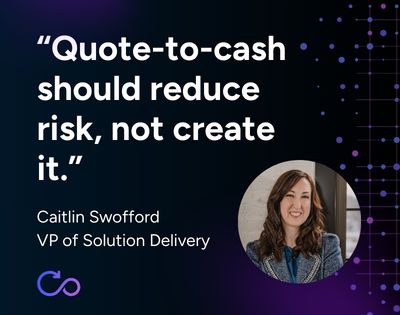
Continuous is scaling its NetSuite presence and strengthening delivery to match. Caitlin Swofford, VP of Solution Delivery at Continuous, brings deep experience spanning NetSuite administration, Salesforce, enterprise applications, consulting, and engineering leadership.
Her focus is simple. Help finance teams make quote-to-cash work as pricing models grow more complex, without adding more systems, risk, or spreadsheet-driven workarounds.
We sat down with Caitlin to talk about what drew her to Continuous, how she approaches delivery as a strategic lever, and what it really takes to make NetSuite work for modern finance teams.
You’ve had a unique path into NetSuite. What led you here?
I didn’t start in finance or ERP. I started in marketing operations and marketing technologies, working with tools like Marketo, Eloqua, and even Siebel CRM early on. My first exposure to NetSuite came in a high-growth environment, and the more I saw it, the more intrigued I became. It was powerful, configurable, and deeply connected to how the business actually runs.
When an opportunity opened up to step into a NetSuite administrator role, I jumped at it. From there, I expanded into owning broader enterprise applications, including NetSuite and Salesforce, with a strong focus on compliance, change management, SDLC, and segregation of duties. Later, I shifted into consulting and services, partnering directly with customers to implement and optimize NetSuite in real-world environments.
That mix of being both a system owner and a services partner really shapes how I think about delivery today.
What made Continuous the right next step?
Two things stood out to me. The people and the product.
Culture matters a lot to me, especially as a remote worker. I want to feel like I’m part of a team moving in the same direction and building something meaningful. Continuous gave me that feeling from day one.
The product mission was equally compelling. I’ve seen how often quote-to-cash becomes a bottleneck as pricing models evolve. What stood out is that Continuous is not about adding another system. It is about improving how the systems finance teams already rely on work together.
How do you explain Continuous Revenue Fabric to finance leaders dealing with complexity across Salesforce and NetSuite?
I think of Revenue Fabric as something that embeds into your existing tools and helps them work together the way they were meant to.
If sales is quoting in Salesforce and finance is managing orders, billing, and revenue in NetSuite, those systems often don’t speak the same language, especially with usage-based or hybrid pricing. Continuous Revenue Fabric enables that flow end to end so sales can stay in Salesforce, finance can stay in NetSuite, and the handoffs actually work without forcing teams into a third standalone system.
Why does embedded revenue infrastructure matter from a delivery perspective?
From a delivery standpoint, the biggest risk I see is introducing more complexity in the name of solving complexity.
Standalone billing platforms often introduce a separate operating layer with their own logic, workflows, and reconciliation processes. Even when data syncs back to Salesforce or NetSuite, teams still end up managing pricing rules, billing behavior, and exceptions outside the systems they rely on day to day. That fragmentation is where delivery risk shows up.
Embedded infrastructure keeps the flow where it belongs, between the systems finance and sales already trust. That leads to cleaner implementations, fewer points of failure, and more confidence in the numbers downstream.
Where do you most often see misalignment between sales and finance?
Sales and finance are working on the same deal, but with very different objectives. Sales needs speed and flexibility to support the customer and close the deal. Finance needs clean, auditable data they can rely on to bill, recognize revenue, and close the books.
Misalignment shows up when processes force extra work. Fields that exist just because, manual handoffs, or one-off steps that don’t reflect how the business actually sells. The fix is treating quote-to-cash as one continuous motion so both teams get what they need without unnecessary workarounds.
As VP of Solution Delivery, what are you focused on building right now?
My focus is on helping customers be successful with Continuous, not just at go-live, but over the long term.
That means partnering closely with customers to understand how they actually use NetSuite and Salesforce, making sure implementations reduce risk instead of adding it, and helping teams build a foundation they can scale as their business evolves. Success looks like trust in the system and confidence in the data.
What excites you most about the opportunity ahead for Continuous?
There are so many companies running on NetSuite and Salesforce that still struggle to make quote-to-cash work smoothly, and that complexity is only increasing.
Continuous has a real opportunity to help finance teams simplify that reality through cleaner handoffs, less manual work, and a more connected view of revenue. Helping customers build that foundation and grow on top of it is what excites me most.
Finally, outside of work, what’s something people would be surprised to learn about you?
I recently became certified as a Maine Master Naturalist, a ten-month program focused on nature education. I volunteer with a wildlife rehabilitation center, and my areas of focus are birds and mammal tracking. It’s what I spend a lot of my nights and weekends doing.
As Continuous continues to grow in the NetSuite ecosystem, Caitlin is helping shape how the company shows up for finance teams that need more than another system. Her focus is clear. Make NetSuite work the way modern finance teams need it to work. Reduce risk in delivery. Simplify quote-to-cash. And build a foundation that supports scale as revenue models evolve.
It’s a delivery-first approach grounded in real-world experience, and one that reflects Continuous’ broader commitment to helping finance teams move from managing complexity to driving confidence and growth.
A Q&A for product, delivery, and operations leaders on how Continuous builds operating discipline, predictable delivery, and scalable execution as the company grows.
TL;DR

- Continuous is deliberately building internal delivery rails that keep product development and customer delivery work moving in sync.
- Strong program management improves visibility, prioritization, and time to production as complexity increases.
- Customers experience this as faster execution, clearer communication, and predictable delivery—even as Continuous scales.
Scaling a company is not just about what you build. It’s about how you build it.
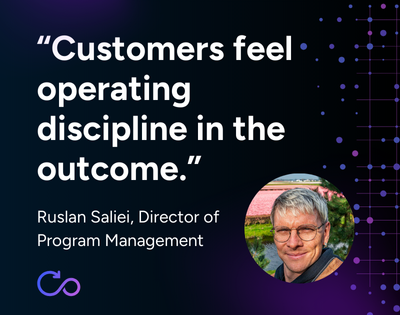
As Continuous grows, building strong operating rhythms behind the scenes becomes just as important as the products delivered to customers. That is where Ruslan Saliei, Continuous’ Director of Program Management, comes in.
Ruslan has built his career at the intersection of technical delivery, program management, and operational leadership. From leading scaled Agile teams in a high-growth e-commerce environment across Southeast Asia to running a revenue-driving delivery practice at a B2B commerce integration firm, he has repeatedly helped teams move faster with more clarity and less chaos.
At Continuous, Ruslan is focused on building the internal operating rails that help product and delivery move in sync, improve visibility and prioritization, and ultimately shorten the path from idea to production.
We sat down with Ruslan to talk about his background, what drew him to Continuous, and how strong program management translates into a better customer experience.
Tell us about your background. How did you build your career across program management, product, and technical delivery?
I’ve worked in IT management since graduating from university. I have a master’s degree in computer science, and early on I thought I would become a software engineer. I quickly realized that while I understand technology, my real strength is working with people and systems — building teams and improving how work gets done.
I started my career in ad agencies in Ukraine, delivering full-cycle work for large brands. That experience gave me a strong foundation in how businesses operate and how cross-functional teams collaborate. From there, I moved to Southeast Asia to join Lazada, part of Alibaba Group, which was building an Amazon-like platform for the region.
At Lazada, I led an engineering and QA organization of more than 100 people responsible for the web experience. Operating at that scale required strong delivery practices and operating models, especially with many dependent teams moving in parallel.
Later, I joined Zaelab, a B2B commerce integration firm, where I progressed from delivery management into portfolio leadership and eventually led the company’s largest revenue-driving practice. That experience reinforced a core belief of mine: high performance and predictable delivery don’t happen by accident — they’re built through intentional operating discipline.
What brought you to Continuous, and why was now the right time?
I’d previously worked with Jon Pora, now Vice President of Professional Services at Continuous, and as the company entered a new phase of growth, it was clear there was an opportunity for my background in scaled delivery and operating cadence to add value.
I was looking for a new challenge. I missed the energy of building in a startup environment, where you are inventing ways of operating, not just following an established playbook. Continuous has that energy. It is a growing company, a new domain for me, and the team quality really stood out.
People are a huge value metric for me. When the company is full of great people aiming for success, I want to be part of that.
What is your role as Director of Program Management, and what will you focus on first?
My main focus is improving time to production and strengthening the internal operational processes that help teams deliver consistently.
Continuous is moving fast, and my job is to make sure our operating cadence keeps pace so teams stay aligned and delivery stays predictable. That means creating clearer operating patterns and reusable flows, so teams have more alignment, less distraction, and clearer execution.
I will be working across product and customer projects, because much of what I do is internal operations, and improvements there benefit both. My role is not primarily client-facing. It is about being the glue internally so teams collaborate more effectively and delivery becomes more consistent.
I will also be working closely with the professional services organization to improve how product and delivery move together as we scale.
How does better program management translate into a better customer experience?
Improving visibility, traceability, and predictability across delivery translates directly into customer value.
When teams have a clearer view of requirements, priorities, and progress, customers experience more reliable timelines, clearer communication, and fewer surprises. Stronger operating rhythms allow us to plan, forecast, and manage change more effectively, which shortens the path from idea to production.
It also reduces the day-to-day burden on delivery teams by removing unnecessary manual work and ambiguity, allowing them to stay focused on execution. The result is a smoother delivery experience.
Where do you see the biggest opportunities to improve how Continuous scales product development and delivery at the same time?
One big opportunity is building clearer criteria and flows for how work created for a customer becomes part of the core product.
As we grow, we need a more transparent and scalable approach so decision-making stays consistent even as the volume of work increases.
Another priority is strengthening how we prioritize work across product investment and customer-driven initiatives so engineering has one clear operating cadence and teams spend less time context switching.
You’re based in Spain. How does that shape the way you support a global team?
Being based in Europe gives me a strong perspective on how global teams collaborate. I naturally sit between regions, which helps with continuity and communication across teams working in different time zones.
More importantly, it reinforces my focus on fundamentals. Regardless of geography, strong operating rhythms, clear processes, and good communication are what allow teams to move quickly and stay aligned.
What are you most excited about in this next chapter at Continuous?
I’m excited about growth and about learning a new domain. I have touched CPQ in previous work, and I see how important flexibility is becoming for companies. I also find modern billing models interesting, because so many companies want to be more flexible in how they package and price what they sell.
Most of all, I’m excited about the people. I’ve met strong individuals and personalities across the company, and that makes me want to commit fully and focus on making the team’s work easier and more effective.
Outside of work, what’s something people would be surprised to learn about you?
I do motorcycle racing on superbikes. I’m also a certified rescue scuba diver. I do photography, play beach volleyball, and I’ve traveled to more than 50 countries. I spent several years living in Southeast Asia, including Thailand and Vietnam, and I still love that part of the world.
As Continuous grows, the difference between moving fast and scaling well is execution. Ruslan’s focus is on strengthening the operating discipline, cadence, and cross-team collaboration that allow product and delivery to keep pace with customer demand.
It’s the kind of intentional rigor that customers feel in the outcomes: faster time to production, clearer communication, and more predictable delivery, all built on a foundation that scales with the business.