Analyst reports from Gartner and Forrester expose a deeper issue in recurring billing. This article is for RevOps, Finance, and IT leaders evaluating billing platforms who want to understand why standalone billing systems create complexity, and what a better model looks like.
TL;DR
- Analyst reports reveal a recurring billing market built around standalone billing systems.
- These platforms attempt to own sales, billing, and finance workflows that already belong in CRM and ERP.
- The result is fragmented data, costly integrations, and rigid architectures that slow change.
- Recurring billing works best when embedded directly into systems like Salesforce and NetSuite.
- Continuous challenges the standalone billing model by extending CRM and ERP instead of replacing them.
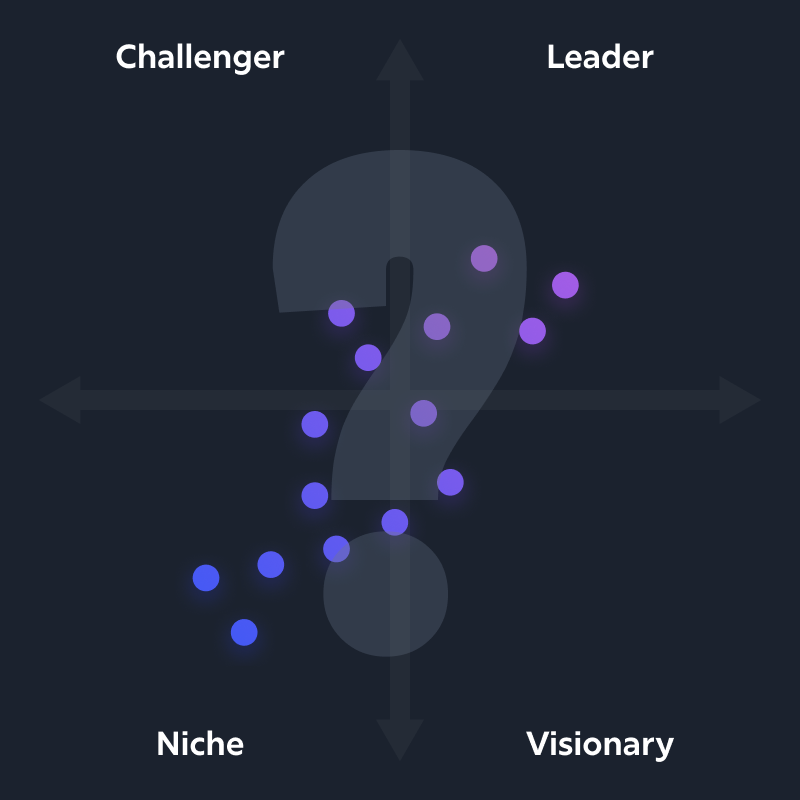
On August 6, 2024, Gartner released their latest “Magic Quadrant for Recurring Billing Applications“ followed by Forrester’s “The Recurring Billing Solutions Landscape, Q3 2024“ on September 3, 2024. These reports assess a competitive landscape that has been evolving for over a decade, evaluating vendors based on their ability to manage the entire sales-to-finance process for recurring billing.
While these reports are valuable, they also reveal a deeper problem in the industry—a problem rooted in how standalone billing systems approach the recurring billing challenge. At Continuous, we believe the way the market has evolved has fundamentally misunderstood the nature of the recurring billing problem, making it difficult for analysts to cover accurately and even more painful for customers to select the right solutions.
Both the Gartner and Forrester reports rank vendors based on their ability to handle the entire recurring billing lifecycle, which includes tasks such as:
Sales Process and Quoting:
Creating flexible pricing models and accurate quotes within the sales cycle, ensuring they align seamlessly with both CRM and billing systems.
Contracting:
Managing the transition from quoting to contracts, including drafting, signing, and handling amendments or renewals, while integrating pricing and terms from the sales process.
Service Provisioning:
Setting up and activating services according to contract terms, tracking usage in real-time to ensure accurate billing.
Usage Data Collection and Rating:
Capturing, mediating, and rating usage data in real-time, applying pricing rules to ensure accurate and scalable billing for consumption-based models.
Billing and Invoice Generation:
Consolidating one time, periodic and usage charges into detailed invoices, ensuring timely delivery to customers via their preferred channels.
Payment Processing:
Facilitating payment collection, managing recurring payments, and ensuring accurate reconciliation with financial systems.
Revenue Recognition and Financial Reporting:
Ensuring compliance with accounting standards by accurately recognizing revenue and providing detailed financial reports that integrate with the ERP system.
These tasks encompass a wide range of functions traditionally handled by CRM (Sales) and ERP (Finance) platforms. However, over the past decade, specialized billing vendors have emerged to address gaps in these systems. Their solution? Introduce a “billing system of record” – a third platform that sits between CRM and ERP to manage these critical processes. This shift has created a new category of software, one that analysts like Gartner, Forrester, IDC, and others are now tasked with evaluating.
The Rise of Standalone Billing Systems: A New Category Emerges
Around 2010, a belief took hold that CRM and ERP vendors couldn’t handle the increasing complexity of billing as companies shifted from traditional perpetual license models to subscription billing models. In response, a range of specialized billing systems began emerging, offering solutions to support this new “Subscription Economy”.
By 2017, this new category of standalone billing systems had matured enough to receive formal analyst coverage, leading to the release of reports like the Gartner Magic Quadrant and Forrester Wave. These vendors promised to simplify recurring billing by offering a third-party solution that could manage the billing lifecycle independently. This trend accelerated as consumption and prepaid credit models gained popularity, leading to the crowded market landscape we see today.
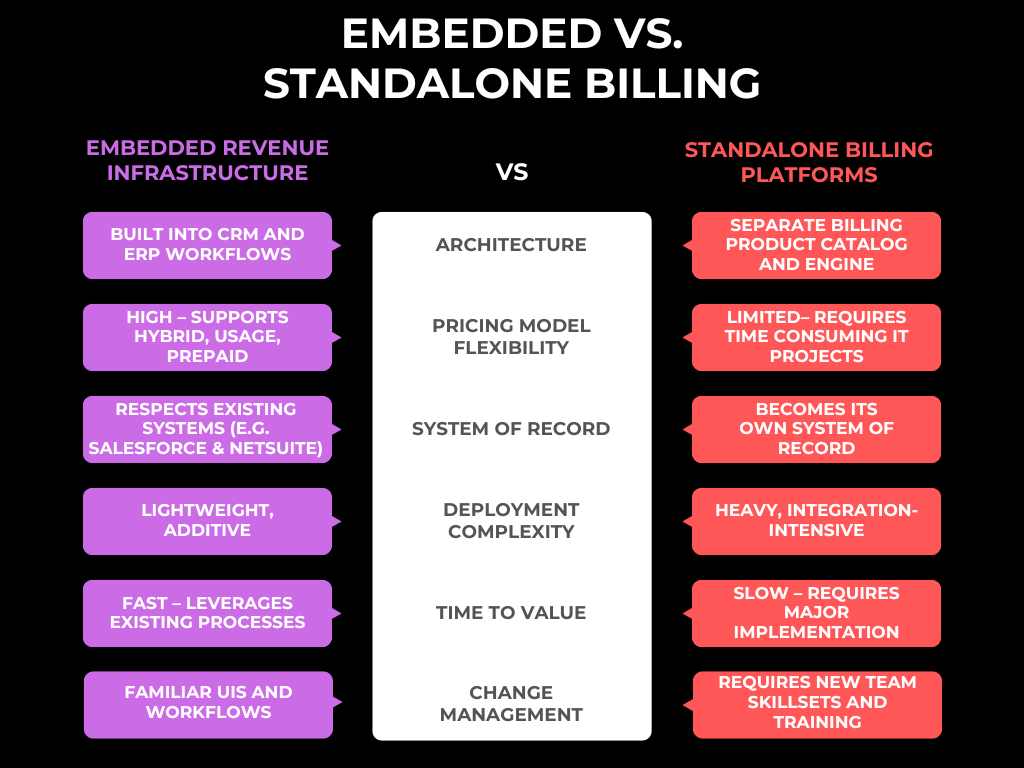
But here’s the issue: billing is not, and never should be, a standalone process. It’s intertwined with sales, finance, and customer management. When billing is siloed into a separate platform, businesses are forced to build complex integrations, juggle multiple systems, and deal with costly maintenance—problems that CRM and ERP systems were originally designed to solve.
What These Reports Reveal: Complexity, Not Simplicity
The criteria used by Gartner and Forrester to evaluate vendors include tasks that traditionally belong within the domains of CRM and ERP systems. However, instead of enhancing these core systems, standalone billing vendors have introduced an unnecessary third layer of complexity.
Consider the following:
- Quote Creation and Negotiation are native functions of CRM systems, where sales teams manage customer interactions and quote data from all channels should be stored.
- Contract Drafting and Management should flow naturally from CRM to ERP, enabling seamless financial reporting.
- Invoice Creation and Payment Processing are core functions of billing that should reside within the ERP or CRM system, where financial and sales data is already managed.
By positioning a third-party billing system as essential, standalone vendors have shifted what should be natural extensions of CRM and ERP into fragmented processes. This fragmentation forces businesses to build complex integrations, making it harder to achieve a seamless sales-to-finance workflow.
The Problem with Standalone Billing Systems
At Continuous, we believe the current approach taken by standalone billing vendors is fundamentally flawed. Instead of simplifying processes, these vendors create friction by placing themselves as overlapping solutions with the CRM and ERP systems they are also dependent on. This introduces costly, cumbersome integrations that are difficult to maintain—particularly as pricing and packaging models evolve.
There’s no inherent reason why traditional sales and financial processes should be managed by a separate system when sales and finance teams have already invested in systems like Salesforce and NetSuite. Standalone billing vendors want businesses to believe they must control these processes, but the reality is that doing so makes their systems “stickier” by requiring complex customizations and significant services investments. The end result for customers of these vendors are deployments that are:
- Expensive to integrate: Building and maintaining integrations between CRM, ERP, and standalone billing systems often requires costly services and custom work.
- Rigid and limiting: Once integrations are built, they become rigid, making it difficult for businesses to adapt to new pricing models or market changes without extensive rework.
- Manual and error-prone: Despite these integrations, many billing processes still require manual intervention, leading to inefficiencies and potential errors in financial reporting and customer invoicing.
This is why the current market is so difficult for analysts to cover: the premise of a standalone billing system is inherently flawed. The criteria that Gartner and Forrester use to evaluate these vendors encompass functions that should naturally belong in core CRM and ERP systems. However, standalone vendors pull these critical processes into a third cloud, which struggles to work effectively alongside CRM or ERP solutions.
The Continuous Approach: Back to Common Sense
At Continuous, we challenge this status quo. We believe that the best way to solve the recurring billing problem is to go back to what was previously common sense: there should not be a third cloud in between CRM and ERP.
Instead, we advocate for enhancing the core applications that B2B companies already rely on—CRM for sales and ERP for finance—and supplementing them with a powerful calculation engine that integrates with customers’ internal platforms. By doing this, we enable a truly unified quote-to-consumption process that is:
- Easier to maintain.
- More flexible as pricing and packaging needs evolve.
- Less expensive to deploy, reducing both software license and integration costs.
Conclusion: Challenging the Status Quo
The release of the Gartner Magic Quadrant and Forrester Wave reports highlights how deeply entrenched the idea of standalone billing systems has become. But as businesses increasingly adopt complex pricing models and usage-based billing, the limitations of these systems become more apparent.
At Continuous, we believe there’s a better way—one that embeds billing awareness directly into the tools businesses use every day, rather than introducing another layer of complexity. By rethinking how billing should work, we can simplify the process for businesses and create a more efficient, flexible future for recurring billing.
Ready to simplify your sales and finance processes?
Stop juggling fragmented systems and costly integrations. At Continuous, we unify your sales and finance workflows by building on the trusted CRM and ERP platforms you already use.
If you’re ready to move beyond the limitations of standalone billing systems, let’s talk. Explore how Continuous can streamline your quote-to-cash process and help your business scale with confidence. Find out more today at: Product | Continuous Technologies.