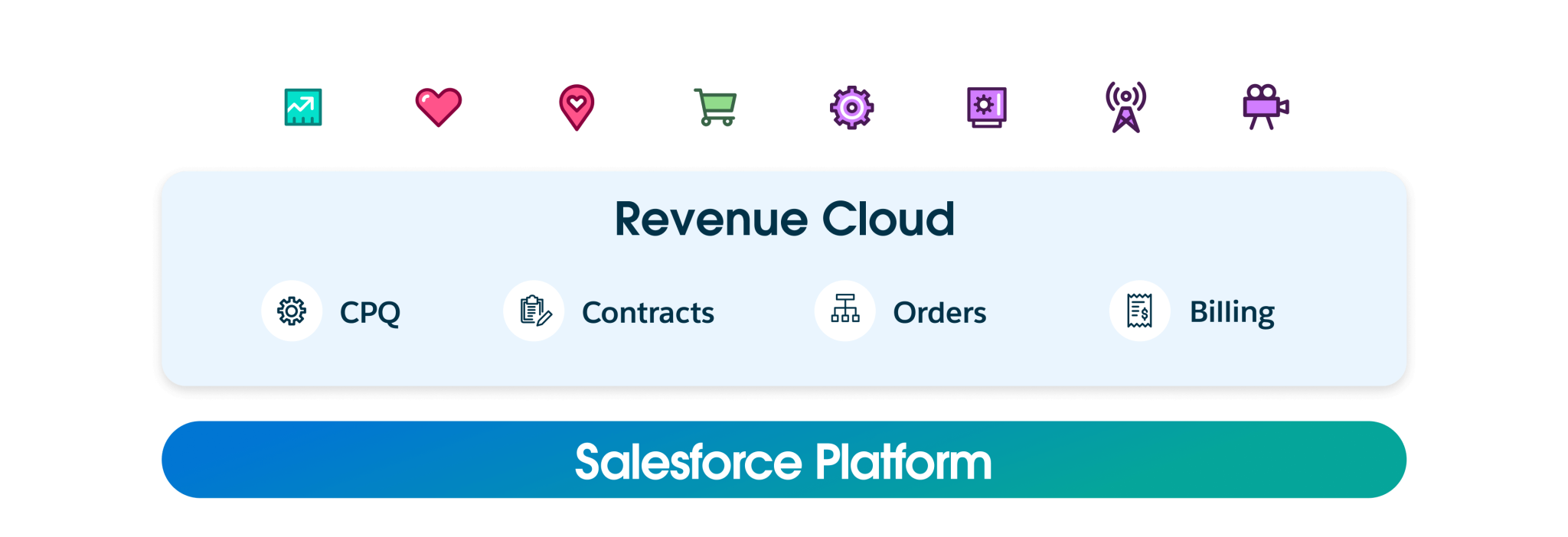

A recap for RevOps, Sales Ops, Finance, and Product leaders on CPQ end of sale, ARM readiness, and how to plan next steps without disrupting revenue.
TL;DR
- Salesforce CPQ end of sale does not require immediate migration, but it does require intentional planning. CPQ remains supported, giving teams a meaningful window to prepare.
- There is no direct upgrade path from CPQ to ARM. Revenue Cloud Advanced is a reimplementation with a different architecture, fewer guardrails, and greater operational responsibility.
- Most organizations succeed by modernizing in phases, extending CPQ where it makes sense while avoiding disruption to quoting, billing, and revenue workflows.
- Fragmenting quote-to-cash systems to “test” usage or consumption pricing often creates long-term reconciliation, reporting, and data integrity issues.
- Teams that plan now gain flexibility later, moving faster and with less risk when change becomes necessary.
In early 2025, Salesforce announced that CPQ would be end-of-sale. The news immediately raised questions across RevOps, Sales, and Product teams about what comes next.
As many companies approach the end of the fiscal year, that question still looms large. Budgets are being set. Roadmaps are being finalized. And for many teams, the refrain remains the same: What now?
To explore what CPQ EOS really means in practice, and how revenue teams should be thinking about next steps, John Banks, CEO and Founder of Continuous, sat down with John Garvens, Salesforce Revenue Cloud expert and Principal Architect at Garvens Consulting, for a live Quote-to-Cash Conversations discussion moderated by Rachel Bruce, VP of Marketing at Continuous.
Rather than fueling alarm, the conversation surfaced a more grounded reality. CPQ end-of-sale is not a cliff. It’s a runway. CPQ is still supported, the lights are not turning off tomorrow, and most teams have more time than they think. What has changed is the urgency to plan with intention.
Modern revenue models are putting new pressure on legacy quote-to-cash architectures. Hybrid pricing, credits, commitments, and usage-based monetization are no longer edge cases. They are rapidly becoming the default. If your business wants to experiment, launch, or scale those models, the real question is not simply what product comes next, but whether your quote-to-cash foundation is ready for where revenue is headed.
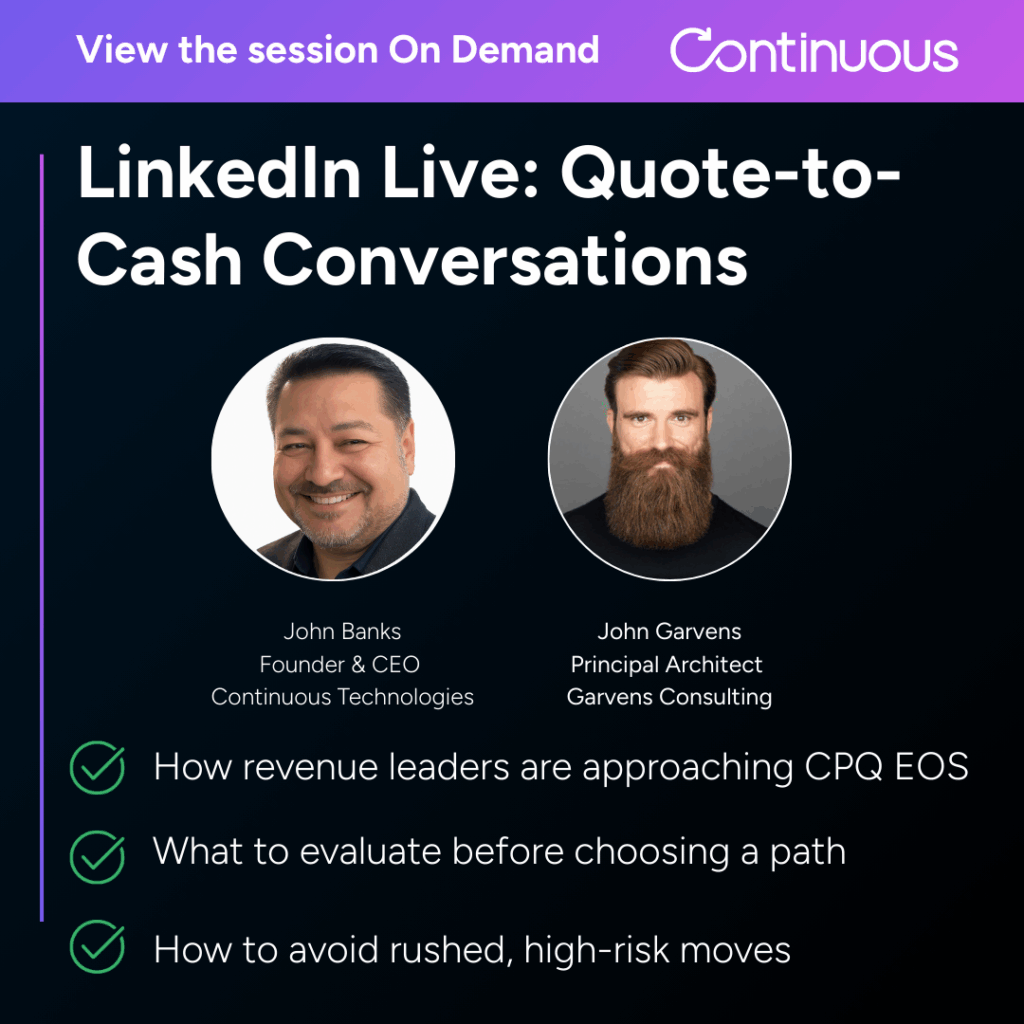
What follows is a curated recap of the most relevant insights from the conversation, focused on the choices revenue teams are weighing and what those choices mean in practice.
CPQ EOS is not a crisis, but it is a forcing function
End-of-sale does not mean end-of-life. CPQ is not disappearing overnight. The real risk is letting uncertainty turn into inertia, then finding yourself forced into a rushed decision later.
This period is best used as a planning window. It’s a chance to understand what actually lives inside your Salesforce org, how much of your revenue process relies on custom workarounds, and where friction has quietly turned into tech debt. Even teams that plan to stay on CPQ for several more years benefit from doing this work now, because preparation creates options.
Most companies are choosing one of three paths
While every environment is different, most teams navigating CPQ EOS tend to fall into one of three scenarios.
1. Stay on CPQ for now.
Some teams will remain on CPQ for a period of time because budget, bandwidth, or organizational readiness make a near-term change unrealistic.
2. Start fresh in a contained scope.
Others will implement newer tooling for a new product line, a new business unit, or a recent acquisition. This allows progress without disrupting the broader organization.
3. Take a phased bridge approach.
Many teams will modernize incrementally, keeping the business running while gradually transitioning their quote-to-cash architecture.
The important distinction is that moving from CPQ to Revenue Cloud Advanced is not an upgrade. It’s a reimplementation with a different operating model, fewer guardrails, and a much higher premium on process clarity and architectural discipline. Treating it like a lift-and-shift is where teams tend to get into trouble.
Fragmentation is the fastest path to future pain
One of the strongest warnings that emerged from the conversation was around fragmentation. When teams try to test consumption or usage-based pricing by bolting on a separate billing system “just for a pilot,” the complexity rarely stays contained.
Over time, those experiments often create a second customer record, a second product catalog, and a second transaction engine. Reconciliation becomes manual. Reporting becomes unreliable. The quote-to-cash model slowly loses coherence.
If the goal is to introduce credits, commitments, usage, or hybrid pricing, the safer long-term approach is to extend what you already have without breaking the integrity of your architecture. That means protecting a single customer view, a single source of product truth, and clean lifecycle management even as monetization evolves.
The bridge matters because revenue cannot stop
A useful analogy surfaced during the discussion. Moving from CPQ to ARM requires a merge lane. Most companies cannot pause quoting, selling, amending, and invoicing while they rebuild their revenue stack. Continuity is not optional.
A phased transition allows teams to modernize transactionally, reduce risk, and avoid a single high-stakes cutover. When done well, migration becomes a controlled progression rather than a disruptive reset.
ARM success depends on people as much as product
While there is real excitement around ARM, the conversation was candid about where implementations can stall. The platform is evolving quickly, which creates opportunity but also risk for enterprise teams that need stability and governance.
Projects tend to struggle when teams build against the product’s intent, compensating with custom workarounds that become permanent. Over time, those decisions compound complexity instead of reducing it.
The implication for RevOps and Product leaders is clear. Domain expertise matters. Successful teams have experienced quote-to-cash practitioners in the room who understand not just what is possible, but what should be avoided. Being able to push back on requirements is often as important as delivering them.
A realistic planning window for CPQ EOS transitions
For many organizations, a six- to twelve-month preparation window is realistic, especially once remediation, catalog cleanup, process clarity, and cross-functional alignment are factored in. That time is not about delay. It’s about laying the groundwork that prevents expensive mistakes later.
Measured planning now leads to faster, more predictable outcomes when change does happen.
Final Thought
CPQ EOS does not demand immediate action, but it does reward intentional planning. Teams that use this period to clarify their processes, clean up their architecture, and modernize thoughtfully will have far more flexibility when the next decision arrives.
Want to go deeper?
- Watch the full Quote-to-Cash Conversations recording to hear the complete discussion on CPQ EOS, ARM readiness, and modern revenue models, including real-world examples and audience Q&A.
- Not sure what CPQ EOS means for your quote-to-cash architecture?
Take the Salesforce CPQ EOS Assessment to understand your current state, evaluate your options, and identify the safest next steps based on your revenue model, quote-to-cash architecture, and timeline.
Whether you’re planning to extend CPQ, phase into Revenue Cloud Advanced, or explore alternatives, the right path starts with clarity.
▶ Watch the full recording
🧭 Take the CPQ EOS Assessment
CPQ EOS: Common Questions Revenue Leaders Are Asking
Do we need to replace Salesforce CPQ now that it’s end-of-sale?
No. End-of-sale means CPQ is no longer sold to new customers—not that it stops working. Existing customers will continue to receive support, giving teams time to plan instead of reacting under pressure.
Is moving from CPQ to ARM an upgrade?
No. ARM introduces a different operating model with fewer guardrails and greater architectural responsibility. Treating it as a lift-and-shift often leads to delays, rework, and avoidable complexity.
What happens if we wait too long to plan for CPQ EOS?
Teams that delay planning often face rushed decisions, fragmented architectures, and higher implementation risk once timelines compress. Early planning creates options—even if the decision is to stay on CPQ longer.
Can we experiment with usage or consumption pricing without breaking our architecture?
Yes—but only if experimentation happens within a unified quote-to-cash model. Adding separate billing or usage tools for pilots frequently leads to duplicate data, manual reconciliation, and reporting gaps.
How long should teams plan for a CPQ EOS transition?
For most organizations, six to twelve months of preparation is realistic. That time includes catalog cleanup, process alignment, cross-functional readiness, and architectural planning—not just implementation.
About Continuous
Continuous helps companies modernize and future-proof their quote-to-cash process directly inside Salesforce and NetSuite. By embedding pricing, usage, and credit models into the platforms teams already use, Continuous eliminates the need for another system, portal, or integration layer.
With Continuous, Sales can quote and close faster, Finance gains confidence in forecasts and compliance, and Product can launch new pricing and packaging strategies without bottlenecks.