Author: Owen Karlsson

Sales Leads With Imagination. Finance Has To Follow GAAP

Sales Leads With Imagination. Finance Has To Follow GAAP

For CFOs, RevOps leads, and anyone who has watched Finance absorb the consequences of commercial decisions made without them: Sales leads with imagination. Finance follows GAAP. And somewhere between those two realities, most SaaS companies are losing time, money, and confidence in their numbers. Here’s why — and what to do about it

TL;DR
  • Sales and Finance aren’t misaligned because of poor communication. They’re optimizing for fundamentally different things, and nobody built a system that could serve both at the same time
  • Sales has no ceiling on how it structures a deal. Finance operates under GAAP, IFRS, and ASC 606. Those rules don’t bend for new monetization models
  • Every new pricing model, ramp, swap, or usage component lands on Finance’s desk as a new problem to solve, often with manual processes that accumulate over time
  • The gap isn’t a communication problem. It’s an architecture problem. Sales and Finance are measured on different numbers, own different systems, and have different definitions of done
  • The companies that handle this well involve Finance early, build for alignment not just integration, and invest in infrastructure purpose-built for the boundary between CRM and ERP

Sales exists to close deals. Finance exists to report them accurately. Those sound compatible, and in simple businesses, they are. But in a modern SaaS company, where pricing models are multiplying, contracts change mid-cycle and usage gets layered on top of subscriptions, the two functions are optimizing for fundamentally different things. Sales operates in a place of constant iteration and innovation, there’s no ceiling on how it structures a deal. Finance operates under a strict set of rules.

GAAP. IFRS. ASC 606. They don’t bend to accommodate new monetization models. And nobody ever built a system that could serve both of them at the same time.

The Models Are Multiplying. The Rules Aren’t.

This dynamic has always existed to some degree. Finance has always had to keep up with commercial decisions made without their input. But for most of SaaS history, the monetization models were relatively stable. You sold a subscription. You recognized revenue ratably over the term. The rules were complex but at least they weren’t changing every quarter.  That’s no longer true.

Usage-based pricing has gone from a niche model to a mainstream expectation. AI-driven products are introducing consumption patterns that don’t map cleanly to anything finance has handled before. Companies that started on pure subscription are layering on usage components mid-cycle. Customers want flexibility, credits, prepaid wallets, co-term options, and sales is happy to offer it.

Every one of those models lands on finance’s desk as a new problem to solve. Not just a new revenue recognition question, but a new billing structure, a new reconciliation workflow, a new set of edge cases that the existing systems weren’t built to handle.

And the systems matter here. Because it’s not just finance’s brain that has to adapt, it’s the infrastructure. Salesforce. NetSuite. The integration between them. The logic that governs how a closed deal becomes a correctly structured sales order, how a mid-contract change flows through billing and revenue, how a ramp deal recognizes evenly over three years under ASC 606. Every time sales adds a new model, that infrastructure has to catch up


It usually doesn’t. Not fast enough anyway


Who Pays When the Models Change

I’ve seen this play out the same way at company after company. Sales get excited about a new model. Leadership approves it. The first deal closes. And then finance spends the next two weeks figuring out how to book it.

That’s not an exaggeration. I’ve watched revenue accountants build manual Excel processes to handle deal structures that the systems couldn’t support. I’ve seen companies carry those manual processes for months, sometimes years, because nobody had the bandwidth to build something better. And every month those manual processes run, the reconciliation work piles up, the close cycle stretches, and the risk of getting the revenue number wrong grows a little larger.

The finance team working 60-hour weeks during close isn’t doing it because they’re inefficient. They’re doing it because they’re absorbing the operational consequences of commercial decisions made without their input. Every new pricing model is another manual process. Every mid-contract change is another reconciliation item. Every creative deal structure is another conversation that starts with someone in finance saying: we need to figure out how to book this.

This Isn’t a Communication Problem

Here’s what I think gets missed in most conversations about this: it’s not a communication problem. It’s not that sales and finance need to talk more. They do talk. The problem is structural.

Sales is focused on bookings and quota retirement. Finance is measured on the accuracy of revenue. Those are different numbers from the same deal, and they’re owned by different teams with different incentives, different systems, and different definitions of what done looks like.

Sales closes a deal and moves on. Finance inherits it. And everything that happens to that deal between close and the recognition of revenue, amendments, credits, upgrades, cancellations, usage true-ups, lands on finance to execute, reconcile, and report correctly. Without necessarily having been part of the conversation when the deal was structured.


That’s not a gap in communication. It’s a gap in architecture


What the Companies That Handle This Well Do Differently

I want to be careful here because there’s no single answer and anyone who tells you otherwise is selling something.

But I do think there are a few things that separate the companies that manage this well from the ones that don’t.

The first is buying decisions. The companies that handle this well involve finance when they’re evaluating commercial systems, not after the fact. Not to rubber-stamp a decision that’s already been made, but early enough to ask the right questions about what the downstream execution is going to look like.

The second is architecture. There’s a meaningful difference between having Salesforce and NetSuite connected and having them aligned. Connected means data moves. Aligned means what Sales closes in Salesforce executes correctly in NetSuite, as the right sales order, with the right revenue recognition, with full traceability from booking to billing to recognized revenue. Most companies have the former. Far fewer have the latter.

The third, and this is the one that matters most as monetization models get more complex, is having infrastructure at the boundary between CRM and ERP that was purpose-built to handle the translation. Not middleware that moves data. Not manual processes that compensate for the gap. Something that understands the financial relationships between records and governs what happens after a deal closes.  Especially as large volumes of consumption start driving billing, data storage and processing further complicating the “messy middle”. 

Sales isn’t going to slow down. The models are going to keep getting more complex. The gap between what sales can sell and what finance can cleanly execute is going to widen unless the architecture between those two functions is built to handle it.


Finance has GAAP. The least we can do is give them infrastructure that keeps up


Frequently Asked Questions

Because they’re optimizing for fundamentally different things. Sales is measured on bookings and has unlimited flexibility to structure deals. Finance is measured on revenue accuracy and operates under GAAP, IFRS, and ASC 606. Those rules don’t bend for new monetization models. The misalignment isn’t a people problem or a communication problem. It’s structural

Because Sales has no ceiling on how it structures a deal, but Finance operates under a strict set of accounting standards. Every new pricing model, ramp structure, or usage component has to be mapped to GAAP correctly before Finance can recognize it. Sales can launch a new model in a quarter. Finance often spends months building the manual processes to support it

The obvious cost is time, revenue accountants building manual Excel processes, reconciliation work piling up, close cycles stretching. The less obvious cost is risk. Every manual process is a potential source of error. Every month the close runs long is another month the business is making decisions on stale numbers. And a revenue restatement, even in the company’s favor, signals to investors that Finance doesn’t have control of the number that matters most

Connected means data moves between the two systems. Aligned means what Sales closes in Salesforce executes correctly in NetSuite, as the right sales order, with the right revenue recognition, with full traceability from booking to billing to recognized revenue. Most companies have the former. The latter requires infrastructure purpose-built for the boundary between CRM and ERP, not middleware that moves data.

Continuous sits at the boundary between Salesforce and NetSuite as a purpose-built execution layer. It ensures every deal that closes in Salesforce, including ramps, swaps, amendments, and usage-based structures, executes correctly in NetSuite without manual intervention. Finance gets full traceability from booking to billing to recognized revenue, and the infrastructure keeps up as monetization models evolve.
Ramps and Swaps 101: Easy Math, Hard Execution, Real Cost

Continuous Insights_Ramps & Swaps 101

Why the Math Is Easy, the Execution Isn’t, and Both Are Costing SaaS Companies More Than They Realize

For CFOs, CROs, and RevOps leaders at mid-market SaaS companies: learn why ramps and swaps cause bookings, billings, and revenue to diverge in Salesforce and NetSuite — creating margin leakage, RPO reporting gaps, and a finance team reconciling numbers that should never have drifted.


Ramps and swaps are two of the most common contract structures in B2B SaaS — but two of the most reliably painful to execute. A ramp is a multi-year deal where the price increases each year: for example, a customer commits to $20,000 in year one, $25,000 in year two, $30,000 in year three. A swap is a mid-contract product exchange: a customer returns the unused portion of what they bought and applies the credit toward something different. Both are standard. Both are expected. And both have a way of breaking things that shouldn’t break.

Consider this scenario. A customer calls their account manager. They’ve been on Product A for six months and want to upgrade to Product B. They expect a credit for what’s left on their current contract. It seems straightforward. The account manager agrees. They go to build the quote.

However, in most mid-market SaaS companies, what actually happens is more complicated than a three-day delay. The account manager calls finance, who is buried in month-end close. But even when the number comes back, it may not be what anyone expected. The implementation, training, or support services bundled into the original deal — discounted or included at no cost — were still allocated a portion of the contract revenue at the time of booking. The account manager never knew. They see what the customer paid, estimate the remaining value, and build the quote on a number that was never accurate to begin with. Add in the days that have elapsed since the swap request came in, and the proration has shifted too. The number is wrong twice over. The customer is frustrated. The deal is delayed. And everyone involved is doing work that, in a properly architected system, no human should have to do at all.

This is the ramps and swaps problem. Not a math problem. Not a people problem. A systems problem — one that most companies quietly absorb by building a RevOps team whose real job, underneath the title, is cleaning up the accounting side effects of deals the systems were never designed to handle.  What sales sees on an opportunity and what finance is actually recognizing in NetSuite are separated by seven records. That’s not a gap. That’s where margin goes to die.

Why Do Ramps and Swaps Leave Sales Flying Blind and Finance Cleaning Up the Mess?

To understand why this breaks, you have to understand what happens to a deal after it closes.

When an opportunity closes in Salesforce, the booking reflects what was sold: the price on the quote, the products on the order. That’s the number sales owns. It’s clean, it’s simple, and it’s already out of date by the time the deal reaches NetSuite.

In NetSuite, two things happen that Salesforce will never see. The first is allocation. When a deal includes a software license and a professional services engagement — even if the implementation was “free” — the revenue has to be distributed across both components based on their standalone value, not what the invoice says. A deal booked as $50,000 for software and zero for services might become $30,000 for software and $20,000 for services once NetSuite applies allocation. The invoice wasn’t wrong. The revenue treatment just reflects the economic reality of what was delivered.

The second is recognition timing. A ramp deal — $20,000 in year one, $25,000 in year two, $30,000 in year three for the same product — can’t be recognized as billed. The total contract value has to be spread evenly, because you’re delivering the same thing each year. So you recognize $25,000 annually regardless of what the invoice says. Year one generates an unbilled receivable. Year three generates deferred revenue. None of this is visible in Salesforce.

The portion of that total contract value not yet recognized is what’s known as Remaining Performance Obligation, or RPO. For a three-year ramp deal, RPO represents the revenue the business is committed to deliver but hasn’t yet earned. It’s a number that matters enormously to investors and auditors, and one that’s almost impossible to report accurately when ramp deals aren’t configured correctly in NetSuite from the start.

“The post-allocation financial picture that lives in NetSuite never makes its way back to Salesforce. In 99% of cases, only the most sophisticated organizations manage to close that gap — and they’ve had to build it themselves.”

So when the account manager goes to quote a swap, they’re working from the Salesforce number — what was originally booked. The actual remaining recognized value is a different number, sitting in NetSuite, accessible only to someone who knows where to look and has time to pull it. The gap between those two numbers is where margin goes to disappear. Sales closes the deal with the wrong credit. Finance inherits the mess: reconciling recognition patterns the sales rep never knew existed, after a deal that can no longer be unwound.

What Does It Really Cost When Ramps and Swaps Go Wrong?

The most immediate cost is margin leakage — and it’s more common than most finance teams realize. When a customer wants to swap products and the account manager calculates their credit as $25,000 because that’s what six months of a $50,000 contract looks like on paper, but the actual remaining recognized value is $15,000 because of how allocation was applied, the business has two choices. Get finance involved, slow the deal down, and try to explain to the customer why they’re getting less credit than expected. Or just give them the $25,000, close the deal, and eat the $10,000 difference. And it’s worth being clear about what’s actually happening here. The rep isn’t cutting corners — they’re working with the only number available to them. When systems aren’t architected to surface the real revenue position, over-crediting isn’t a training problem or a process failure. It’s the predictable outcome of asking people to make financial decisions without financial data. The rep trades margin for a fast quote. The customer gets their answer. The business absorbs a loss it didn’t know it was taking.

Most companies, most of the time, take the path of least resistance. They don’t have a process that makes the right answer easily available, so they default to the wrong one. Across PE-backed SaaS companies, it’s common to see 1 to 3 percent of ARR effectively donated this way each year — purely because swap credits are based on invoice math instead of recognized revenue. That’s not a rounding error.

“When a swap credit should be $15,000 but the sales rep can only see the invoiced number, companies are often cornered into issuing $25,000 and eating the $10,000 difference. It happens constantly. It’s not an edge case. It’s the hidden cost of two systems that don’t talk to each other.”

Beyond the immediate margin hit, the reporting consequences compound over time. When a customer’s recognized revenue drops mid-contract because a swap was executed at the wrong value, it shows up in the CFO’s monthly report as an unexplained ARR decrease. Weeks after the fact. Long after anyone could have done anything about it. Revenue forecasts drift. ARR reporting reflects bookings rather than recognized revenue. The gap between what the CRO thinks the business is doing and what the CFO knows it’s doing widens with every quarter.

For PE-backed companies, the stakes are higher still. Covenant compliance, investor reporting, and the credibility of the management team all depend on financial numbers that reconcile, including RPO, which investors increasingly scrutinize as a forward indicator of revenue health. When they don’t, the conversation shifts long before the board asks a question. Executives are defending numbers instead of discussing growth. The CRO and CFO are reconciling versions of reality instead of aligning on what’s next. By the time someone asks why bookings, billings, and revenue don’t line up, the credibility cost has already been paid.

Why Can’t Your Systems Handle Ramps and Swaps Automatically?

Because the revenue position that matters sits seven records deep in a system the sales team never touches. A deal moves through a chain: opportunity in Salesforce, order line in Salesforce, sales order in NetSuite, sales order line in NetSuite, revenue element, recognition plan, journal entries over time. By the time allocation has been applied and recognition has begun, the number that’s relevant for a swap or a ramp reconciliation is buried at the end of that chain. No existing tool has been built to traverse it automatically and send the answer back.

To get that number back to the person quoting the deal, someone has to manually bridge the gap. Call finance. Run a report. Export a spreadsheet. In organizations that have tried to build this themselves, it typically means a sales ops person who has a standing relationship with someone on the revenue team and knows to call before month-end when the queue is manageable. That’s not a process. That’s a workaround with a name badge.

The reason no one has solved this systematically is that it requires being native to both systems simultaneously — not integrated with them or synced to them on a schedule, but genuinely embedded in the data layer of both Salesforce and NetSuite. Most tools live on one side of that boundary. The revenue data lives on the other.

“Most quote-to-cash stacks stop caring about revenue the moment the invoice goes out. Everything after that gets handed to finance and forgotten. To take the final answer on that revenue element and tie it seven records back to the opportunity in Salesforce — and have a system send that answer back automatically — No one had built that yet. Until now. That’s what Continuous solved.”

How Does Continuous Solve the Ramps and Swaps Problem?

Continuous operates at the architectural boundary between Salesforce and NetSuite, embedded in both systems’ transaction and revenue layers, not bolted on through middleware or nightly syncs. It tracks the full lifecycle of a deal from opportunity through allocation, recognition, and journal entry, keeping the revenue position accurate in real time across both systems.

For swaps, that means the account manager sees the actual remaining recognized value before they build the quote. Not invoice math. Not a CPQ estimate. The number pulled directly from post-allocation accounting. Credits reflect financial reality, finance doesn’t get a phone call, and margin doesn’t quietly erode.

More importantly, the system enforces alignment. Revenue logic is embedded directly in the quoting flow, so sales cannot issue credits that exceed what has actually been earned. The gap between bookings and recognized value closes before it ever becomes a reporting problem.

For ramps, Continuous structures recognition correctly from the start and recalculates automatically when a contract changes. Allocation, deferred revenue, and billing schedules stay aligned without manual intervention. No surprises when a ramp year turns over, no reconciliation required when a customer modifies mid-term.

The same infrastructure governs amendments, credits, true-ups, and hybrid pricing models, absorbing commercial flexibility into system design rather than leaving finance to reconcile it after the fact.

On the reporting side, bookings, billings, and revenue reconcile structurally. The CRO and CFO operate from the same source of truth. ARR reflects recognized reality. Mid-contract changes surface in forecasts immediately, not six weeks later.

Continuous isn’t another billing tool. It’s embedded revenue infrastructure built to close the seven-record gap automatically — so ramps and swaps execute cleanly, accurately, and without hidden margin loss

Ready to learn more? See how Continuous ensures your revenue position is always accurate, in both systems, in real time.

Frequently Asked Questions (for FAQ section)

What are ramps and swaps in SaaS contracts?

A ramp is a multi-year contract structure where the price increases by a pre-negotiated amount each year. For example, a customer might pay $20,000 in year one, $25,000 in year two, and $30,000 in year three for the same product. A swap is a mid-contract product exchange where a customer returns the unused portion of an existing product and applies the remaining credit toward a different one. Both are common in B2B SaaS and both create significant complexity when it comes to revenue recognition and billing.

Why do ramps and swaps cause problems in NetSuite?

NetSuite applies revenue allocation and recognition rules that change the financial value of a product after a deal closes. A ramp deal that bills at different amounts each year must be recognized evenly across the contract term under ASC 606. A bundled deal with a free implementation must allocate value across each component based on standalone selling price. These adjustments happen entirely in NetSuite and are never reflected back in Salesforce, creating a disconnect between what sales knows and what finance knows.

What is the difference between bookings, billings, and revenue recognition?

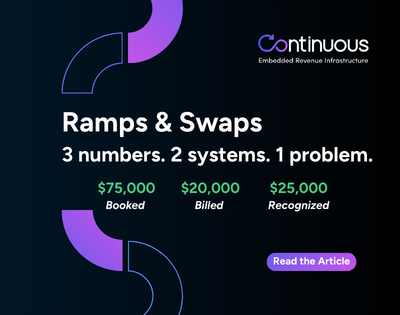
Bookings are the total value of deals closed, typically recorded in your CRM on the day the contract is signed. Billings are the amounts actually invoiced to customers, which may follow a different schedule. Revenue recognition is the amount recorded as earned revenue under ASC 606, which depends on when and how value is delivered. For a ramp deal, all three numbers can be different in the same year: you might book $75,000, bill $20,000, and recognize $25,000. Understanding the difference is critical for accurate ARR reporting and financial forecasting.

How does revenue allocation affect swap credits?

When a deal includes multiple products or services, NetSuite allocates revenue across each component based on standalone selling price, regardless of how the invoice was structured. This means the recognized value of a product can be materially different from what appears on the quote. When a customer goes to swap that product, the credit they are owed should be based on the remaining recognized value, not the invoiced amount. If sales quotes the swap using the invoiced figure, the company may issue a larger credit than it has actually earned, resulting in direct margin leakage.

Why does ARR drop when a customer swaps products?

ARR can drop after a swap when the new ARR secured in the replacement product is less than the recognized ARR being retired from the original product. This often happens because the account manager is quoting based on the Salesforce booking value rather than the actual remaining recognized revenue position in NetSuite. The difference between those two numbers can be significant, and without visibility into the real revenue position, sales teams routinely offer more credit than the business has earned.

How can software companies automate ramps and swaps?

Automating ramps and swaps requires closing the data loop between your CRM and your ERP. The recognized revenue position for each product needs to flow back into Salesforce automatically so account managers have the right number before they quote. This means being native to both systems, tracking the full chain from opportunity through revenue element and recognition plan, and updating the revenue position in Salesforce as it changes over time. Continuous is built to do exactly this, eliminating the manual handoffs between sales and finance that slow deals down and introduce errors.

What is Remaining Performance Obligation and how do ramps affect it?

Remaining Performance Obligation, or RPO, is the total contract revenue a company is obligated to recognize in the future but has not yet earned. Under ASC 606, it represents the value of work still to be delivered on existing contracts. For ramp deals, RPO can be significant: a three-year ramp with $75,000 in total contract value has $50,000 in RPO at the end of year one. If ramp deals aren’t configured correctly in NetSuite — with even recognition across the full contract term — RPO will be understated, misrepresenting the company’s forward revenue position to investors, auditors, and the board.